

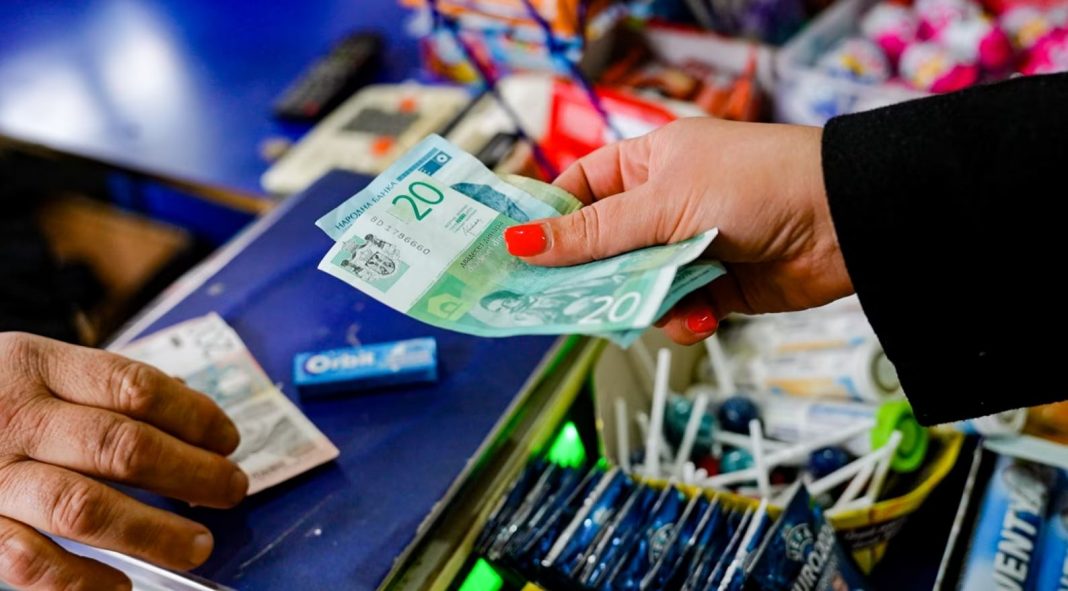
The European Union has reiterated its desire to help Kosovo and Serbia find a solution to the issue of the use of the Serbian dinar in Kosovo, following the entry into force of the regulation of the Central Bank of Kosovo (CBK), which stipulates the euro as the sole currency for cash payments in the country.
However, the EU spokesperson for Foreign Affairs and Security, Peter Stano, during a press conference on February 23, did not want to provide details about a meeting called for the next week in Brussels on this issue.
“We need to return to the current practice of not speaking publicly and holding press conferences for the logistics of preparing meetings at the level of working groups,” Stano said.
Kosovo’s President Vjosa Osmani stated on Friday that the dinar issue “can be resolved here in Kosovo”, adding that this topic should not have caused “clashes with allies”.
Meanwhile, Kosovo’s chief negotiator Besnik Bislimi, earlier in the week confirmed that his office had received an invitation from the EU for a meeting on the dinar issue. He said he would not attend the meeting, emphasizing that he does not know who from Kosovo might participate.
“We sent the letter to the parties and explained in detail how we expect certain issues to be dealt with. We hope that both parties will find a solution to an issue that was created with a decision without a deadline and without consultations with the other party, which had an impact on the other party,” Stano said.
“We are not commentators, but facilitators, and we make efforts to help the parties find a solution,” he added.
Responding to the question of what consequences Kosovo might face if it does not participate in the meeting in Brussels, called by the EU’s Special Envoy for the Kosovo-Serbia Dialogue, Miroslav Lajčák, Stano said, “we cannot speculate on what will happen, if it happens”, adding that invitations to the parties have been sent, and the EU is only trying to find a solution.
It was earlier confirmed that Lajčák had sent an invitation to Kosovo and Serbia to participate in a meeting in Brussels on February 27 to discuss the dinar issue.
Bislimi, in a media statement, had said that Lajčák’s invitation constituted a violation of his principles because, according to past practices, no issue can be put on the agenda of a meeting without the prior agreement of both parties.
Kosovo believes that the dinar issue is not a topic that should be discussed in the dialogue, but banking authorities in Serbia have requested that a solution to this issue be found within the framework of the Brussels dialogue.
On February 1, Kosovo began implementing the CBK regulation for cash operations.
The CBK regulation has also been criticized by the international community, which has said that the decision was made without prior consultations and without considering the impact on the Serbian community.
The United States has requested that Kosovo postpone the implementation of the decision, arguing that failure to comply with this request has only affected the quality of relations between Washington and Pristina.
The CBK has stated that the decision will be implemented through a transitional phase lasting no more than three months.




