

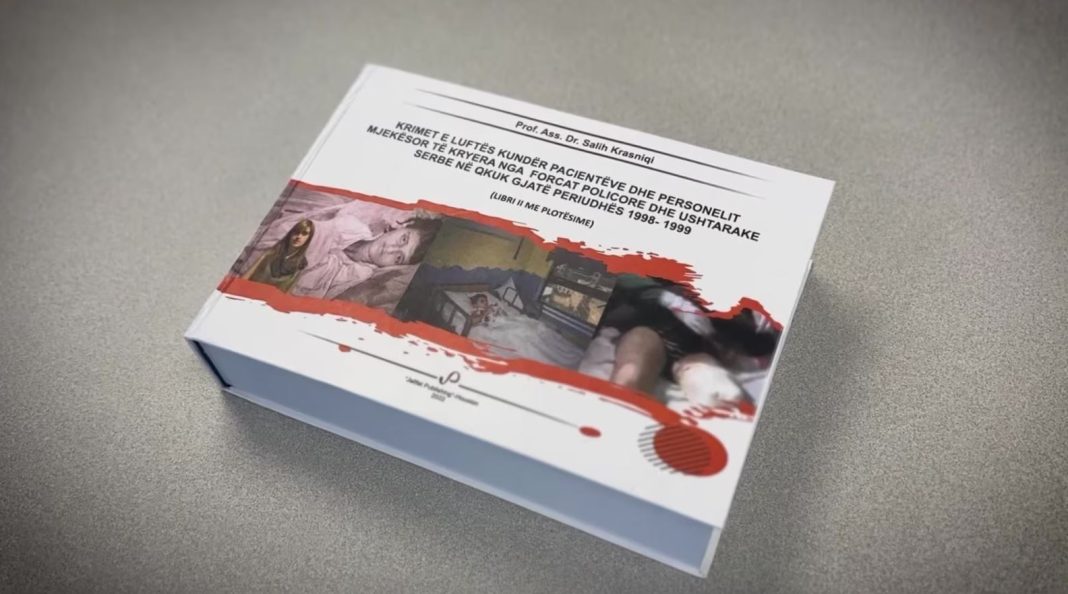
The war surgeon, as Dr. Salih Krasniqi known in Kosovo, says he has gathered evidence for over 1,200 Albanian patients at the University Clinical Center of Pristina who, according to him, have been subjected to crimes and torture by Serbian forces.
He has published all the evidence, from May 1998 to June 1999, in the two-volume book he claims to have worked on for over 20 years. In over 1,000 pages, he provides the files secured at the University Clinical Center of Pristina as evidence for the claims he makes.
“There were also 45 healthcare workers killed throughout Kosovo. The book includes children and adults. From children, there are cases of 402 children and 741 adults in the book,” Dr. Krasniqi states.
He says he did not gather evidence solely based on the documentation found after the war in the University Clinical Center of Pristina, but in many cases, he was also a witness to what he describes as crimes and torture committed against Albanians while they were patients.
“During their treatment, they were tied to radiators, or behind the beds, or their wounds were opened with guns after they were operated, so their wounds were opened with automatic weapons. We were a small number until March 18, 1999, at work. When we went for rounds, patients would tell us, ‘Please don’t help us, or don’t bring us more food or supplies, because then they beat us worse than when you don’t help us at all’,” Krasniqi says.
Voice of America: After you left?
Dr. Salih Krasniqi: Yes, because in the afternoon, we were not there, and they (Serbs) did whatever they wanted with them.
During the Kosovo war, those few international media outlets that were still allowed to operate under the strict conditions of Slobodan Milošević’s regime were occasionally invited by the Serbian hospital authorities in Pristina to film Albanian and Serbian civilian victims being treated at the University Clinical Center of Pristina. The aim was to show how civilians were victimized by NATO airstrikes.
One of these cases was on April 2, 1999.
“Since the NATO aggression began, we have received many wounded civilians every day. I would like to ask NATO, do they know who they are hurting with the bombs?” said the director of the Surgical Clinic, Rade Grbić, on April 2, 1999.
Dr. Salih Krasniqi says a former Serbian colleague from the time of the war falsely presented Albanian patients as victims of NATO, and he adds that he found evidence for this.
“I found data that there were 420 patients, and he (Grbić) says they were 60%, which means 252 patients were operated on at University Clinical Center of Pristina supposedly due to injuries caused by NATO. But when I examined the data on what diagnoses or surgeries were performed, their number is very small. Based on the data, out of these 252 patients, about 111 patients are missing, who are not registered at all. The question arises, where did these patients go if they were admitted but not registered,” explains Dr. Krasniqi.
According to him, a good example to explain how victims of attacks by Serbian forces were presented as victims of NATO bombings is the case of Dubrava prison, near Istog.
On May 19 and 21, 1999, NATO conducted airstrikes on this prison, saying it was in response to Yugoslav military activities near the prison area. From these attacks, 19 officially known to be dead, mainly Albanians, who were held prisoners there, and hundreds wounded.
“In this place, the most terrible loss of prisoners has been recorded. There have been a large number of victims who were transferred to the nearest hospital, and investigations are ongoing,” said the investigating judge, Vladan Vojić from Peja, on May 21, 1999.
However, Dr. Salih Krasniqi says the diagnoses of patients he found at University Clinical Center of Pristina tell a different story.
“The massacre there was carried out by Serbian institutions and not by NATO, as they have also written in the stories of the patients I have encountered, which state that they were injured by NATO. However, the diagnoses I found state that they were injured by firearms, small arms, not by airstrikes. They were taken to the sports field in Dubrava Prison and started shooting at them. Some managed to escape. They were wounded while hiding in bushes or other places,” Dr. Krasniqi states.
He says another crime committed against Albanians in Dubrava is that most of them, despite being injured, were never sent to the hospital for treatment. Dr. Krasniqi says out of about 300 injured, only 31 former prisoners were registered as patients at the hospital.
“They were all kept in prison for 4 to 20 days at first, and then 31 of them were brought to the hospital. The others were sent to other prisons. Even those brought to the hospital, after 3 or 5 days, were discharged from the hospital and sent to Serbian prisons”.
Voice of America: How many of them needed medical treatment and were not allowed to receive it?
Dr. Salih Krasniqi: Almost all of them, as nearly all of them were injured, mainly by Serbian forces.
According to Dr. Salih Krasniqi, similar to the injured at Dubrava prison, hundreds of other Albanian patients who were sent to prisons, although medical treatment could have made the difference between life and death.
“For example, they took Muhamet Kiçina, a young man, in January 1999, they caught him wounded in Drenas under the right armpit, the Serbs brought him to the hospital, and we operated on him with Professor Sadri Bajraktari, but after two or three days, they took him from the hospital even though we did not sign the discharge paper because he was not fit to be sent to prison. They did not ask us”.
Muhamet Kiçina and another patient, Naim Cufaj, whom Dr. Krasniqi says he illegally took out of the hospital and sent to his house, survived the war in Kosovo.
During the war, Dr. Krasniqi had two jobs. Five days a week, he worked at the University Clinical Center, and on other days, he went to areas where there was war and treated patients and soldiers of the Kosovo Liberation Army (KLA).
“We were assigned in such a way, a group that didn’t work at the hospital, worked from Monday to Friday, and on Friday, we, the group working at the hospital, would replace them. In military hospitals (of the KLA) or I took my annual leave, pretending I was going somewhere and went to war zones”.
Voice of America: How did you manage this without what you were doing being disclosed, because this was risky for your life too?
Dr. Salih Krasniqi: I was much more afraid when going to the mountains than when I was in the mountains because we were armed there. However, there were problems on the way. Some colleagues were caught and beaten.
Dr. Krasniqi says he is working to translate the book into English and German. Meanwhile, he adds, the Ministry of Justice of Kosovo is gathering evidence to prove the crimes committed by Serbian forces in Kosovo.




