

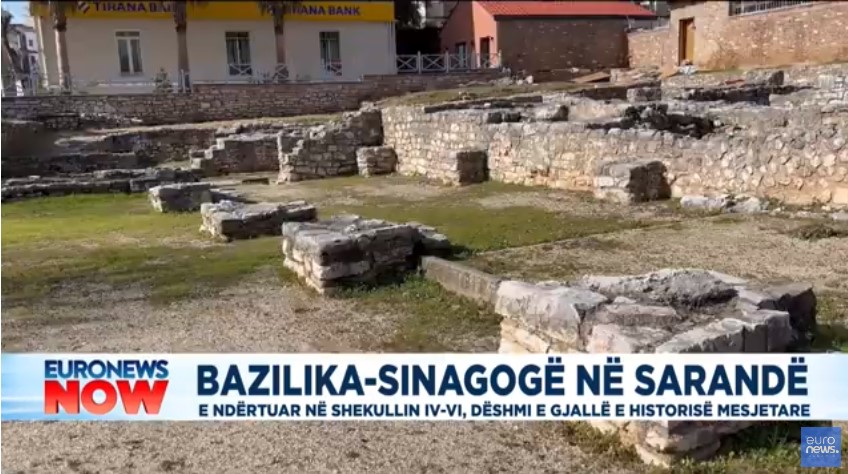
Built from the 4th century BC to the 6th century, the Basilica-Synagogue of Saranda, located within the walls of the medieval fortress of Onhezmi, is living evidence of the early history of the coastal city.
In the urban and archaeological context, this rare complex for the period shows the organization of the ancient center of Saranda.
“There have been three phases of construction, from the 4th century to the 1st century BC, then the second phase belongs to the 1st century BC to the 1st century and the third phase from the 1st century to the 6th century until it was destroyed by the invasions,” said the archaeologist. Geni Kaçi.
“The presence of such a large basilica also indicates the presence of a large number of people who lived in this city”, said archaeologist Geni Kaçi.
Archaeological ruins were discovered in 1980, while it is believed that until 1960 the surrounding walls were in existence. Today, what remains sheds enough light on the past.
The discovery of the ruins then led to the alienation of the place, then they were discovered by a well-known group of archaeologists of that time.
“It is a monument which in its name is called Basilica Synagogue, due to the condition of a large paleo-Christian basilica, in the south of it there are some premises that have served as a basilica. We prove this very easily by finding some mosaics that are currently covered, but which are very well reflected in these panels”, said archaeologist Geni Kaçi.
The Basilica-Synagogue, due to its location in the center of the city, is the first stop of every foreign tourist. For archaeologist Genci Kaçi, this is just a cultural monument.
“Because every tourist who comes to Saranda must also visit this monument, it is administered by the archeology department in Saranda Municipality and the entrance is ticket-free”, said archaeologist Geni Kaçi.
The Basilica-Synagogue in Saranda reveals the mosaics once every 10 years, to make them accessible to the public.