

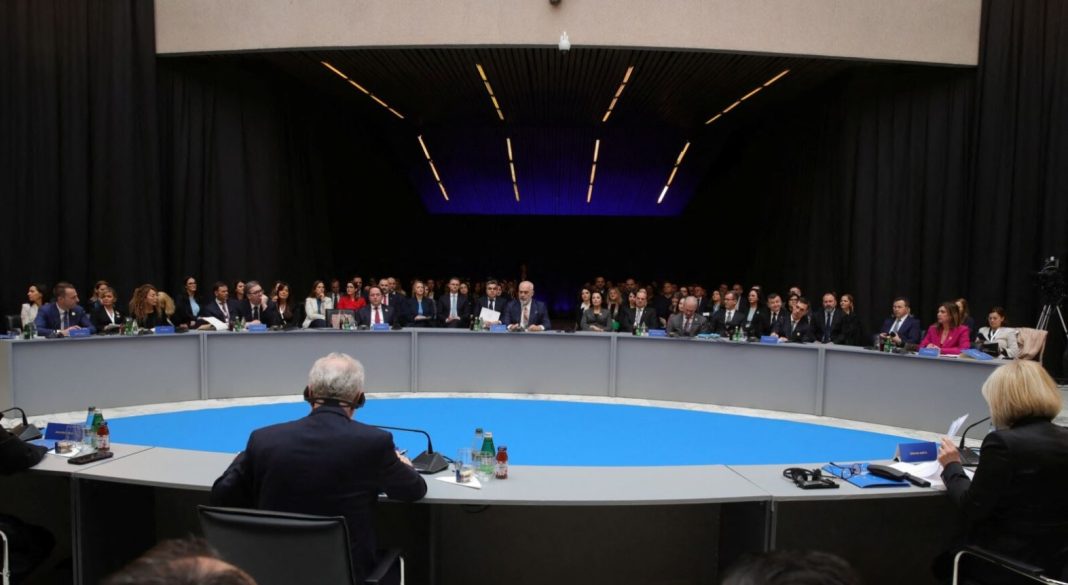
The European Commissioner for Enlargement, Oliver Várhelyi, stated that the European Union’s plan for economic growth in the Western Balkans is an ambitious plan that could potentially double the economies of the six Balkan countries.
At the outset of the Regional Summit on the growth plan, held in Tirana, Albania, the European Commissioner stated that the plan becomes functional only if the six Western Balkan states implement the required reforms and criteria.
“We have full confidence in all Western Balkan countries that you will be able to reap the benefits of this plan, a plan that has the potential to contribute to doubling the economies of the Western Balkans in the next decade,” he said at the summit attended by regional leaders.
According to Várhelyi, the plan is part of the enlargement process and implies that alongside the reforms undertaken by aspiring states in the region, the bloc offers them “all the benefits that membership brings before your countries become EU members”.
“We are at the beginnings of a very fundamental, but also very rapid change in the Western Balkans,” he emphasized.
The EU allocation for this plan for the period 2024-2027 is 6 billion euros.
In addition to Albanian Prime Minister Edi Rama as the host, other regional leaders attending the summit include Serbian President Aleksandar Vučić, North Macedonia Prime Minister Talat Xhaferi, and the Chairwoman of the Council of Ministers of Bosnia and Herzegovina, Borjana Krišto.
Kosovo’s Prime Minister Albin Kurti will not be physically present at the February 29 summit, “due to previous commitments”, as stated by the spokesman for the Government of Kosovo, Përparim Kryeziu.
“However, Kurti will be part of the summit virtually through a video address,” said Kryeziu.
Montenegro’s Prime Minister Milojko Spajić is also not present at the summit but will address the participants via video link.
The EU’s plan for the Western Balkans aims to boost the region’s economic growth, accelerate necessary reforms, and undertake investments that could advance the EU enlargement process with these countries.
A similar summit for this plan was held on January 22 in Skopje, North Macedonia.
What is the plan for economic growth in the Western Balkans?
The new plan for economic growth in the Western Balkans countries, approved by the European Commission on November 8, 2023, is based on four pillars.
The first pillar is “strengthening economic integration in the EU’s single market”.
This will depend on the adaptation of the region’s countries to the rules of the single market and simultaneously opening their markets in relevant sectors to neighboring countries.
The second pillar of this plan is “strengthening economic integration within the Western Balkans through a common regional market”.
According to the EU’s experience, this could lead to a potential economic growth of 10 percent.
The third pillar of this plan is “accelerating fundamental reforms”. This implies enforcing the rule of law, which also helps attract foreign direct investment and strengthens regional stability.
The fourth pillar of the European Commission’s new plan for economic growth in the Western Balkans is “increasing financial assistance to support reforms”. This includes the proposal for 6 billion euros in aid.
As the region’s countries benefit from trade relations with the European Union through the respective Stabilization and Association Agreements, the European Commission proposes to go beyond this by making changes to these agreements to ensure equal conditions in the market and between countries in the enlargement process and EU member states.
All these goals are in line with the ideas being implemented through the Berlin Process, as well as the creation of the “common regional market”.