

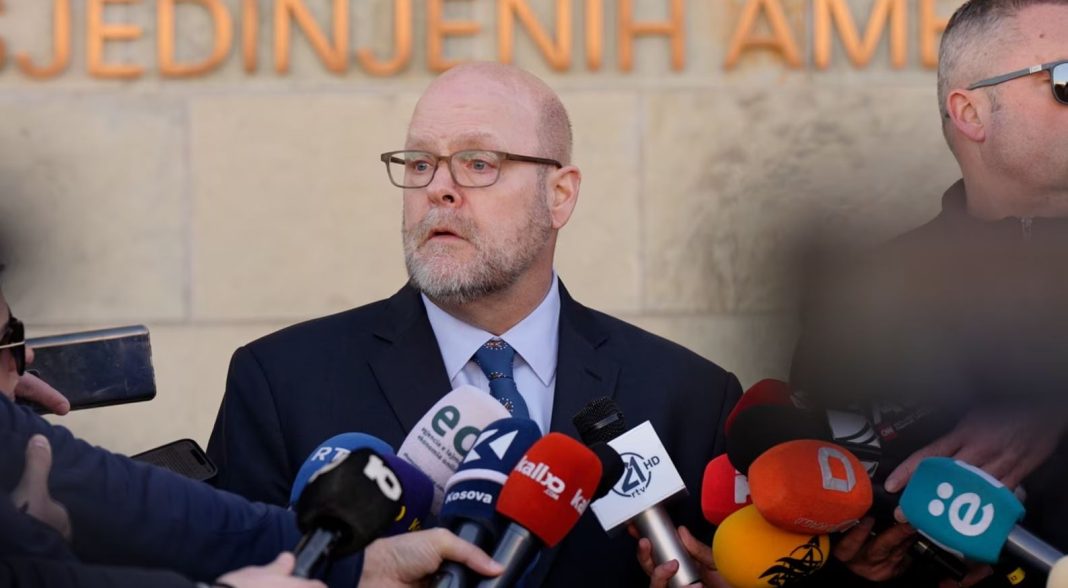
The United States Ambassador to Kosovo, Jeffrey Hovenier, has advised the Government of Kosovo to seek the opinion of the Constitutional Court as soon as possible on a draft statute prepared by the West for the establishment of the Association of municipalities with a Serbian majority.
“In this way, Kosovo would benefit substantially. There will be an answer as to whether [the document] is constitutional or not, whether it has executive competencies or not, and we believe that only the Court can provide that assessment. Such a thing will create a different dynamic and will reflect Kosovo’s commitment to fulfilling its obligations,” said Hovenier during a discussion with journalists at the US Embassy building in Pristina.
Last October, Western diplomats presented Kosovo and Serbia with a draft statute for the formation of the Association, which the parties accepted in principle.
However, no steps have yet been taken towards its establishment.
Kosovo and Serbia reached an agreement on the Association in 2013 and later in 2015 on the principles for its establishment.
However, in 2015, the Constitutional Court of Kosovo found that the agreement was not fully in line with the Constitution.
Serbia insists that Kosovo implement the agreements reached, but the Government of Kosovo has declared itself against a mono-ethnic association.
“The manner of implementing the regulation of the CBK should be discussed”
Hovenier said on Thursday that the manner of implementing the regulation of the Central Bank of Kosovo (CBK) that defines the euro as the sole currency for cash payments should be discussed.
He said that dialogue may not be the most appropriate place to discuss Kosovo’s internal issues, but that the issue of the dinar should be negotiated, as Kosovo has pledged to protect minority communities.
Hovenier insisted that the United States is not challenging the responsibility and authority of the Central Bank of Kosovo nor protecting the dinar, but is concerned about the manner of implementing the CBK regulation.
“It has a direct impact on individuals who are most vulnerable,” said Hovenier, citing the example of a 70-year-old who is used to going to an office to collect their pension.
Among other things, Hovenier said that Serbia should not have a veto over the way aid is offered, but this issue should be discussed.
The new CBK regulation came into force on February 1 of this year.
This regulation has affected Serbian-majority municipalities in Kosovo, as the Serbian dinar is also used in them.
The Republic of Serbia claims to allocate millions of euros for Serbs in Kosovo and pays them salaries, pensions, and additional aid.
The United States has continuously urged Kosovo to suspend the decision on the Serbian dinar and for negotiations on the CBK regulation in Brussels to “continue urgently”.
On February 27, delegations from Kosovo and Serbia met in Brussels, under the mediation of the European Union on this issue, but European officials said “additional meetings will be necessary”.
The Constitution of Kosovo stipulates that there should be only one currency for cash payments.
Kosovo is not part of the Eurozone – which consists of 20 EU member states – but has used the euro as its main currency since 2002.
US-Kosovo Partnership
Asked about what could be jeopardized by damaging the partnership between the US and Kosovo, he said that the US is more dedicated than ever to the people of Kosovo, but it does not imply that every Kosovo government will receive support for the elections it conducts.
“If those solutions are in line with our vision, we will support them, if we see that they obstruct our objectives, we will be critical,” said Hovenier, warning that a degraded partnership has consequences.
“Hesitation” about the idea of an international conference
Hovenier expressed hesitation about the question of whether there is a possibility of organizing an international conference for agreements with Kosovo and Serbia.
“We have a good agreement, reached almost a year ago,” said Hovenier, referring to the agreement reached in Ohrid between Kosovo and Serbia for the implementation of the Agreement on the normalization of relations.
He recalled that both the United States and the European Union consider the agreement binding on both parties, and all that is needed now is the willingness to work on its implementation.
“We are disappointed that nothing like that is happening.”
The 11-point agreement provides for a level of self-management for the Serbian community in Kosovo and mutual recognition of state symbols, while requiring Pristina and Belgrade to implement all previous agreements reached during the dialogue.
Kosovo and Serbia have been negotiating, with the mediation of the European Union, since 2011.
The parties have signed a series of agreements, but not all have been implemented.




