

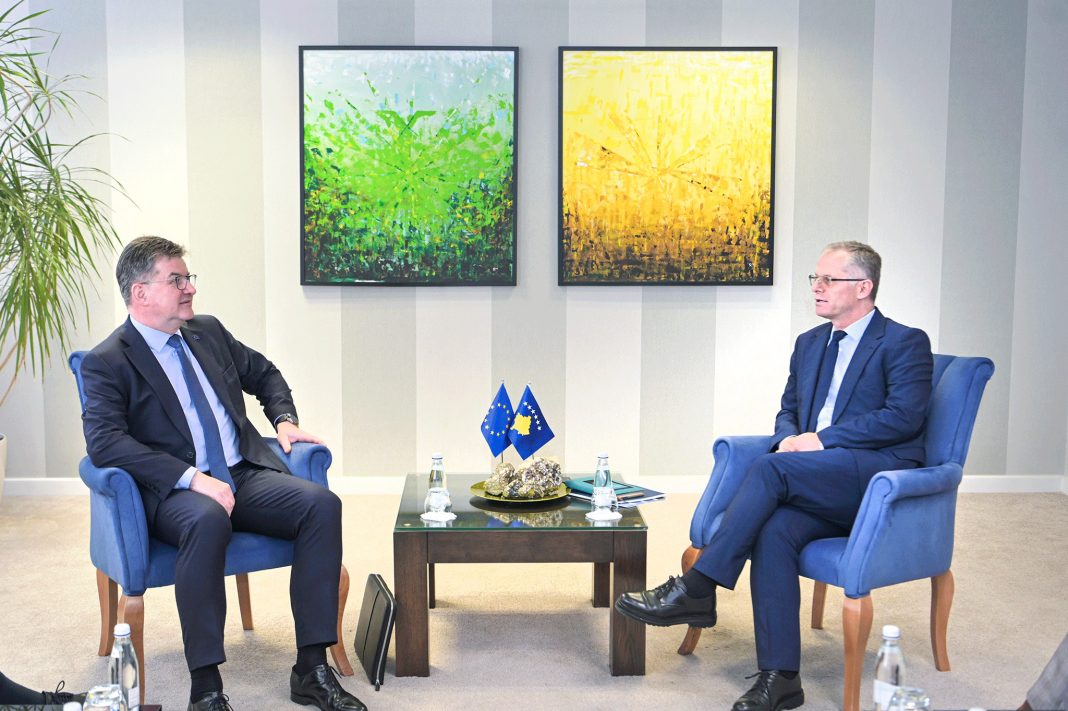
Unresolved issues, focusing on the Agreement towards normalization and the issue of the Serbian dinar, were topics of discussion between the Deputy Prime Minister of Kosovo, Besnik Bislimi, and the EU envoy for the Kosovo-Serbia dialogue, Miroslav Lajčák, on March 5 in Pristina.
After the meeting, Lajčák stated that the implementation of the Basic Agreement is in everyone’s interest, while Bislimi, who is Kosovo’s chief negotiator in the Brussels dialogue, once again blamed Serbia for refusing the full implementation of the agreement.
In the meeting, the two officials said that a series of issues were discussed, with Bislimi stating that punitive measures imposed by the EU against Kosovo were discussed, as well as Kosovo’s membership opportunities in the Council of Europe, the implementation of the Energy Agreement – reached earlier in the dialogue – the issue of license plates, telecommunications, and passports issued by Serbia for Serbs in Kosovo.
After the meeting at the building of the government of Kosovo, Lajčák told the media that the most important issue discussed was the implementation of the Basic Agreement.
“We have a long list of issues we discussed, but the most important is the implementation of the Basic Agreement. It is in everyone’s interest to see faster progress in this direction,” Lajčák told reporters in Pristina.
According to the European envoy, the Basic Agreement – reached in Brussels last February, and later in March in Ohrid an agreement was reached on its annex – is legally binding, regardless of the fact that the parties have not signed it.
“This agreement is the best agreement Kosovo and Serbia could have achieved. I am very sure about that. If there were a better agreement, it would have already been proposed. Therefore, it is in everyone’s interest to start its implementation. With this agreement, we have answers to the questions of how, what to do, and when to do it. The only question left is when, and I ask: Why wait? This agreement is good and should be implemented,” he said.
The 11-point agreement towards normalization also provides for a level of self-governance for the Serbian community in Kosovo and mutual recognition of state symbols, while requiring Pristina and Belgrade to implement all previous agreements reached during the dialogue.
Meanwhile, Kosovo’s Deputy Prime Minister Besnik Bislimi said in a media statement that signing the Basic Agreement would be a guarantee for its acceptance and implementation.
“Deputy Prime Minister Bislimi reiterated that the agreement must be implemented through a fair, equal, and balanced sequencing plan between the parties. He said that signing the agreement is a guarantee for its acceptance and implementation,” the statement said.
During his remarks to reporters, Lajčák also spoke about the Serbian dinar issue, admitting that he had organized a meeting in Brussels on February 27 on the matter.
However, he said, some aspects of the regulation of the Central Bank of Kosovo (CBK) had to be discussed with Bislimi.
“I know we had the meeting last week at the expert level in Brussels. The meeting was constructive, and we managed to find answers to some questions. But there are some questions that go beyond the mandate of these experts, and we have discussed these issues with Bislimi. Our communication will continue, and I plan to organize a new meeting in the coming days at the level of chief negotiators,” Lajčák explained.
Regarding this issue, according to a statement released by Bislimi’s office, the Kosovo government’s position was reiterated that the regulation of the CBK is not part of the negotiations in Brussels.
“The government of Kosovo is interested in ensuring the continuity of Serbia’s financial support for Serbs in Kosovo in the fields of education, health, and social protection,” the statement said.
At the February 27 meeting in Brussels convened for the Serbian dinar issue, Kosovo was represented by heads of the Central Bank of Kosovo, while Serbia was represented by its chief negotiator, Petar Petković.
Lajčák, speaking about Bislimi’s non-participation in this meeting, said that “intentionally” in the invitation sent to the parties, he had left open the possibility for them to choose who would represent them at the meeting.
The CBK regulation, which provides only the euro as the currency for cash transactions, came into force on February 1.
The Serbian state distributes millions of euros to Serbs in Kosovo after paying them in dinars – through a parallel system – salaries, pensions, and additional assistance.
The regulation has been criticized by the EU and the United States. Washington has demanded that Kosovo postpone the implementation of the decision, arguing that it was taken without prior consultation and without taking into account the influences on the Serbian population.




