

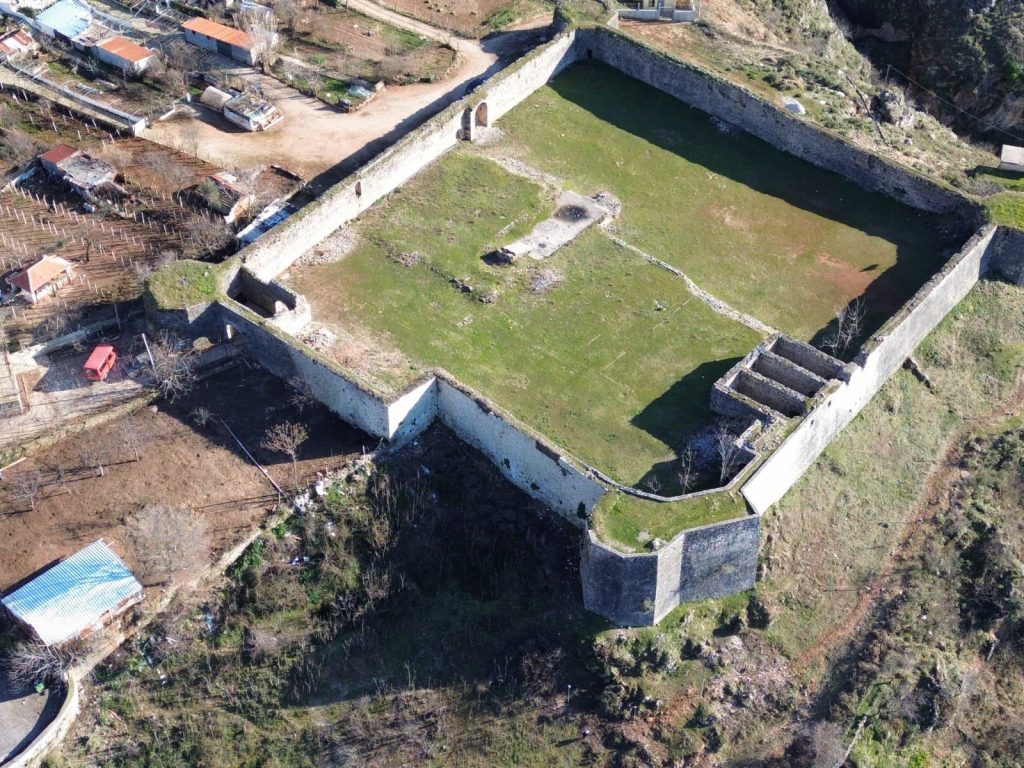
The Libohovë Castle rises on a rocky hill in the northeastern part of the town of Libohovë with an almost quadrangular plan of 70 x 80 m.
The Gjirokastër Regional Directorate of Cultural Heritage provided information about this location, which has attracted the attention of historians and researchers and can now be visited by the public.
The Libohovë Castle is reinforced by four polygonal towers at the corners and a regularly geometric bastion adjacent to one of the towers at one of the corners. The fortification is equipped with three entrances. It preserves all the characteristics of typical constructions of Ali Pasha.
The castle has served as a fortified palace, built for Ali Pasha’s sister, Shanisha. Within the castle, the ruins of Ali Pasha’s sister’s sarays are still identified.
The sarays and the castle are contemporaneous, and François Pouqueville mentioned it only as a saray and not as a castle, thus bearing the characteristics of a saray of an important figure like the Beys of Libohovë, of which Ali Pasha’s sister, Shanisha, was a part.
From the book “Tepedelenli Ali Pasha 1744-1822” by the great-nephew of Shanisha, Ahmed Müfid Bey Libohova, it is called a saray, the Beys’ sarays, and mentions the fact that Ali himself stayed overnight as a guest of the Beys of Libohovë or even Lord Byron on his way to Tepelenë (at that time, Gjirokastër had not yet fallen).
It is certain, according to specialists, that this construction belongs to the late 18th or early 19th century and predates Ali’s takeover of Gjirokastër (1808) or the construction of the Saint Trinity castle in front of Gjirokastër.
Sarays
From the magnificent sarays, traces of foundations and some galleries in the western part, once part of the sarays, have remained. During the survey, a decorative element was evident as part of the masonry of a cylindrical arch foot within Tower No. 3, which seems to have been rebuilt. The sarays had 3-4 floors and extended throughout the east-west length of the castle.
The wall structure of the castle consists of two stone walls between which rubble stone filling has been poured.
The inner face of the masonry is irregularly constructed; on one side, traces of the wooden beam layer are clearly visible even today, consisting of transversal beams with a section of 8 cm and horizontally laid planks with dimensions of 4×10 cm placed almost on the outer edge and covered with a narrow horizontal strip of stones.




