

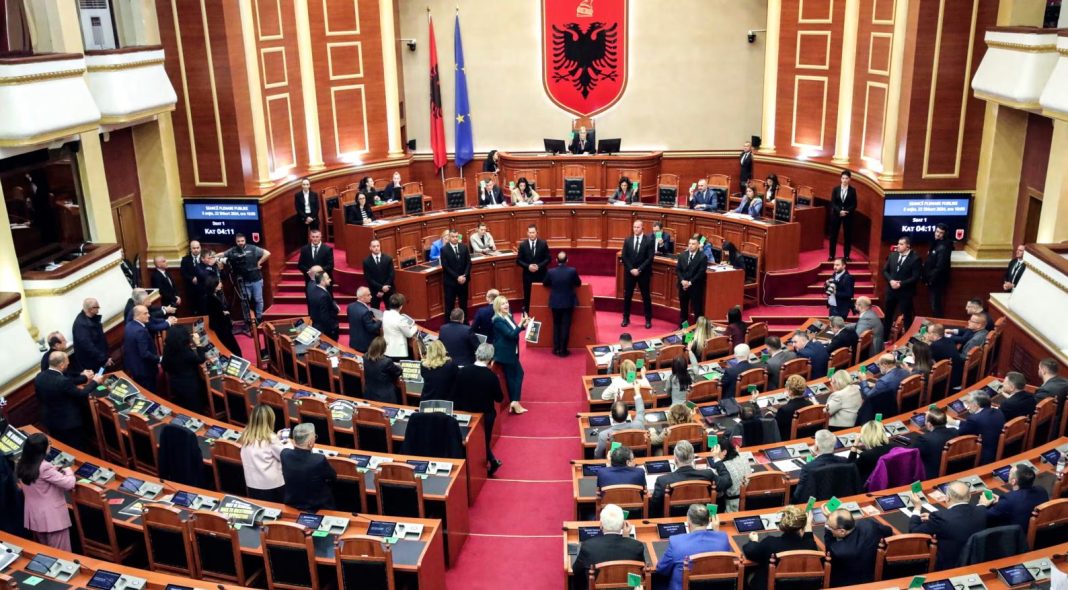
The two largest parliamentary groups, those of the Socialists and Democrats represented by deputies supporting former Prime Minister Sali Berisha, reached an agreement that will unlock the work of the Albanian Parliament.
The agreement was reached at the conference of chairpersons on Friday, where the opposition’s request for the establishment of two investigative commissions was accepted. One of them will have the concession contracts in healthcare as its object of parliamentary investigation, specifically those for the sterilization of surgical equipment and for check-ups or basic health analyses.
The other investigative commission will focus on investigating the alleged unlawful intervention in the personal data of the TIMS system, according to the opposition. According to the head of the Socialist Party group, Bledi Çuçi, the majority has been willing to establish these commissions, but they waited for their investigation content to comply with the law, which the majority amended some time ago, solely with its votes. The opposition has challenged this law, filing a complaint with the Constitutional Court.
However, the head of the Democratic Party parliamentary group, Gazment Bardhi, did not clarify whether it will be expected for the Constitutional Court to express its opinion first or if the establishment of the commissions will proceed.
Although Bardhi’s group had requested an investigative commission for four concession contracts in healthcare, he said they initially agreed on two of them, as they had evidence of numerous violations in these contracts.
The heads of the parliamentary groups, Bledi Çuçi and Gazment Bardhi, stated that there is also an agreement for the parliamentary law commission to find the proper mechanism to establish a working group to create political dialogue for laws requiring a majority of 94 votes, as well as those that are part of Albania’s integration agenda with the European Union.
Another demand of the Democratic group was the restructuring of the composition of the electoral reform commission, which has as co-chairman deputy Enkelejd Alibeaj, a representative of the chairman’s group of the Democratic Party, Lulzim Basha.
Regarding this request, Bardhi said that this commission’s mandate expires on March 21, and then, after discussion also with OSCE/ODIHR, decisions will be made about further steps.
“For five months, we have been accused that our action in Parliament had other motives, but we proved and kept the promise that by solving our three concerns, Parliament will return to normality,” said Bardhi.
The opposition’s three requests were: allowing parliamentary control through the acceptance of requests for the establishment of investigative commissions, allowing the Democratic Party parliamentary group to be represented in the special parliamentary commission for electoral reform, with the chairman and members selected by the opposition itself, and timely consideration of legislative proposals from opposition deputies, which have been suspended for two years and not included in parliamentary procedures.
The Democratic Party led by Lulzim Basha has described the agreement as a “deal between Prime Minister Edi Rama and former Prime Minister Sali Berisha to undermine electoral reform”.
The Minister for Relations with Parliament, Elisa Spiropali, said that from next week plenary sessions will return to normality, but she did not respond if it was agreed that the opposition would give its votes for penal amnesty.
“We have made agreements, but not deals. We hope that all government initiatives will be discussed and voted on by the opposition, for the good of the citizens,” said Spiropali.
The draft law on penal amnesty, from which around 700 convicted and pre-trial detainees would benefit, was withdrawn from the vote, as the majority did not have the 94 votes needed to approve it.
The return to the normal functioning of Parliament was immediately noticed after the agreement was reached, as the Parliament announced that the meetings of parliamentary committees that will be held next week will be with the physical presence of deputies and not online.
For five months, the Albanian Parliament has held its sessions amidst disruptions, smoke bombs, noise, and physical clashes. Some deputies have been excluded from Parliament’s work, and the majority has also amended the Parliament’s rules, tightening the penalties for deputies creating such scenes. As a result, a large number of laws have passed without debate, as sessions have been adjourned within minutes without going into discussion, but directly to voting on laws.
The agreement reached between the parties was welcomed by the US Embassy in Tirana, the office of the EU Delegation to Tirana, and the Embassy of the United Kingdom. The internationals emphasized that “a functional Parliament is key to the integration process” and urged deputies to show commitment to democracy for the benefit of the Albanian people.




