
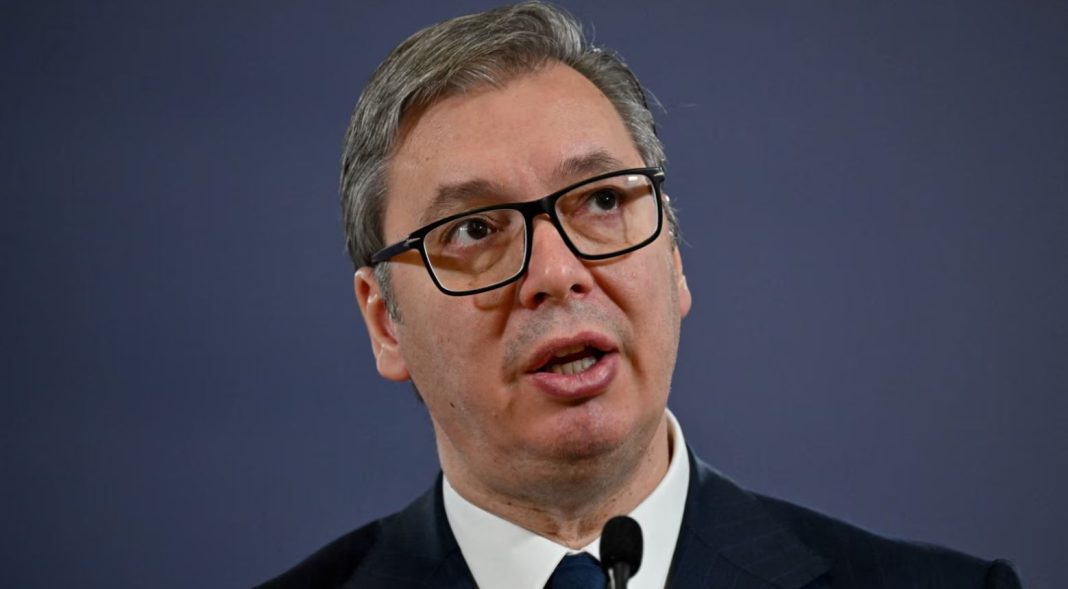
The President of Serbia, Aleksandar Vučić, has said on Sunday that he expects “only bad news” for his country and that Serbia will change its approach to the dialogue with Kosovo, which is mediated by the European Union.
“I will explain how we were deceived, where and how some so-called friends have lied to us, and many others, and this has to do with Kosovo’s membership in the Council of Europe (CoE),” said Vučić.
Speaking about Kosovo’s accession to the CoE, Vučić said, “We told them what would happen if this were to happen. Because they think they have the right to interpret the agreement falsely, not incorrectly or as they wish, but falsely.”
“It will be very difficult for us, because someone’s aim is to push the Serbian people as far away from Kosovo as possible,” he added.
In the agreement reached in early 2023 to normalize relations with Kosovo, Serbia is required, among other things, not to obstruct Kosovo’s membership in international organizations.
Kosovo hopes to be able to join the Council of Europe, as on March 13, the government of Albin Kurti requested the Cadastral Agency to transfer 24 hectares of land in the name of the Deçani Monastery. Prime Minister Kurti said that implementing the Constitutional Court’s decision on the land would be decisive for Kosovo’s acceptance into the CoE during the Parliamentary Assembly of this institution, which will be held in April.
If Kosovo gets the green light in the Parliamentary Assembly, then the final word must come from the Committee of Ministers of the Council of Europe – something the government expects to happen in May.
In that case, Kosovo’s accession to the Council of Europe may also be conditioned on other issues.
The Deputy Assistant Secretary of State, Gabriel Escobar, told Radio Free Europe (RFE) last week that there are some European countries that are also demanding two conditions for Kosovo’s membership.
“One has to do with some actions regarding the property takings taking place in the north. And the other is the Association,” he said.
Vučić also warned of changes in his country’s approach to the dialogue.
“It won’t be easy, especially for our people in Kosovo. But there will be changes in our doctrine and approach. They won’t lead us anymore by the nose and tell us that an agreement has been reached to pay here, then to pay there, and then to convert from dollars to euros, and from euros to others,” he emphasized.
On Tuesday, Kosovo and Serbia’s chief negotiators will meet in Brussels to discuss within the dialogue framework the issue of the Serbian dinar, the use of which Kosovar authorities banned through a new regulation on currency that came into force in February.
Escobar told RFE that he failed to persuade Prime Minister Kurti during his visit to Pristina this week to suspend the decision to ban the Serbian currency in Kosovo until the European Union, United States, and the government of Kosovo find a long-term solution, such as electronic transfer of euros through Kosovo’s system.
Vučić – whose state allocates millions of euros for Serbs in Kosovo and pays them salaries, pensions, and additional aid – accused Kosovo authorities of forcefully implementing the decision of the Central Bank of Kosovo, which stipulates that only the euro is to be used for cash payments.
“You can enforce anything, but you have to accept that you have enforced it. Will we ever have to accept it, it’s possible, but it will be clear that there is no agreement on this and that you have enforced it. We will speak in a different way. We are always ready to talk, but now with a different approach. We are no longer fools,” Vučić emphasized.