

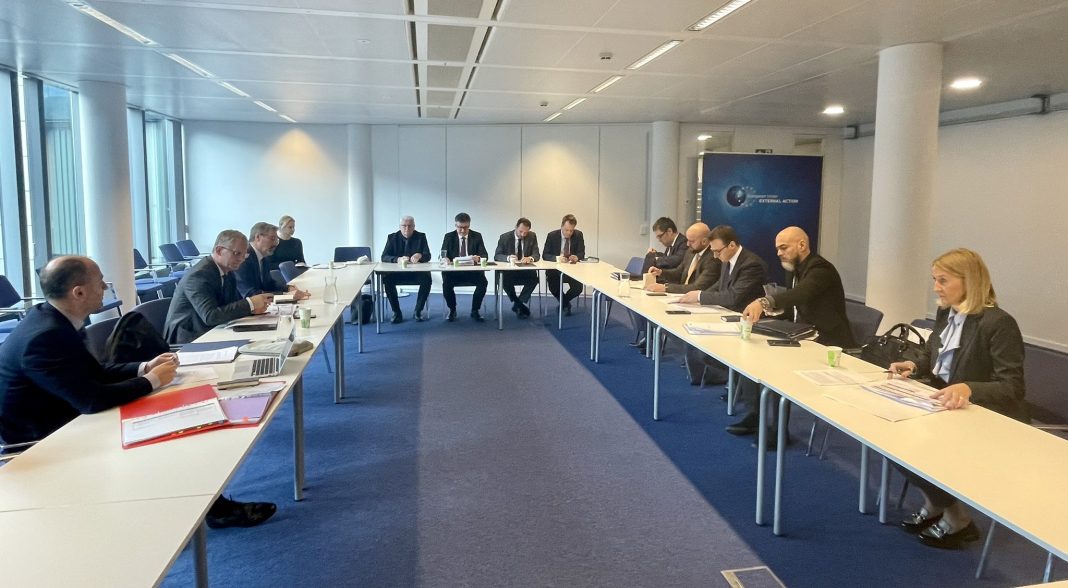
Kosovo and Serbia will submit their proposals for the use of the Serbian dinar in Kosovo until March 22, and next week they will meet again in Brussels to discuss options, said Kosovo’s chief negotiator in talks with Serbia, Besnik Bislimi.
He and Serbia’s chief negotiator, Petar Petković, met on Tuesday with the mediation of the EU’s special representative for the Kosovo-Serbia dialogue, Miroslav Lajčák.
Lajčák confirmed on the X platform that the two chief negotiators had agreed to continue the discussion on this issue next Monday.
It was the first time that officials from the government of Kosovo participated in such talks since Kosovo, with a regulation of the Central Bank (CBK) that entered into force on February 1, banned the use of the Serbian dinar, making the euro the sole means of payment.
The issue, besides angering Serbia, also caused disagreements between the government of Kosovo and the international community, as the Serbian community in Kosovo has been receiving payments in dinars from the Serbian budget for years.
Western diplomats urged Kosovo to suspend the regulation to give affected citizens time to adjust to the new practice.
Petković said it is important for Serbs in Kosovo to be able to receive their money in Kosovo and not go to Serbia to withdraw it.
In an interview with Radio Free Europe (RFE) on the same day, the Prime Minister of Kosovo, Albin Kurti, said that proposals for the dinar that are in conflict with the regulation of the CBK will not be accepted.
What else was said in Brussels?
Petković said the first thing the Serbian side insisted on was the establishment of the Association of Serb-majority municipalities in Kosovo, because “this would also solve the issue of financing all Serbian institutions in Kosovo”.
Petković also said it is important to find a solution that would allow the Serbian bank in Kosovo, the Savings Bank and the Post Office to continue operating.
He added that he expects the discussions to continue “in a constructive spirit” – perhaps starting next week.
Petković also said his counterpart from Pristina has been insisting all along on some formalization of the Agreement on the Normalization of Relations between Kosovo and Serbia.
However, the Serbian delegation, according to him, spoke about the necessity of establishing the Association, as the agreement for it, he recalled, has already been signed by both Belgrade and Pristina, as well as by the EU.
Bislimi said there might be a meeting between the leaders of Kosovo and Serbia to declare on the Agreement on the Normalization of Relations reached last year.
He told reporters that the Serbian side confirmed it is not ready to fully implement it.
According to Bislimi, the Serbian negotiator, in response to many questions from Lajčák, said the agreement with Kosovo “is problematic” because of the part concerning Kosovo’s status.
“Lajčák noted that Serbia has a problem moving in this direction and, therefore, this should be discussed at a future meeting with the heads of state,” Bislimi said.
In his update on X, Lajčák briefly said that the agreement would have to be addressed by the leaders.
A day earlier, the European Union warned that it would increase pressure on both countries to implement the agreement reached a year ago in Brussels.
A few weeks later, in Ohrid, the implementation annex was also agreed upon.
The agreement, among other things, calls for good neighborly relations, reciprocal recognition of documents and state symbols, as well as reciprocal respect for sovereignty and territorial integrity.
The agreement also requires the parties not to obstruct each other in integration processes, but does not require mutual recognition.
According to it, the parties must also implement earlier agreements reached within the framework of the dialogue for the normalization of relations – a process started as far back as 2011.




