

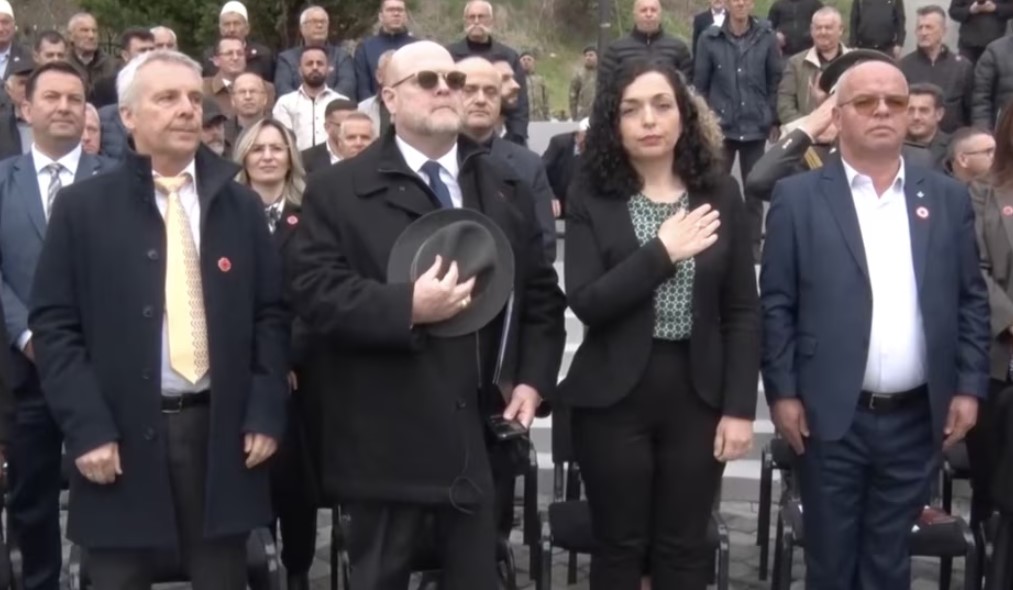
The American ambassador in Pristina, Jeff Hovenier, said on Tuesday that NATO intervened 25 years ago to end the war in Kosovo precisely because of events like the one in Krusha e Madhe.
He made these comments during a memorial ceremony in this village in western Kosovo, where on March 25, 1999, Serbian forces killed around 250 civilians.
“NATO acted precisely because of such terrible crimes that were taking place. On the same day, the then US Secretary of State, Madeleine Albright, declared “it is impossible for us to negotiate while (Slobodan) Milosevic increases the number of forces, attacks civilians and burns villages in Kosovo. NATO’s actions aim to promote peace and stability in Europe by ending atrocities and the humanitarian crisis,’ he said.
Twenty-five years ago, NATO launched an aerial bombing campaign against Serbian forces. The air campaign that lasted 78 days, on the ground was used by the Serbian forces for revenge attacks against the Albanians. Over 10,000 people were killed, over 800,000 were sentenced from Kosovo, while another 5,000 were counted as missing at the end of the war.
25 years later, nothing is known about the fate of over 1,600 people. Among them are the bodies of 60 people killed in the Krusha e Madhe massacre.
“The families of the victims need justice, Kosovo needs justice because this is the basic principle on which every society should function, without which peace is never right,” said the president of Kosovo, Vjosa Osmani.
She praised as “institutionalization of collective memory” the establishment of a museum that was inaugurated today in this village, with testimonies and confessions from the events of March 25, 1999.
“The importance of such a museum is extraordinary. By shedding light on the dark events of our past, we ensure that the voices of the victims are never silenced and never forgotten in our history. We must not forget the path we have gone through, but we must learn from the past for a brighter future and lasting peace,” she said.
American Ambassador Hovenier said that the act of remembrance that this museum enables is an essential part of transitional justice that aims to address the past and build the foundations for a future of healing and reconciliation.
“It is the right thing to do to have a physical witness to the terrible events that took place here and to have a place where we can come together to honor the memory and legacy of those who were killed. The United States is proud to have supported your efforts for this museum, including training in interviewing skills, history ethics, curation and archiving,” said the US ambassador.
The German ambassador in Kosovo, Jorn Rhode, said that the massacre of Krusha is evidence that NATO’s intervention was more than necessary to stop a further humanitarian catastrophe and the ethnic cleansing that was happening in Kosovo.
“This intervention was the right thing to do and we stand behind it. Most of the perpetrators of these crimes are still at large and all I can say is that impunity cannot be allowed. I am proud to stand here today and say that Germany has helped build Kosovo as a free, democratic and multi-ethnic state”, he said.
Nine years after NATO’s intervention, Kosovo declared its independence with Western support, but continues to be opposed by Serbia and its ally Russia.
Although the leaders of Kosovo and Serbia agreed on an agreement to normalize relations in 2023, tensions between them continue to be high.




