

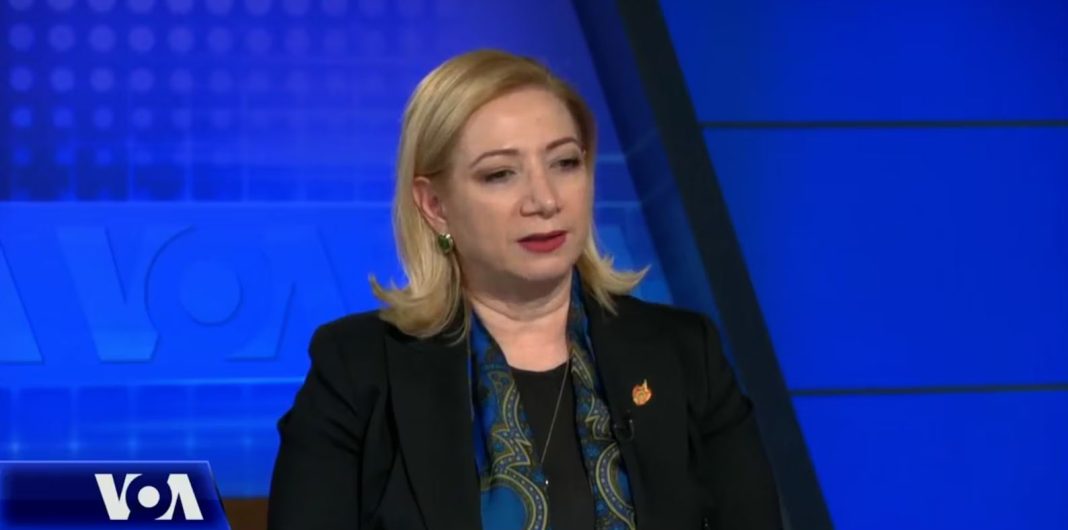
The President of the Constitutional Court of Albania, Holta Zaçaj, said it is not up to politics to decide how to implement the decisions of the Constitutional Court, as it is the Constitution that determines the necessity of their implementation.
She spoke in an interview for Voice of America during a visit of a delegation of members of the Constitutional Court and the High Court to Washington for meetings at the Department of Justice and the State Department.
Zaçaj said that the failure of institutions to implement its decisions reflects the level of democracy in the country. She dismissed accusations that the court is biased.
Voice of America: First, let’s talk about the purpose of this visit here in Washington. What was its objective?
Holta Zaçaj: It was a scheduled visit between the two courts and partners of justice reform, with the Department of Justice and the State Department. We also had a visit to the American Bar Association and Georgetown University.
Voice of America: Let’s now move on to some of the topics regarding Albania and the work of the Court. In Albania, some decisions of the Court are not being implemented by the Parliament or are being delayed, as is the case with the mandate of deputy Olta Xhaçka. It’s an unusual situation. In the absence of a mechanism to enforce these decisions, what happens? It’s a worrying situation…
Holta Zaçaj: It’s a question, in fact, repeatedly asked to the Court and to me personally in my public appearances. It’s indeed an unusual and impossible situation to occur in a democratic state. I have mentioned it before – the decisions of the Constitutional Court must be implemented, and the implementation of the decisions of the Constitutional Court constitutes, in fact, the implementation of the Constitution itself. So, words are too much to give a message beyond what I just said. Every decision must be implemented. There is no other way, no other mechanism, and the reason why there is no other mechanism is because it is impossible to imagine that the decisions of the Constitutional Court are not implemented, so there is not much left to interpret at this moment.
Voice of America: But the reality is such that some of these issues are being delayed…
Holta Zaçaj: Besides what I just said, I cannot make any other statement. It is certain that the institutions charged with enforcing the decisions of the Constitutional Court must act constitutionally. This is the message I have.
Voice of America: Another decision of the Court concerns the diaspora vote, which seems unlikely to be implemented in the upcoming elections. Do you see this as a lack of political will in the country, and will its non-implementation affect the legitimacy of future elections?
Holta Zaçaj: I believe I answered this question. In other words, the fact that we have one decision or another does not change the approach of the Constitutional Court regarding the implementation of its decisions. The Court speaks through its decisions, and the decisions of the Court must be implemented. The decisions of the Court are unequivocal; it is not left to politics to decide how and in what way the decisions should be implemented. The decisions are self-executing. So, any action that does not correspond to what is stated in the decision of the Constitutional Court, I believe, is not the right decision or the right actions.
Voice of America: Does this indicate a disrespect for an important branch of governance in Albania?
Holta Zaçaj: Definitely, it is an indicator of the type of democracy we have and the state of democracy we have.
Voice of America: The opposition has criticized the Court several times for siding with the government on some decisions that have had a narrow outcome, such as the Rama-Meloni pact. How do you respond to these criticisms?
Holta Zaçaj: We highly value freedom of expression and the right to speech, which is one of the most important freedoms in the Constitution, but surely everyone is allowed to give their opinion and their opinion. The decision of the Court is the one given, and we as judges do not comment beyond that. Certainly, in every decision of the Court, there are parties that remain dissatisfied as in any other decision-making of any judiciary. So, the criticism or different opinions we see as a value of democracy regarding the implementation and respect for the right to express oneself. But beyond that, the decision of the court has its arguments, as do the arguments of the minority judges on one issue or another. Beyond that, it is impossible for us to comment. Of course, we respect the different opinion that comes from the public, but as an opinion belonging to the public. The Court, keep in mind, operates hermetically. We fought to have a hermetic court and independent judges or an independent court. So, the other part of how the public thinks about a decision of the Court, which is based on the Constitution and should only be based on the Constitution and the law, is actually just an achievement of the right to express oneself. Beyond that, the Court has spoken.
Voice of America: Although the court operates hermetically, the vote of the members, or how they think, is made public. Some of the decisions are taken 5 to 4. Do these very close results undermine the authority and credibility of the court?
Holta Zaçaj: No. I think this is a sign of democracy. And the fact that the court and the judges operate independently, the fact that we have decisions 5 to 4, 6 to 3, just shows that the judges are independent, they do not operate under pressure, there is no internal pressure within the court to have, so to speak, false unanimity. So, we see it as a sign of the internal democracy of the institution, but also the independence of the institution in general. This often happens. It happens here too. It happens in many other countries, where judges disagree. The fact that the procedure in Albania allows minority judges to express their opinions is another way to show, or an instrument in a way of accounting to the public, to express how each one thinks about an issue, but beyond that, this does not undermine decision-making itself.
Voice of America: For another specific case, which was also unusual, for Butrint, because the government did not provide a UNESCO document, the unusual step was taken to reopen this issue. This precisely revealed the fact that the government did not provide a document that should have been provided. How do you assess such a thing?
Holta Zaçaj: The opening of the judicial investigation is actually a procedure provided for in the court’s regulations and in the law. And it’s something that also happens in the ordinary judiciary. So it happens only when a certain evidence, which was not possible to obtain during the normal course of the judicial process, becomes known to exist, and for this reason, due to the parties’ requests for this issue, the court must certainly take it into consideration.
Voice of America: … I meant that in this case, it was not possible to obtain because a document that should have been provided was not given. It was an obligation to be given.
Holta Zaçaj: I want to explain something, that the judgment in the Constitutional Court certainly relies on documents and the parties that give testimony and provide information, bear their responsibilities. But it is not a criminal trial. There are different characteristics of constitutional adjudication from criminal adjudication. Until that moment, representatives of the government said they did not have this report. And then it turned out it had been sent at a certain time by UNESCO. For the court, it is important that constitutional adjudication and decision-making be based on all possible evidence. And so we used that procedural instrument that the regulations and the law allow us to come closer to the truth, for what this evidence is worth. Beyond that, each body involved in the process bears its own responsibilities, and this is my comment on this issue.




