

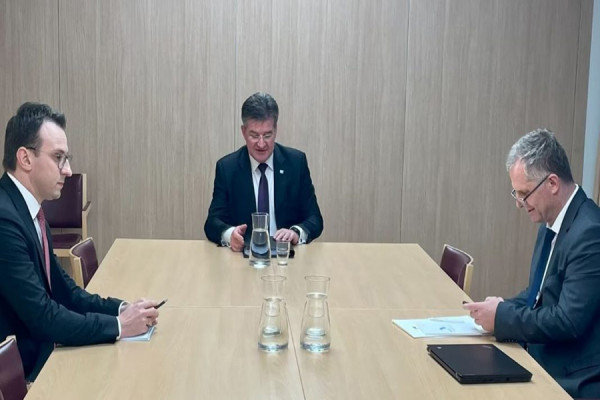
The absence of the tripartite meeting on Tuesday in Brussels, within the dialogue, is considered one more evidence of the failure of this process, under the mediation of the EU emissary, Mirosalv Lajčák. The opposition parties are skeptical that there will be anything concrete in the coming months towards the implementation of the Basic Agreement of Brussels and the Ohrid Annex, while Kosovo is on the verge of elections and emissary Lajčák’s mandate is ending. On the other hand, in the ruling party, the Vetëvendosje Movement, they ask the European Union to have a balanced approach to this process. According to them, the EU should insist that Serbia withdraw the letter attacking the points that confirm Kosovo’s citizenship and sign the Ohrid agreement.
The absence of the tripartite meeting on Tuesday in Brussels, within the dialogue, is considered one more evidence of the failure of this process, under the mediation of the EU emissary, Mirosalv Lajčák.
The opposition parties are skeptical that there will be anything concrete in the coming months towards the implementation of the Basic Agreement of Brussels and the Ohrid Annex, while Kosovo is on the verge of elections and emissary Lajčák’s mandate is ending. On the other hand, in the ruling party, the Vetëvendosje Movement, they ask the European Union to have a balanced approach to this process. According to them, the EU should insist that Serbia withdraw the letter attacking the points that confirm Kosovo’s citizenship and sign the Ohrid agreement.
The deputy of the Democratic Party of Kosovo, Blerta Deliu, tells KosovaPress that Kosovo should be a constructive party in the dialogue, but rather discussing internal issues in Brussels.
“I do not expect that there will be new developments due to the barricading of the two parties in the process and due to the electoral context that Kosovo will have on February 9. Naturally, it would be important for Kosovo to benefit in the dialogue process as a constructive and important party. The developments of Kosovo and Serbia in the dialogue will also be decisive in matters of integration into the European Union. The Kosovo-Serbia dialogue process will be decisive not only for the expansion process but also for our integration future. Kosovo should be aware to be more cooperative”, emphasizes Deliu.
Meanwhile, the deputy of the Alliance for the Future of Kosovo (AAK), Time Kadrijaj, declares that the emissary Lajčák has attempts for meetings at the level of chief negotiators only because of the justification of his work, when he is at the end of his mandate.
According to her, no progress is expected in this process as Kosovo is only in the election process, until she accused Prime Minister Kurti of having made major concessions in the dialogue with the acceptance of the Brussels agreement and the draft for the establishment of the Association of municipalities with a Serbian majority.
” Lajčák is struggling, since he is at the end of his term, since now the EU will have a different configuration and they are in the phase of constitution of institutions. He tries to justify his mandate with efforts for mutual meetings, knowing that the parties will not accept. The Vetëvendosje Movement and Mr. Kurti will struggle with populism by rejecting their agenda, while we know that for four years there has been dialogue, but they have made big concessions. (Kurti) There was a dialogue without principles and a dialogue that was not transparent”, Kadrijaj emphasizes for KosovaPress.
On the other hand, the deputy of the Vetëvendosje Movement, Arbëreshë Kryeziu-Hyseni, tells KosovaPress that despite Lajčák’s attempts for tripartite meetings at the level of chief negotiators in Brussels, it is high time for the EU to act correctly in the dialogue, asking Serbia to sign the Brussels agreement and the Ohrid annex and withdraw the letter sent by the former Serbian prime minister, Ana Brnabic.
“If dialogue is required, both parties must accept the same document and stay within the framework of that document. If one party is not there, I think that the EU should direct its orientation towards this party and do the same to return to the basic agreement in order to move forward with the dialogue process. On the contrary, we have no reason to dialogue with a state that has carried out a terrorist attack for the annexation of the northern part of Kosovo… It is high time for the European Union to open its eyes and act correctly and correctly in terms of the approach to the process of dialogue”, she emphasizes.
After the failure of the tripartite meeting in Brussels, the EU emissary for the Kosovo-Serbia dialogue, Miroslav Lajčák, expressed his regret that there was no such meeting to address, as he said, the urgent issues.
The Kosovar chief negotiator, Besnik Bislimi, accused his Serbian counterpart, Petar Petkovic, that the meeting did not take place because of his fault, as he did not accept the discussion agenda agreed with the mediator Lajčák. Petkovic did the same to Bislimi.
In addition, Bislimi announced that Serbia has not withdrawn the letter from Brussels, despite Lajčák’s statement in Pristina that it has done so.
After the bilateral meetings of the parties with Lajčák, it was reported that Bislimi and Petkovic also had separate meetings at the NATO headquarters regarding the main bridge over the Iber River in Mitrovica.




