

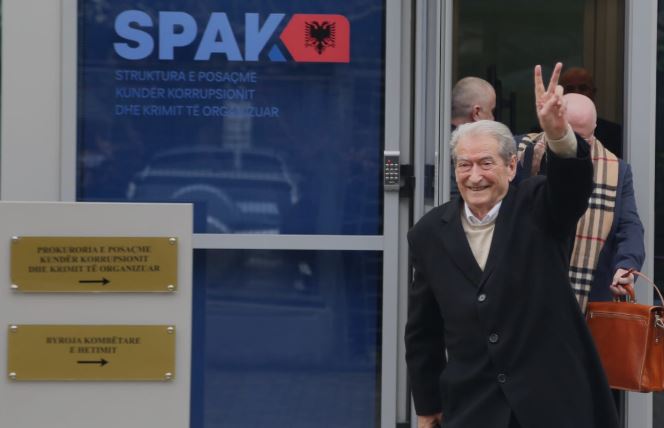
The Constitutional Court has announced the decision regarding the appeal filed by Sali Berisha regarding the first two measures of SPAK, “obligation to appear” and “prohibition of leaving the country”, for which the Special Prosecutor’s Office (SPAK) ignored the authorization from the Assembly.
The Constitutional Court has partially accepted Berisha’s request by revoking the decision of GJKKO on the “ban on leaving the country”.
The journalist of Euronews Albania, Enkeleda Mema, in a direct report, said that the Constitutional Court has therefore considered only the first appeal made by the former Prime Minister Berisha, which is related to the first measure given against him.
Meanwhile, she added that Mr. Sali Berisha’s lawyers have filed a second appeal for the second measure against him, that of house arrest.
PRESS RELEASE
- NOVEMBER 21, 2024
The court first considered the criteria of legitimacy and concluded that the applicant met them with the exception of the claim of violation of the impartiality of the court based on the argument that the judge of the first instance was previously dismissed by the applicant in his function as President of the Republic and at the same time chairman of the KLD at that time.
In relation to this claim, the court assessed that the applicant had not exhausted the legal remedies in the disposition, specifically he had not presented them formally during the ordinary trial according to the procedural rules for this purpose. The request for exemption for this judge was requested for a different reason than the one above.
Regarding the merits of the case, taking into consideration the explanations of the applicant and the parties’ objections, the Court, by majority vote, decided to examine the case in terms of constitutional rights to be elected under Article 45 of the Constitution and freedom of movement under Article 38 of the Constitution.
In response to the applicant’s claim that, based on Article 73/2 of the Constitution, the prosecution should have received authorization from the Assembly before requesting from the courts the appointment of personal security measures “obligation to appear before the judicial police” and ” ban on exiting the country”, the court made a purposive and semantic analysis of the constitutional provision in question. In the framework of this analysis, the Court also referred to the materials of the legislative process which preceded the constitutional amendment of 2012 when Article 73/2 was adopted with this content that it has today, as well as the precedent in the Tahiri case and the jurisprudence of the Strasbourg Court.
The court interpreted the phrase “deprivation of freedom in any form” based on the spirit of the constitutional amendment of 2012, which aimed to reduce the procedural immunity of deputies as much as possible, article 73/2 should be interpreted narrowly as a temporary procedural advantage enjoyed by MPs in function of the good functioning of the Assembly as a whole and not as a privilege of MPs as individuals. In this spirit, the Court, by majority vote, concluded that the temporary procedural protection that Article 73/2 guaranteed to deputies refers only to personal freedom and not to freedom of movement.
The court examined the security measure “obligation to appear before the judicial police”, from the point of view of the right to be elected according to Article 45 of the Constitution. Referring to the obligation imposed by the measure and the frequency of its implementation (once every two weeks), the court unanimously concluded that it does not affect the legislative functions of the Assembly and does not prevent the deputy from exercising his rights as a deputy. As a result, the court unanimously concluded that in the present case, this measure does not constitute a restriction of personal freedom and, therefore, authorization from the Assembly is not needed for its application to the deputy.
The court examined the security measure “prohibition of leaving the country within the freedom of movement guaranteed by Article 38 of the Constitution, which is different from the personal freedom guaranteed by Article 27 of the Constitution and as a result, the petitioner in the capacity of a member of parliament does not enjoy special protection in this aspect, so the Court by a majority of votes assessed that the request for the authorization of the Assembly by the Prosecutor’s Office for this measure was not necessary.
The court examined the applicant’s claim regarding the impartiality of special judges due to the provisions of law 95/2016, namely articles 48-51, which provide for the periodic control of their bank accounts and personal telecommunications of judges, their family members by the BKH investigators, which according to the applicant depends on the SPAK Special Prosecutor’s Office. The court decided by majority vote that the applicant’s claim is unfounded for the following reasons:
- the authorization for the periodic control regime is provided for in the Constitution and as such cannot be subject to constitutional control;
- The law contains sufficient guarantees to ensure the independence of judges in the way the control is carried out, since the results of the eventual control carried out by the BKH are subject to evaluation by the court in cases of criminal proceedings and by the Supreme Court in disciplinary cases;
- The law contains sufficient guarantees to ensure the independence of judges in the way the control is carried out, since the results of the eventual control carried out by the BKH are subject to evaluation by the court in cases of criminal proceedings and by the Supreme Court in disciplinary cases;
The court also examined the petitioner’s claims regarding the regular process in terms of effective protection, and by a majority of votes assessed that it is unfounded since, as the ordinary courts have reasoned, the petitioner was given the opportunity to defend himself in accordance with the procedural guarantees provided by the law.
Further, the Court examined each security measure in light of the principle of proportionality linked to the standard of justification. The court, with a majority of votes, assessed, referring to the reasoning of the ordinary courts, that the measure given to the applicant “obligation to appear before the judicial police” is proportional in terms of necessity, appropriateness and severity.
In relation to the other measure, the Court decided the partial acceptance of the applicant, annulling the judicial decisions subject to constitutional review, only for the part that determined the measure “exit ban” against the applicant Sali Berisha in relation to the other measure, the Court decided the partial acceptance of the applicant, annulling the judicial decisions subject to constitutional review, only for the part that determined the measure “exit ban” against the applicant Sali Berisha.