

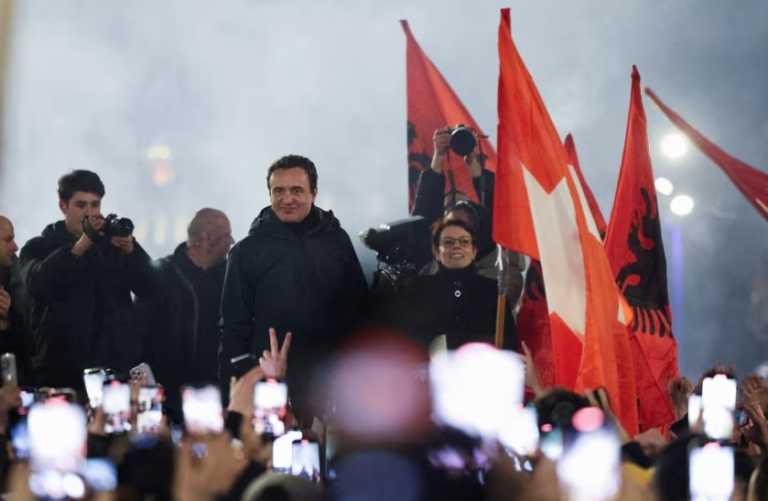
Kosovo held parliamentary elections on Sunday, February 9, where Vetëvendosje emerged as the party with the most votes. However, this party still cannot form the government alone, as it does not have the necessary numbers in the Assembly. Now, Kosovo is expected to face several possible scenarios for forming the government. But what are these scenarios? The following report provides more details.
On Sunday, February 9, the citizens of Kosovo voted for the new Assembly, which will also determine the country’s new government for the next four years.
Based on preliminary results from the Central Election Commission, Vetëvendosje is the winning party, followed by PDK and LDK, while the AAK-Nisma coalition ranked fourth.
However, this victory for Albin Kurti’s party, which seeks another term at the head of the executive, does not grant it enough numbers to form the new government on its own.
VV must necessarily form a coalition with one of the opposition parties, but most of them have already stated that they do not wish to cooperate with VV.
LDK, through its chairman, Lumir Abdixhiku, announced on Sunday evening that it will remain in opposition, giving no indication of interest in joining Kurti in government.
Similarly, AAK leader Ramush Haradinaj stated that he would not cooperate with Kurti under any circumstances and prefers an opposition-led government.
Meanwhile, PDK has not taken a clear stance on this issue, although during the campaign, its position aligned with Haradinaj’s.
Considering this situation, there are only two viable scenarios that could quickly lead to the formation of a new government.
The first scenario involves a coalition between VV, non-Serb minority parties, and one of the opposition parties, if the latter can be convinced to join.
In this case, the election of the president next year could also proceed smoothly, preventing the country from heading into snap elections.
The second option is a coalition between the opposition parties and non-Serb minorities.
However, due to the fragile numbers, electing the country’s president after Vjosa Osmani’s term ends is uncertain, given the strong opposition VV would pose from outside the government.
This scenario could lead the country into snap elections next year.
In these possible coalitions, the inclusion of the Serbian List does not appear to be under consideration, as neither VV nor the opposition parties seem interested in having them in a coalition, especially after the recent developments in the north