

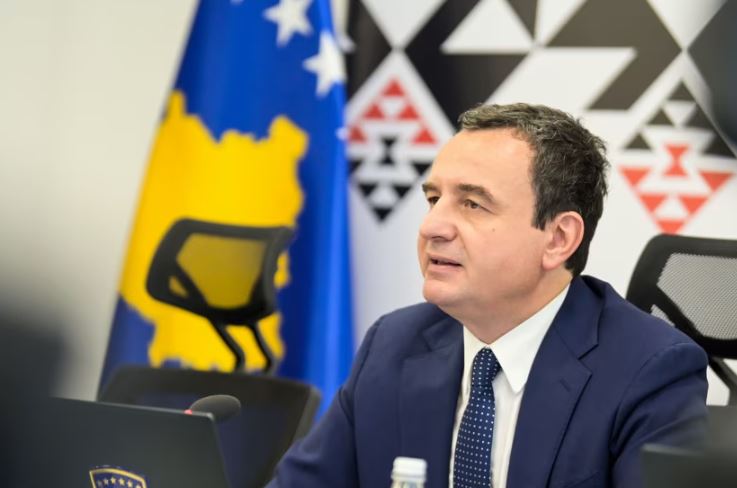
Prime Minister of Kosovo, Albin Kurti, has called on the European Union to address Kosovo’s application for EU membership, stating that Kosovo has “no Plan B” and is fully committed to integration into the European bloc.
“It is time for Kosovo and the EU to intensify joint efforts to overcome the obstacles that hinder Kosovo’s EU membership process,” Kurti said during a discussion in Brussels organized by the Centre for European Policy Studies (CEPS).
“This means: initiating the Questionnaire for Kosovo to assess our institutional and legal capacities for EU membership; and preparing a merit-based opinion on Kosovo’s candidate status,” he added.
Kosovo applied for EU membership on December 15, 2022, and remains the only country in the region that has not yet been granted candidate status.
It may take Kosovo several years to obtain this status, as other regional countries have waited similarly—Albania waited five years, and Bosnia and Herzegovina six. However, some countries like Ukraine and Moldova gained candidate status within just a few months.
Kurti emphasized Kosovo’s achievements in reforms and the implementation of EU standards, highlighting Kosovo’s support for Ukraine with military aid and alignment with the EU’s Common Foreign and Security Policy (CFSP).
Kosovo has condemned Russia’s unprovoked war against Ukraine and supported international sanctions against Russia and its allies.
“Kosovo is a reliable partner of the EU and strongly believes in its European future,” Kurti declared.
He stressed that it is time for the European Union to show that it sees Kosovo as part of its future, thus strengthening Kosovo’s commitment to the European agenda.
Kurti also criticized delays in the enlargement process and stressed that citizens of the region—especially young people—are increasingly concerned about the slowdown, noting that trust in the EU is fading.
Countries that joined the EU in 2004, 2007, and 2013—the last three EU enlargements—took between 8 to 14 years from their application to full membership.
This process takes time, as the candidate country must meet several criteria, align its laws with those of the EU, and wait for ratification of the accession treaty by the parliaments of all EU member states.
The application criteria, known as the “Copenhagen Criteria,” relate to the stability of democracy, rule of law, and the functioning of the market economy.
For Western Balkan countries, additional conditions have been set through the Stabilisation and Association Process.
Croatia—the last country to join the EU in 2013—had applied less than a year and a half after signing the Stabilisation and Association Agreement. However, the entire process until Croatia’s EU accession lasted 12 years.
Kosovo’s journey may be more complex than Croatia’s, as it will be the first time a country applies for membership without being officially recognized by all EU member states. The countries that do not recognize Kosovo’s independence are Spain, Romania, Cyprus, Greece, and Slovakia.




