

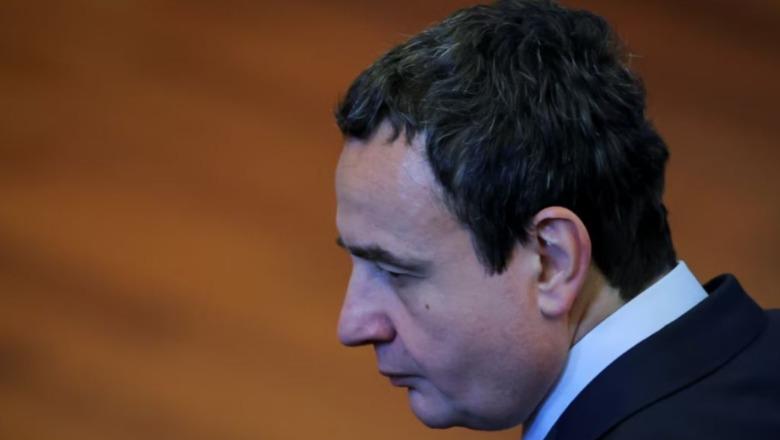
A distancing from Kosovo’s acting Prime Minister Albin Kurti, as well as a warning to his government that international support is fading.
This is how Toby Vogel from the Council for Democratization Policies in Berlin and Gëzim Visoka, professor at the School of Law, Dublin City University (Department of Peace and Conflict Studies), interpret the suspension of the planned U.S.–Kosovo strategic dialogue.
The United States has suspended the planned strategic dialogue with Kosovo indefinitely due to concerns over the actions of the acting government, the U.S. Embassy in Pristina announced Friday.
The embassy justified this decision by citing concern over the actions of the acting government and acting Prime Minister Albin Kurti, which, as stated, “increase tensions and instability.”
“Unfortunately, the recent actions and statements of Acting Prime Minister Kurti have posed challenges to the progress achieved over the years,” the Embassy said, without specifying exactly which statements or actions it referred to.
Kosovo and the U.S. had planned to finalize a strategic dialogue agreement this year, after Kosovo’s President Vjosa Osmani announced in January that an understanding between the two countries had been reached.
The U.S. decision comes at a time when leaders of Vetëvendosje (LVV) are criticizing Constitutional Court decisions on the formation of the Assembly, calling the country’s highest court a “political shadow of the opposition against LVV.”
What Is a Strategic Dialogue?
A strategic dialogue is a process the U.S. State Department usually develops with various countries around the world with the aim of advancing bilateral relations. It involves high-level discussions between two countries, held either in Washington or in the partner country, covering a wide range of topics such as defense, security, environment, energy, economic cooperation, and more.
According to the State Department, the U.S. has held strategic dialogues in recent years with France, the United Kingdom, Romania, Austria, Poland, Slovenia, Moldova, Greece, North Macedonia, Qatar, Oman, Bahrain, Egypt, and others. In the region, only North Macedonia has entered into such a dialogue, with the first meeting held on June 2, 2022, in Washington D.C. Meanwhile, U.S. Secretary of State Marco Rubio announced on August 6 that the United States and Serbia would launch a joint strategic dialogue by the end of this year.
The U.S. also engages in strategic dialogue not only with states but with organizations or movements from countries it does not consider allies, such as the Belarusian Democratic Movement led by Sviatlana Tsikhanouskaya.
Kosovo Government Rejects U.S. Criticism
Kosovo’s acting government has rejected U.S. criticism, stressing that its actions have been in line with Kosovo’s laws and Constitution, aimed at “eliminating sources of instability in order to ensure long-term sustainable stability.”
President Vjosa Osmani has expressed deep regret over the U.S. decision to temporarily suspend the strategic dialogue.
Expert Reactions
Toby Vogel (Council for Democratization Policies, Berlin) told RFE/RL that by suspending the dialogue, the U.S. is signaling it wants to “create distance from Kurti.” He noted that the decision came at a sensitive time, while Kurti is trying to form a new government, and argued that this was no coincidence. According to Vogel, Washington and Brussels do not favor Kurti because he does not act under external pressure as previous Kosovo leaders did, making cooperation more difficult.
He added that the worsening of Kosovo’s relations with the U.S. and the EU is Kurti’s responsibility, since “he has not carefully cultivated these relationships.” Still, he also pointed to dissatisfaction in decision-making centers that “can no longer order the prime minister or president in Pristina what to do.” Vogel questioned whether this move would actually unify the opposition to form an alternative government, expressing doubt that they “have the numbers” and suggesting that early elections might be the “cleanest solution.”
Gëzim Visoka (Professor of Peace and Conflict Studies, Dublin) said the suspension of the strategic dialogue is “a warning sign that international support for Kosovo is waning.” However, he stressed that this does not mean the end of bilateral relations. He underlined that Kosovo has never had a fully formalized strategic dialogue with the U.S., even during times of very good relations, as Washington has avoided formalizing such a partnership in order not to antagonize Serbia.
Previous Criticisms of Kurti’s Government
Over the past four years, Kurti’s government has often faced criticism from the international community, particularly over actions in northern Kosovo, where the Serb majority lives, as it has sought to establish full institutional control.
One recent action took place on September 12, when Kosovo authorities suspended the operations of the Health Insurance Fund and the Pension and Disability Insurance Fund, which had been operating under Serbia’s system in North Mitrovica. Earlier this year, when a number of Serbian institutions south of the Ibar River were closed, the U.S. warned that Kosovo’s actions “directly and negatively affect citizens of Kosovo – ethnic Serbs and other communities – and could undermine Kosovo’s aspirations to join the Euro-Atlantic community.”
The U.S. decision to suspend the strategic dialogue also comes amid Kosovo’s ongoing political and institutional crisis. The Constitutional Court is currently expected to rule on whether the Assembly has been properly constituted, following a complaint by the Serb List party.
Meanwhile, Vetëvendosje has nominated Albin Kurti to form the new government. Kurti has strongly criticized the Constitutional Court, accusing it of bias in favor of opposition parties from the previous legislature. Western countries and the European Union have also criticized his stance.