

It is essential that any activity in Kosovo’s airspace be properly coordinated with NATO’s peacekeeping mission in Kosovo, KFOR, to prevent tensions and ensure security, a NATO official told Radio Free Europe/Radio Liberty.
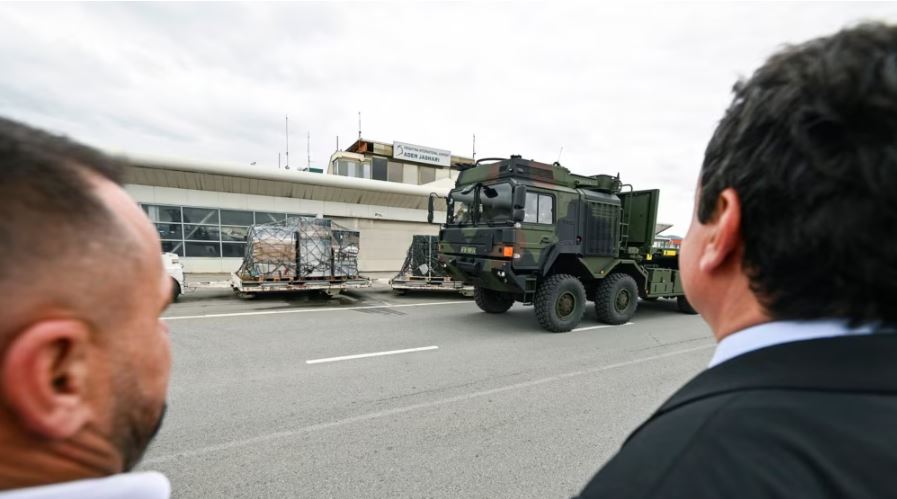
Kosovar authorities announced on October 8 that they had received “thousands” of combat drones from Turkey, prompting strong reactions from neighboring Serbia.
The NATO official praised Turkey as a committed contributor to the NATO-led mission in Kosovo, KFOR, and to regional stability.
However, he declined to answer RFE/RL’s question about the circumstances under which Kosovo might be permitted to use those drones, noting that only the NATO-led mission has authority over the territory’s airspace.
“KFOR regularly monitors Kosovo’s airspace, using all the tools and resources at its disposal, in accordance with its authority and existing mandate under UN Security Council Resolution 1244 of 1999,” the NATO official said.
He stressed that KFOR remains “closely engaged on this important issue and is in close contact with Kosovo security organizations and the Serbian armed forces for this purpose.”
KFOR is also the third security responder in Kosovo, after the Kosovo Police and the European Union Rule of Law Mission, EULEX.
Among other responsibilities, the NATO mission is charged with security along the border line between Kosovo and Serbia.
NATO increased its presence in Kosovo during 2023, following a rise in tensions in the Serb-majority north, and now counts 4,649 peacekeepers from 33 countries.
“Kosovo should have the capacity to defend itself”
Mentor Vrajolli, director of the Kosovo Center for Security Studies (QKSS), told RFE/RL that although Kosovo does not have authority over its own airspace, it still needs to develop defensive capabilities.
“This is a sort of arms race developing in the region, where I think it is to be expected that Kosovo will respond in kind, because its territorial security is openly threatened by a neighboring state,” Vrajolli said, referring to Kosovar officials’ allegations of drone incursions by Serbia.
Kosovar officials said at the end of September that Kosovo’s airspace had been violated by suspected Serbian drones. They did not provide details about those alleged incursions or when they exactly took place.
KFOR, however, told RFE/RL on September 26 that it had not observed any drone entries from outside into Kosovo’s airspace that could affect the security of the whole country.
Vrajolli told RFE/RL that Kosovo’s acquisition should not be seen “outside the regional and global context,” pointing to suspected Russian drone violations in Eastern Europe in recent weeks.
“These are defensive drones — so if someone comes and attacks Kosovo, these drones are used for such actions, and they are not intended to enter another country’s territory to carry out operations,” he added.
He believes Kosovo’s objective is defense, not targeting another state.
“KFOR is not a very large force and the mission does not necessarily have the most advanced technology, because NATO does not yet view Kosovo as a country under direct threat… Therefore Kosovo’s institutions must increase their capacity to counter these drones,” he said.
He added: “Kosovo very much needs to develop technology that detects and disables these drones, because Kosovo could also face terrorist drone attacks, and honestly we do not know to what extent we currently have capacities to confront such threats.”
Serbia’s reaction
Serbia, which does not recognise Kosovo’s independence, has accused Turkey — one of NATO’s most powerful members — of “dreaming of the revival of the Ottoman Empire.”
Serbian President Aleksandar Vučić said he is alarmed by Turkey’s actions and claimed that Turkey had violated the UN Charter and UN Security Council Resolution 1244.
“It is now completely clear that Turkey does not want stability in the Western Balkans and is once again dreaming about the revival of the Ottoman Empire. Serbia is a small country, but we understand their real intentions,” the Serbian president wrote in a post on X.
Later, Serbia’s Ministry of Defence said that after the delivery of Turkish drones to Kosovo, the Chief of the General Staff of the Serbian Army, General Millan Mojsilloviq, held an urgent phone conversation with KFOR Commander Major General Özkan Ulutaş.
In a media statement, it was said that during the conversation General Mojsilloviq strongly protested the “continuing arming of Kosovo.”
What is the Skydagger RTF drone?
Kosovo accepted drones of the Skydagger RTF 7 and Skydagger RTF 15 types, according to Kosovar officials. They said they received “thousands” of them but did not give an exact number.
Vranjolli said the Skydagger RTF drones are not attack drones but defensive, and that Kosovo obtained them for protection; he described the defense sector as “hypothetical.”
“I hope we will not need to use these drones, because they are destructive, but if Kosovo faces an external attack, then Kosovo must have the capacity to defend itself,” he said.
The Skydagger RTF is a “ready-to-fly” drone equipped with an explosive payload for use against stationary and moving targets, although it also has professional applications such as surveillance and search-and-rescue.
RTF signifies that the drone is fully assembled and includes all necessary components — the drone itself, a radio transmitter, a receiver and batteries — making it ready to fly immediately upon purchase.
The Skydagger RTF 7 can reach a maximum speed of 130 kilometres per hour and an operational range of up to 10 kilometres, similar to the RTF 15.
With a maximum payload of 2 kilograms, the RTF 7 can fly for up to 12 minutes fully loaded and 20 minutes without payload. The Skydagger RTF 15 can fly up to 14 minutes with a maximum payload of 5 kilograms, and 36 minutes without payload.
What other equipment does Kosovo possess?
In August this year, the Kosovo Security Force (FSK) — which is in the process of transforming into an army — was also equipped with armoured vehicles purchased from the United States.
Last year, it requested the purchase of 200 Javelin anti-tank missiles and is currently in the payment process.
Kosovo also bought a fleet of Turkish Bayraktar drones in 2023.
In 2018, military Humvee vehicles from the United States arrived in Kosovo. At the time, the Kosovo government signed a contract with the American company AM General to purchase 51 such vehicles.
Two years later, Kosovo bought additional military vehicles from the U.S., and in 2021 the U.S. government donated 55 ASV (Armoured Security Vehicles) to Kosovo.
In recent years, Kosovo’s government has increased the defense budget — this year it reached €207.8 million.
The FSK trains regularly at U.S. and European bases and also participates in multinational exercises like Defender Europe.
At the end of last year, Kosovo also signed an agreement with Turkey to build its first ammunition factory.





