

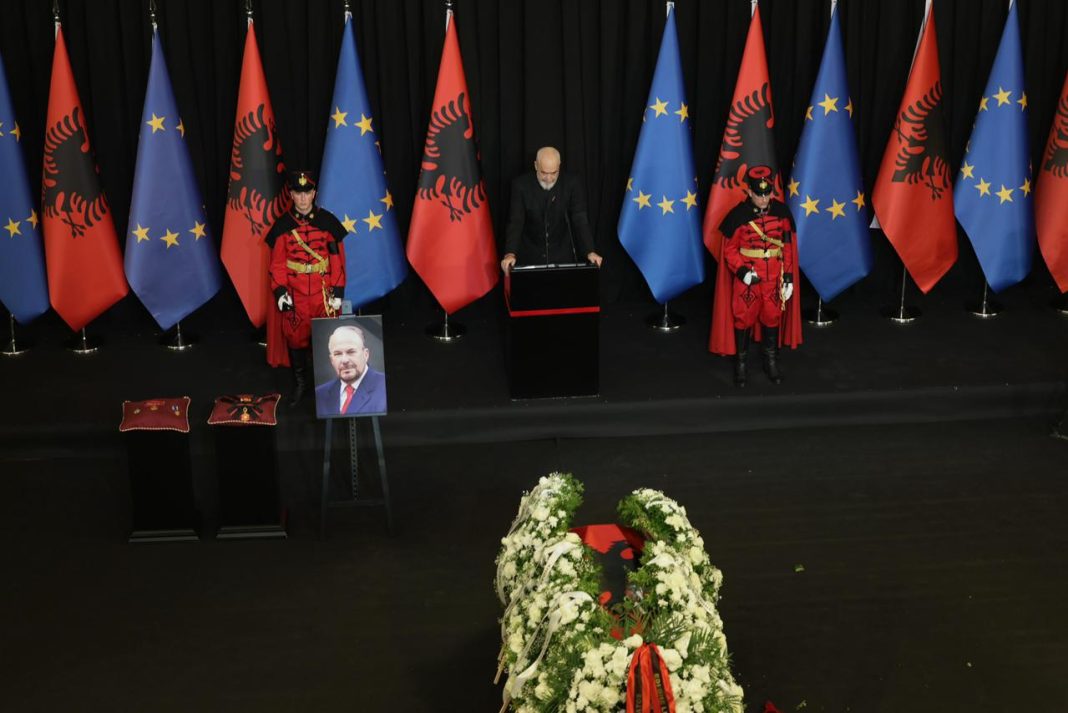
The speech of Prime Minister Edi Rama at the state farewell ceremony for the former Prime Minister of Albania and founding chairman of the Socialist Party of Albania, Fatos Nano:
They say a phrase: “Die so I won’t love you anymore.”
How I wish, dear Fatos, that tonight we could sit down at one of those rare dinners of ours from recent years, full of the taste of the air cleared between us, and go late into the night through our magazine of events and personalities — everything that has been said and written about you since the news came that this time you were gone forever.
But how much they must have loved you and admired you, man of the land!
And also those who didn’t leave a stick unplaced in your wheels and hurled stones on your back!
They could hardly wait to show their love and admiration as soon as they learned you would no longer open your eyes.
There were even those who put you in prison, accusing you of theft, and who came to try to kill you in your office, cursing you as a murderer, and who, for years on end, loaded your face — with all the vilest words of the Albanian language — then savored them as if they had stitched the words of their admiration so beautifully!
It pains me that we are not tonight at a dinner that would have no bill to pay!
But meanwhile, instead of laughing with you a little tonight, I must list the words of a farewell that, to tell you the truth, I could not have imagined at all, not even after our friend Solis wrote to me with great sorrow that you had entered an irreversible coma.
At that moment I thought only of your steadfast wife, Xhoi, who would continue to keep watch perhaps for many more years, as a loyal guardian of your endless sleep; but I swear, I didn’t at all think of you — in no way did I imagine you lying in a coffin to truly leave this life which you loved and lived, taking as many of the small hours of the night as you could, and drinking the glasses of fate to the dregs as they came, and smoking through the chapters with that same thirst — whether when you rose to the top, or when you reached the bottom, or when you withdrew to the side.
But this day of mourning came suddenly for me, and I was assigned the difficult task of the first farewell that the chairman of the largest political family of Albanians gives not merely to a predecessor, but to the first chairman, the founder of our family.
And as I turned my eyes around the white page on the screen, trying to extract from my hands the words of this farewell, I remembered your story with the death of Mao Zedong and I felt exactly like that director at the Metallurgical Plant who had to tell something to the Chinese gathered in the great square of the Kombinat, after the news of Chairman Mao’s passing. Confused by the sudden situation, the director sought guidance from the Central Committee as to what to do with the crowd of Chinese gathered in the square so as to be worthy of the occasion. They told him they would ask very high up and give him an answer, but when the answer was delayed and the Chinese would not stay in place, the poor director again picked up the phone seeking orientation from above. “Tell us what to do,” he said, “because the matter cannot wait.” The reply he received was disarming: “There is no orientation from above at all, so do as you have done other times!”
And of course this time it is very different from other times, also because the man who leaves today without return from Tirana — where he was born, raised, adored and anathematized and where he made history — is a very special case to be farewelled with ad hoc words, without becoming ridiculous, as it seems to me, at least compared to those who, while speaking of Fatos Nano’s passing, have made themselves the subject of these days.
With Fatos, we shared, broke, and re-shared bread, but the story of our relationship — developed through extremes from my “adoption” into the socialist family with his blessing to the “killing of the father” for taking his scepter — has no place here in this eulogy. Or rather, there is room only for one fact: if I am today the spokesman for the sorrow of the entire large socialist family, that is undoubtedly linked to the founder chairman’s intuition and courage to invite me and give me a place in the chamber of our political home, breaking at that time a great dividing wall with the society of the day, when the socialists’ house had not yet been fully aired out by the breeze of the past.
I have asked myself at different times whether Fatos Nano loved or not the burden of the Socialist Party chairmanship, and whether he truly took it on, or whether it fell upon his shoulders with all the roughness of the fact accomplished during those days and nights when the shattered communist army carried out the funeral of the Party of Labor in the midst of the desert, with the tattered flag of the dictatorship of the proletariat at half mast and with morale crushed beneath the worn shoes of the 45-year march, towards a red horizon that kept receding until it vanished into the consumed maw of communism — which, just in the great hall of this Palace of Congresses, issued its last cries for war with the whole planet, while the unstoppable wind of change that blew and struck the “congressmen” turned their wild wailing of despair into a whistle as ear-piercing as it was ridiculous, when from the podium the surrender to reality was declared.
Found there among the pale faces of the leaders, the muffled groan from the arrival of scarcity and the secretaries’ skins scoured by the sun — fields, factories, construction sites, the “blind one,” as comrades called him and as we called him among ourselves — he always seemed at once protagonist and hostage.
The two-faced expression of the cadre of the new party working at the Institute of Marxism–Leninism and of the funny professor at the Economics department, who told mocking jokes about the regime while drinking raki and playing Beatles and Rolling Stones on his guitar.
I never doubted that precisely his non-schematic profile bestowed upon Fatos Nano, with the grace of the unexpected, the scepter of the newly born left after the “burial of the Party of Labor,” but I believe that the very intense ups and downs of his political journey, beyond the decisive force of events — even very harsh ones — were a reflection, precisely a deep duality between the major protagonist and the hostage of a duty from which he tried to “escape” whenever the opportunity arose. However, it was precisely that duality — born of his non-dogmatic and far from systematic nature combined with the absurd imprisonment, which exposed all the primitive dogmatism of the hostage-takers — not only of Fatos but of the democratic movement itself that became the fate of the Socialist Party — that consecrated Fatos Nano as the unrivaled leader of the socialists, giving the Socialist Party a new breath and a real perspective to return as the dominant force of Albanian politics.
Without his imposed sacrifice, the socialists would have had a less generous fate, and perhaps Fatos himself without that imposed sacrifice would not have become a leader so long-lived in a time of upheaval and confusion, outside and inside the party where his leadership was much more spirit than presence, much more space than time, much more improvisation than programming — and where the nature of his leadership together with his spectacular returns after his escapes constitutes historical and socio-political material of extraordinary value for anyone who one day will undertake to truly dissect — and not hypocritically clinch — Fatos Nano’s decisive role, not only for what was under his direction but for what the Socialist Party later became.
In the party headquarters that he led stands a now well-known photo of him, which to me remains the most meaningful image of Fatos Nano immediately after leaving prison. I am always struck by the radical difference between that Fatos and the Fatos who was handcuffed before the judges who jailed him.
The Fatos on trial is the economics professor who is held tightly before the eyes of the people before imprisonment — a double hostage of that day — when they threw upon him the heavy burden that perhaps he never wanted in his heart, and of his crude persecutor who certainly loved him locked away.
Whereas the other Fatos, the one from the party headquarters just out of prison with his left hand pointing forward and eyes gleaming full of sparkle, is a rare political creature who, above all and regardless of everything, has the primary merit that the Socialist Party never once moved away from the gravity of the national interest — which today and always is a taboo for the PS and makes the PS proud of itself: a spokesperson, a defender and an unwavering promoter of the great interests of the country and of the Albanian nation.
Among those who honoured our chairman with grand words after his death were also those who had previously labeled him a “traitor” because he met Slobodan Milošević during an international event in Thessaloniki and for many other matters not worth repeating.
I have heard from him the conversation with the “Butcher of Belgrade” and I have no idea whether Fatos left it written somewhere, but not only was there nothing of a traitor in that meeting and that conversation, but when one day the words spoken in that meeting, as well as in Fatos Nano’s meetings, talks and collaborations with patriots of the national movement for the freedom and rights of Albanians in Kosovo and in Macedonia, come properly to light, then no one, absolutely no one, will be able to doubt that the patriotic contribution of the founding chairman of our party to the liberation of Kosovo and to the signing of the Ohrid Agreement ranks Fatos Nano among the honoured lines of Albania’s history.
After the burial of the Party of Labor, Fatos Nano was key in leading the socialists across the desert and in uniting them with the democratic world.
I recalled yesterday his joy after the meeting — in that adjoining grand hall — where he announced the Socialist Party’s acceptance into the Socialist International as a family of progressive ideas of the new time. “Like a graduation day this is today,” he told me laughing.
At the head of the government of the country, he had to lead the people out of the desert of the pyramids and restart state-building from zero after the devastating upheaval of 1997, facing a primitive, vengeful, destructive opposition — up to armed attacks against institutions and against him personally, physically.
Anyway, this is not the day to write the history of Fatos Nano, but the day to bid him farewell.
Dear Fatos,
I will miss those rare friendly dinners, our communication like that between the first shift’s driver and the second shift’s driver of the same car — where we understood each other in the air — and where, when we happened to share some strategic dilemma, your advice came well-honed, helping me greatly to put the dot over the “i”.
And when I think of what four-wheeled Soviet contraption you took over at the first shift, and with what much better vehicle I took from you at the second, to turn the Socialist Party into the speed brand for the European Albania it is today, it comes quite naturally for me not to say farewell, but simply: may you never die, Fatos Nano.




