

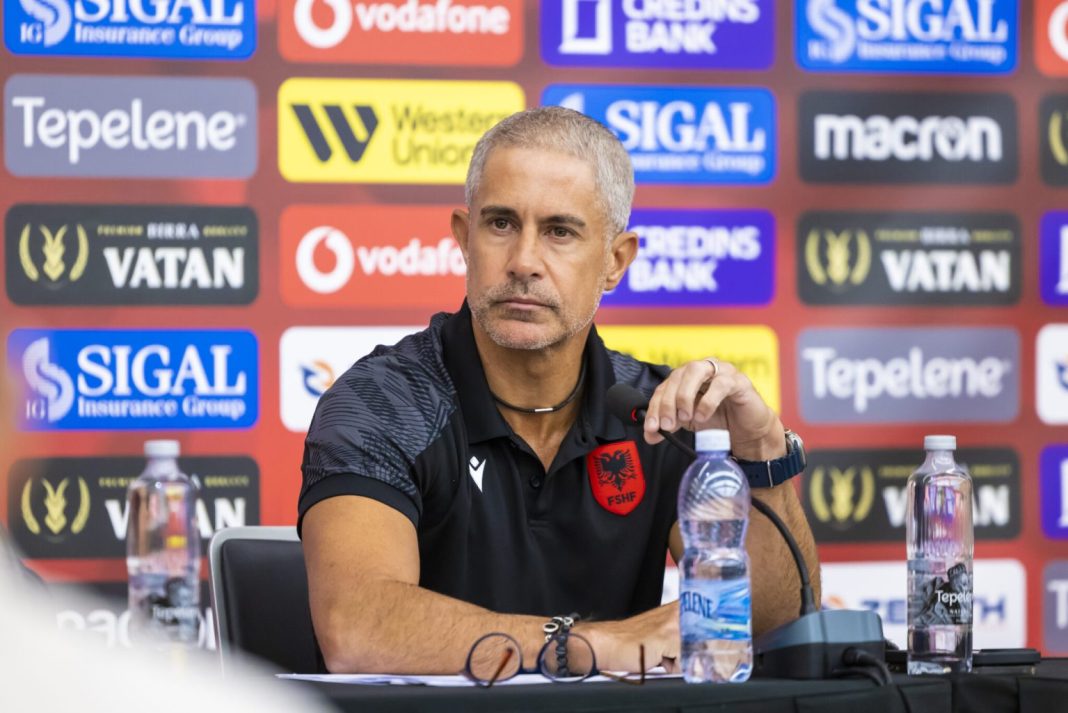
The 14th episode of “In the House of Football” was broadcast live today on the FSHF TV channel. Hosted by Lenida Halilaj, the studio guests were journalist Kristi Sejatllari and football specialist Ardi Behari.
During the episode, there was extensive discussion about the recent performances of the red-and-black players, the progress of the “Abissnet Superiore” championship, with special focus on the matches of the 20th round, where the race for the top of the table and survival has become increasingly competitive. The discussion also covered the Albanian Football Federation’s ongoing investments in sports infrastructure and the development of football in the country.
This episode also featured an exclusive interview with the coach of the Albanian national team, Sylvinho. The national team coach returned to the FSHF facilities more than a week ago after the winter break and has begun close preparations for the matches in March. Albania aims to make history by attempting, for the first time, to qualify for the 2026 World Cup.
Below is coach Sylvinho’s interview for FSHF TV:
How would you analyze or define your year 2025 with the Albanian national team?
– First of all, congratulations to everyone, happy new year! It’s a pleasure to speak with you. If I look back, I’m satisfied with what we’ve done. We’re talking about eight matches in the World Cup qualifiers: we won six, drew two, and had two defeats. Two of those were friendlies, which we won. We have always believed in this team. I must say something else that’s very important: our players, every time they step onto the pitch, give everything—100 percent, with soul and heart. They represent our people very well, and I’m proud of them for that too.
Which moments would you consider difficult, and which very positive, during the qualifiers?
– It’s a long journey, as you all know. With a national team, this happens—eight matches over nine to ten months. A long journey that generates stress. I think a very difficult moment for us was the draw in Latvia. We drew a tough match, but when you’re talking about an objective, a dream, that match needed to be won. That was a difficult moment to recalibrate. It was June, a time to rethink things, do some calculations, and that’s when the idea arises that you have to recover those points in a future match—and next was Serbia, practically. It was very difficult to reset after that moment.
We all know that finishing first in the World Cup qualifying group was extremely difficult, but regarding second place, which moment do you see as decisive for reaching the play-off stage?
– After that very difficult moment in Latvia, in September we beat Latvia, in October we beat Serbia away, and in November Andorra, also away. That was the moment when I saw a more mature team, after three years in which I experienced the European qualifiers and an important, beautiful European Championship. I can say that now we are used to playing important, decisive matches, whether against Italy or against a more modest team. These players have begun to understand and play decisive matches against strong national teams. They did very well in all three consecutive matches. It wasn’t easy, but we won, and that took us to the play-offs. In my opinion, those three months were very special.
In the play-off draw, Albania will face Poland away. How do you assess this draw?
– I was there. I always tell the President that we can’t both go to the draw—either one or the other should go, and of course the President should go. I say this jokingly, of course, because it’s always a difficult draw.
There aren’t many options to choose from there. We’re talking about two matches, where everyone arrives at 100 percent. From time to time, I hear people here say that there might be a weak or easy team to beat. As a coach who has lived football for a decade, I disagree. Football has changed; everything is analyzed, and in 90 minutes anything can happen. Poland is a strong team, we know them well. They have their own process, we have another. Now it will be played, and anything can happen.
We know Poland from the Euro 2024 qualifiers. Comparing Poland and Albania in 2023 and in 2025/2026, how do you see both teams at this moment?
– In football, everything can change in three months, and now we’re talking about two to three years ago. They have a very good team, big players. Few people know or remember that the same Poland, four years ago, went to the play-offs for the 2022 World Cup. They didn’t play the first match because it was against Russia, but in the second match they beat Sweden 2–0 in the final. It’s a team with important players, accustomed to and very familiar with the play-off stage, and they’ve taken part in the World Cup.
On our side, we have a team that has improved a lot. As I said, it’s a team that is now used to playing difficult, decisive matches. All matches are difficult, but these are decisive ones. Ninety minutes in which you know you must make as few mistakes as possible, and that everything matters, because even the smallest mistake can cause great damage.
I believe strongly in our team, in the players, and in our work. There are still two to three months to go; I hope we arrive there at our maximum strength.
As part of preparations for the March match, how have you planned the work with the technical staff? Have you planned meetings with national team players?
– We have a bit of everything. We’ve been back in Tirana for a week now, and the work has begun. I’ve learned a lot from working with the national team, and you can’t make mistakes in reorganizing the work. At this moment, we are here to review many things we did well and not so well over the past year. Now we are communicating with our players. Of course, the time will come to watch matches, study the opponent, but also to visit our players. All of this is in the plan. We need to carry it out over the next six to seven weeks, work well, and of course we will visit three, four, or five players during this period.
Between the objective and the dream, where do you think Albania stands today regarding World Cup participation?
– This is an office. I have another office, but work is done here. I’m used to telling the staff that this is a workspace, especially in a national team where a lot of work is done behind the scenes. There’s a small discussion here with someone from the staff, of course in a positive sense, regarding the dream and the objective. I think we have achieved a dream, and now we must move toward the objective.
Can we do it?
– Absolutely!




