

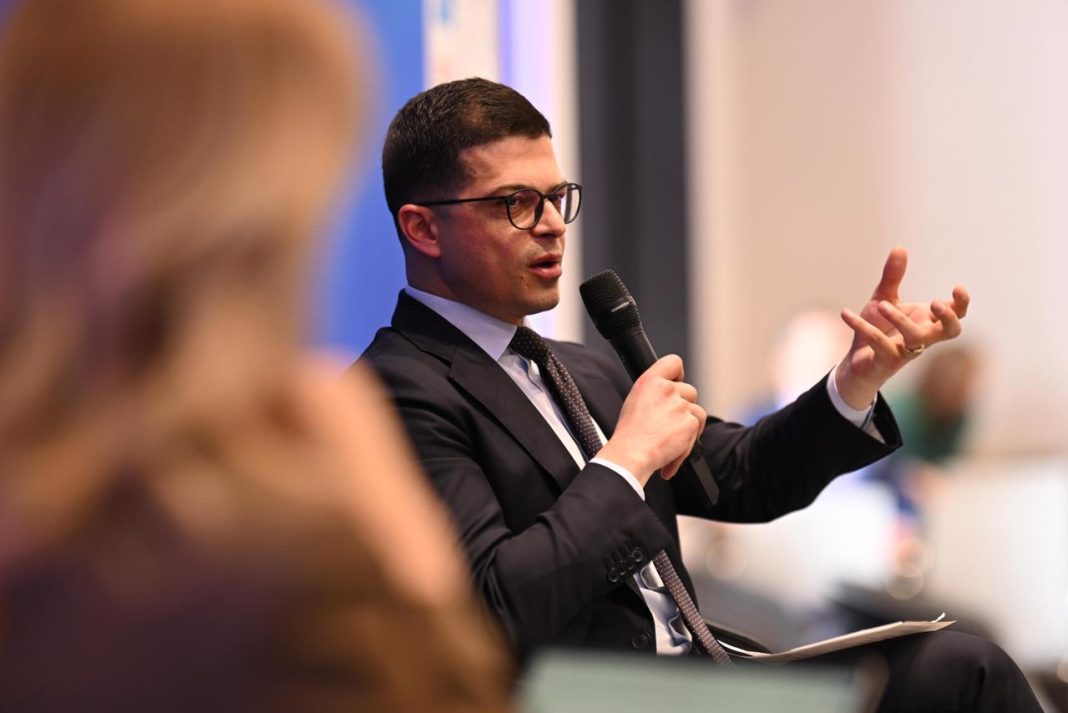
Minister of Defense Pirro Vengu, in an interview with Bjorn Stritzel at the Munich Security Conference, published by Euractiv, stated that the Western Balkans constitute a central part of Europe’s security architecture.
According to him, the region continues to face hybrid and cyber threats, disinformation, and external influence aimed at eroding institutions and fragmenting societies. In this context, he emphasized that Albania’s response is full alignment with the EU’s foreign and security policy, as well as the implementation of recommended reforms. Tirana contributes troops to both NATO missions and EU-led operations.
Asked whether Albania would seek access to the €150 billion SAFE instrument loans if EU accession negotiations accelerate, Vengu stressed that Albania is already a NATO ally, fully interoperable and operationally engaged. EU membership, he said, would further consolidate the country’s defense profile.
The Security Action for Europe (SAFE) instrument is a €150 billion EU initiative offering low-interest loans to member states for investment in defense industrial production and joint procurement.
“More than a year ago, we signed a new Security and Defense Partnership with the EU. We work closely with the European Defence Agency. We benefit from the European Peace Facility. However, we remain outside SAFE financing,” he said.
The minister underlined that more modest allies require long-term financing mechanisms to materialize joint projects and integrate Albania’s defense industry into the European supply chain. He added that EU enlargement toward Southeast Europe is linked both to the EU’s geopolitical coherence and to candidate countries meeting required standards. Albania aims to join the EU by 2030.
Regarding lessons learned from the war in Ukraine, Vengu stressed that “speed and scale have regained importance” in innovation, production capacity, logistics, and reserves.
“It is now clear that deterrence without strong supply chains is an illusion. Resilience is first and foremost a national responsibility before it becomes an allied one. A country’s readiness cannot be delegated,” he said.
According to him, Albania is reviving segments of its defense industry, strengthening logistical corridors, and upgrading ports and connectivity infrastructure. He noted that the domestic defense industry is benefiting from economic growth, as the country’s GDP has doubled since 2016.
So far, this initiative has resulted in four joint ventures and six agreements focused on anti-drone systems, tactical vehicles, ammunition, protective equipment, and specialized components.
In line with commitments made at the latest NATO summit, the Albanian Armed Forces are focusing on increasing capabilities across all combat forces, modernizing land, air, and naval systems, and investing in ground-to-air defense systems.
“All our modernization agreements have been implemented with companies from allied and partner countries, including the United States and European firms,” he said, mentioning companies such as Lockheed Martin, Elbit Systems, Thales Group, Heckler & Koch, Saab, as well as ongoing negotiations with Leonardo and Fincantieri.
“Overall, our goal is to be a reliable and predictable member state that contributes to regional stability and European prosperity. If Europe wants to demonstrate strategic depth, it must admit those countries that consistently contribute to guaranteeing it,” Vengu concluded.




