

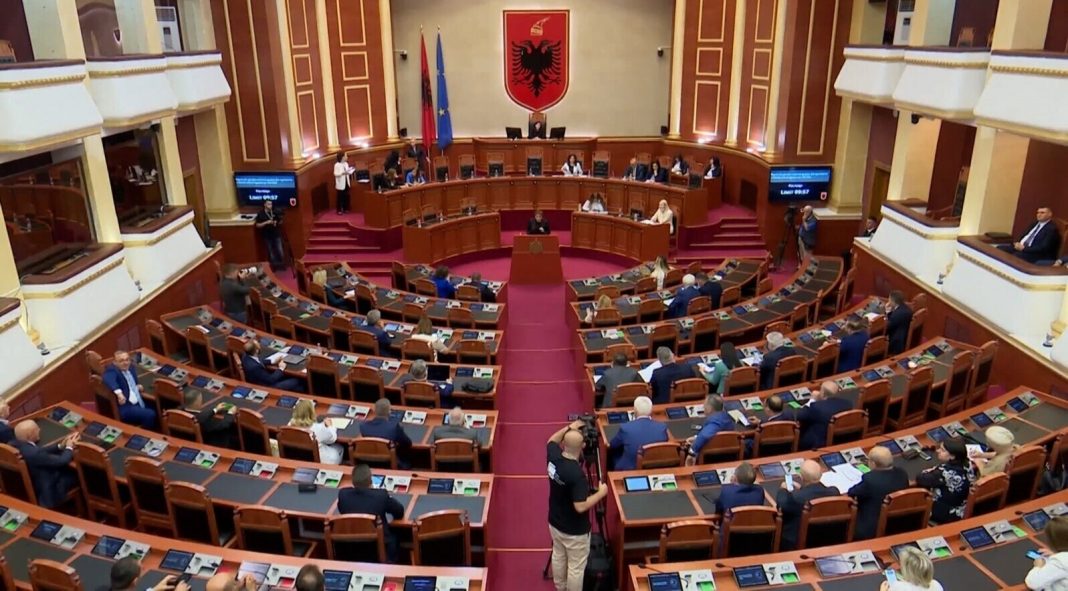
In Tirana, opposition deputies debated with the Socialist Deputy Speaker of Parliament Ermonela Felaj during Monday’s plenary session, about the fact that four of her family members, precisely her husband, brother, sister-in-law, and sister, were working in the prosecutor’s office.
They expressed doubts about political influence in the justice system and undermining its reform. However, the Socialist deputy argued that the careers of her relatives were based on their professional merits.
While representatives of the justice institutions reported on the one-year work of the High Judicial Council, the High Prosecutorial Council, the Special Prosecution Office, and the General Prosecutor’s Office, opposition deputies accused the Socialist Deputy Speaker of Parliament Ermonela Felaj of nepotism in the Tirana prosecutor’s office, where several of her close relatives currently work.
For the past 4 years, Felaj’s husband, Bledar Valikaj has been working as a prosecutor in the Tirana prosecutor’s office, her brother Armando Felaj works as a forensic police officer at the same prosecutor’s office, while his wife, the sister-in-law of the Socialist deputy was transferred from the Durrës prosecutor’s office to the one in Tirana.
A week ago, the High Prosecutorial Council appointed the sister of the Deputy Speaker of Parliament, Eranda Felaj, currently a prosecutor in Vlorë, as the first in the list of vacancies in the capital’s prosecutor’s office.
But in response to the accusations from opposition deputies, Felaj stated that there were no legal violations in these appointments and that they had achieved everything in their careers based on merit and education.
“My family members and I have not been given those titles by politics but by education. Education makes magistrates. We are not from Sali Berisha’s list when he was president, appointing judges and prosecutors based on lists,” said Felaj.
Opposition deputies expressed concern that such nepotistic appointments in the justice system of individuals with family ties to high-ranking politicians, like Felaj, bring political influences and undermine judicial reform.
Deputy Gazment Bardhi emphasized that the High Prosecutorial Council approves appointments based on the surnames of socialist families close to power. According to him, the justice system has not yet changed, and pretends to be functioning, guaranteeing the immunity of a group of individuals due to their status, position, or wealth.
“After seven years since the adoption of judicial reform, we can say that we have not yet succeeded. We continue to have a justice system of friends and comrades, a justice system that accepts political interference, a justice system that still lacks the courage to stand up to anyone,” said Bardhi.
The 2016 law on the status of judges and prosecutors in Article 8 deemed close family relationships among magistrates such as marriage, cohabitation, or their close relatives up to the second degree incompatible, so they could not work in the same court or prosecutor’s office.
However, precisely this article of the law, which is part of the judicial reform, was appealed to the Constitutional Court by the National Association of Judges.
In March 2017, the Constitutional Court overturned Article 8 as incompatible with the Constitution, considering it a limitation of rights and creating the possibility for judges and prosecutors with family ties to work in the same institution.
The law underwent other amendments by Parliament in 2019, so according to representatives of the High Prosecutorial Council, these appointments are in accordance with legislation.
The justice system has been undergoing a profound reform for several years, with new management structures and the selection of judges and prosecutors based on criteria of professional integrity and asset transparency.
The vetting process has removed more than half of the judges and prosecutors reviewed from the justice system, with nearly three-quarters of the total number being analyzed so far.




