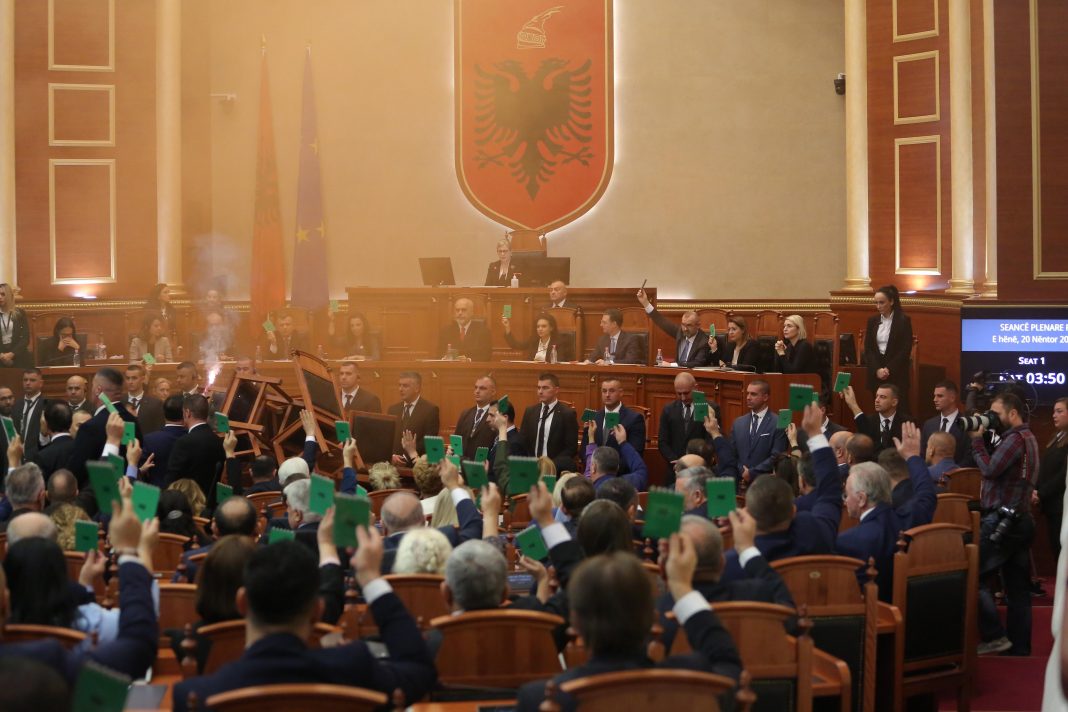
On Monday, the Albanian Parliament gave its initial approval with 73 votes to the 2024 budget. The budget outlines ambitious goals for sustainable economic growth, equitable welfare distribution, support for high-quality employment, and safeguarding social categories, all while emphasizing further fiscal consolidation.
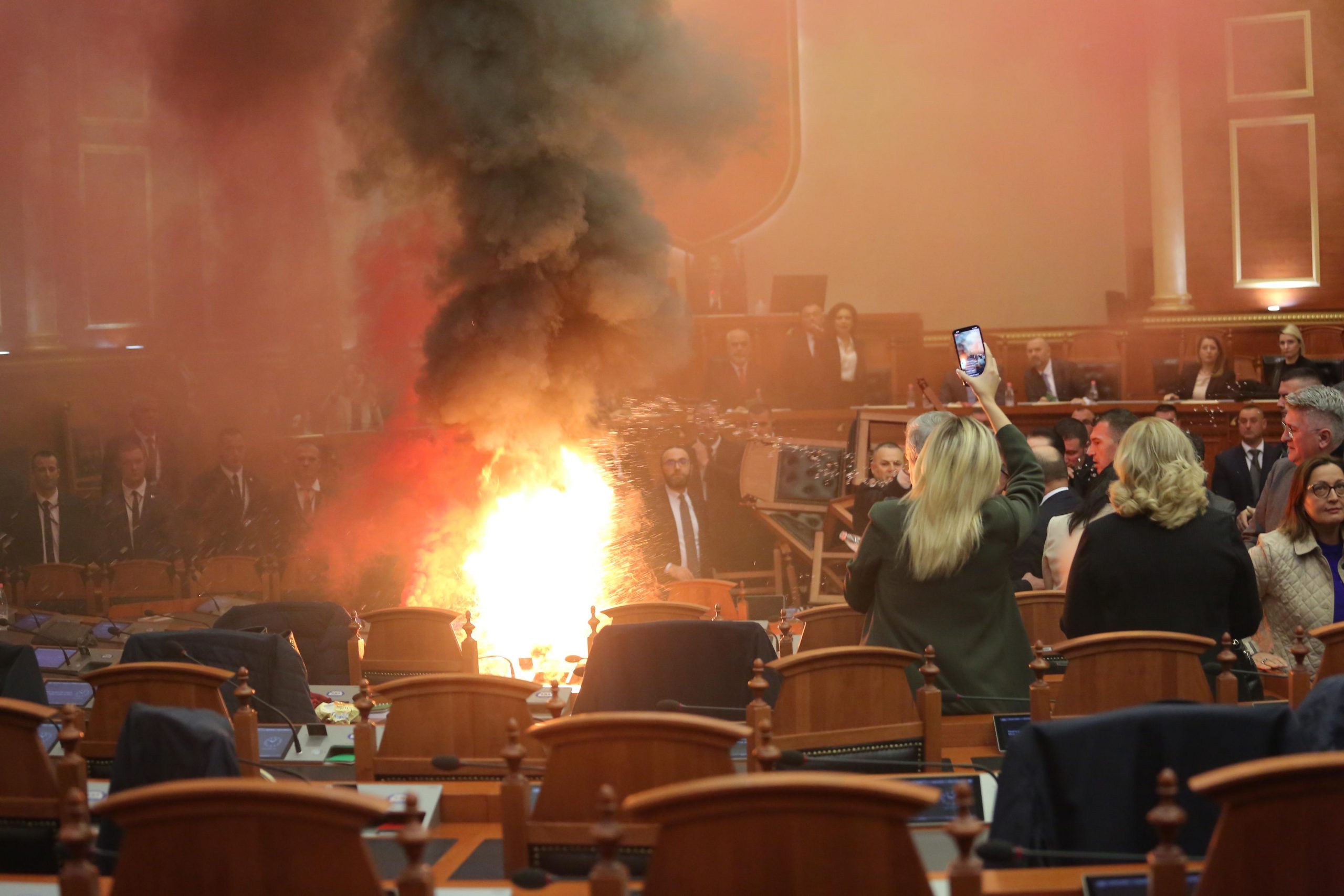
Notably, the most significant financial draft law in the country passed without debate this time, owing to disruptions caused by opposition deputies, who have been obstructing parliamentary sessions for several weeks.
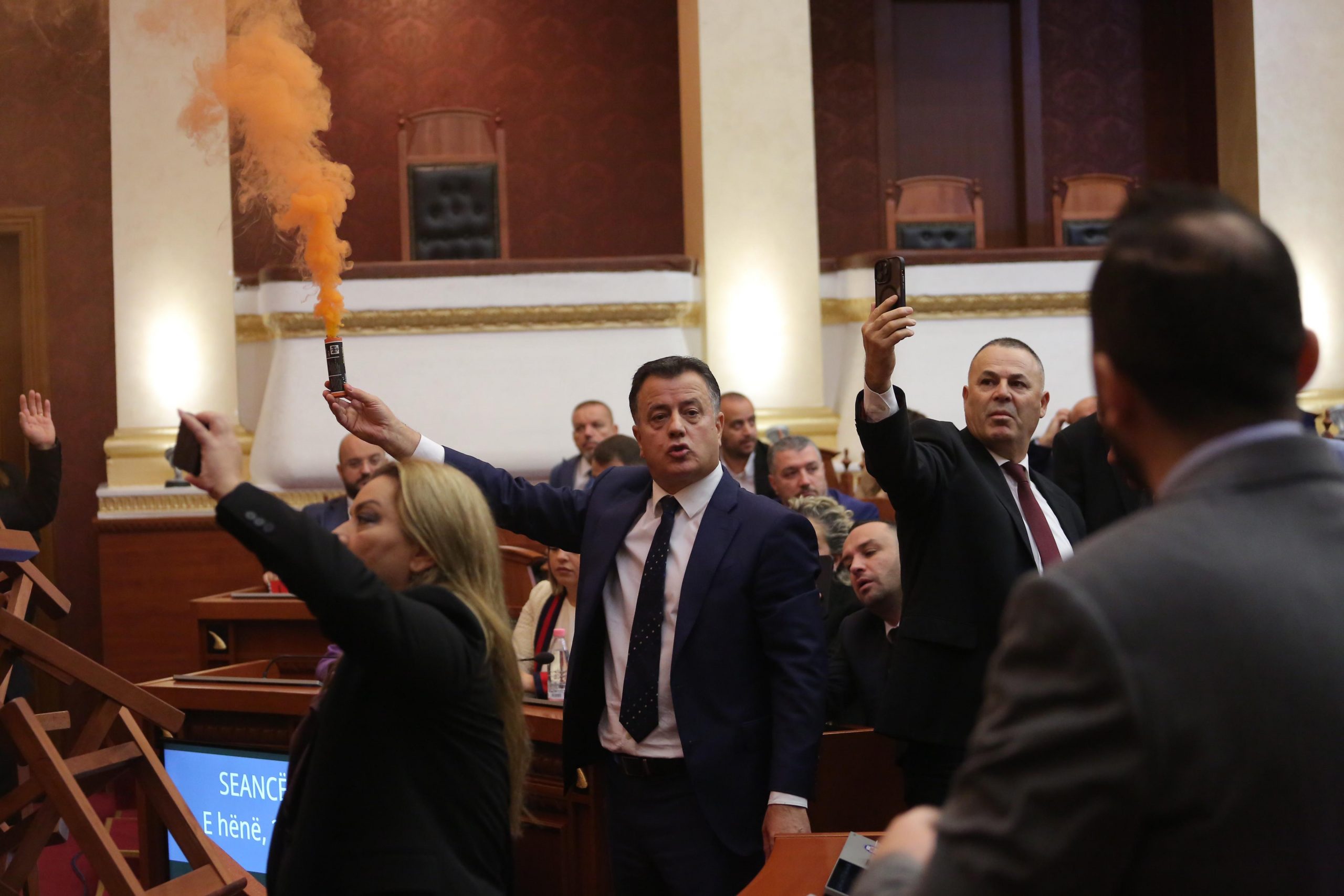
Opposition members once again obstructed the speaker’s podium with chairs, filling the chamber with smoke.
In attendance at the plenary session were members of the cabinet and Prime Minister Edi Rama, all convened to deliberate on the budget.
Parliament Speaker Lindita Nikolla initiated the session by reading out the agenda and announcements, but her address was repeatedly interrupted by opposition deputies. Following the reading of the agenda, opposition members deployed smoke devices within the chamber.
Following this, Nikolla proceeded to call for a vote on the agenda in accordance with parliamentary rules.
Nikolla emphasized the citizens’ desire to hear about their budgetary allocations, addressing issues such as salary increases for 30,000 teachers, free textbooks for 231,000 students, and financial support for 50,000 students. She urged colleagues to continue the budget discussions with the seriousness that the citizens deserve.
Later in the session, Nikolla took the decision to exclude Democrat MP Flamur Noka from the proceedings due to his involvement in deploying smoke devices.
Citizens’ concerns, according to Nikolla, include topics such as the provision of reimbursable medicines for 400,000 individuals and economic aid benefiting 161,000 recipients.
Nikolla also questioned why certain deputies were reluctant to discuss the financial support provided to over 8,000 female heads of households, each with three or more children aged 18 and above.
Before the plenary session commenced, Sali Berisha, the leader of the Democratic Party’s Reestablishment Group, had announced the intention to block the session.
He emphasized the importance of continuing what he termed an “irreversible battle”, expressing conviction that the day is nearing when Albanians will engage in an irreversible protest against the current regime.
In other news, marking a historic moment, the 2024 budget surpasses the planned 7 billion euros in public spending for the first time. Simultaneously, it envisions a reduction in public debt, steering clear of significant fiscal measures and placing a strong emphasis on fiscal responsibility.
In the foundational scenario for the upcoming year, economic growth is projected at 3.8%, with an average annual growth of approximately 4% in the foreseeable future.
Anticipated to rise to an average of 27.8% of Gross Domestic Product (GDP) for the period 2024-2026, budgetary revenues show an increase from the 27% reported during the 2019-2022 period. The Ministry of Finance and Economy attributes this growth primarily to improvements in fiscal administration, including the expansion of the tax base to minimize informality and tax evasion.
Continuing its commitment to substantial wage increases, the budget aims to reach an average monthly wage of 900 euros by the end of 2024.
The financing for planned public investments in 2024 is set at 5.3% of GDP, supporting ongoing economic growth and focusing on the development of tourism, agriculture, and connectivity, with an additional emphasis on employment promotion. The investment package prioritizes national and local infrastructure to meet the growing demand in tourism.
Projected at 5.3% of GDP or 128.5 billion Albanian lek, public investments for 2024 exceed the initial plan for 2023 by approximately 4.6 billion Albanian lek. The majority of capital expenditures are earmarked for ongoing projects such as the Tirana Ring Road, Llogara Tunnel construction, Arbri Road, Orikum-Dukat segment, and water supply and sewage infrastructure projects totaling 11 billion lek. Additionally, urban development projects funded by the Albanian Development Fund, amounting to 16.6 billion lek, continue to receive support. The budget also allocates 7 billion lek for reconstruction, with flexibility for reallocations to expedite the process.
Accompanying the budget for 2024 is a Fiscal Package, designed to ensure the sustainability of legislation and fiscal policies.
Following the initial approval, the budget will undergo discussions in parliamentary committees before final approval in a plenary session.