

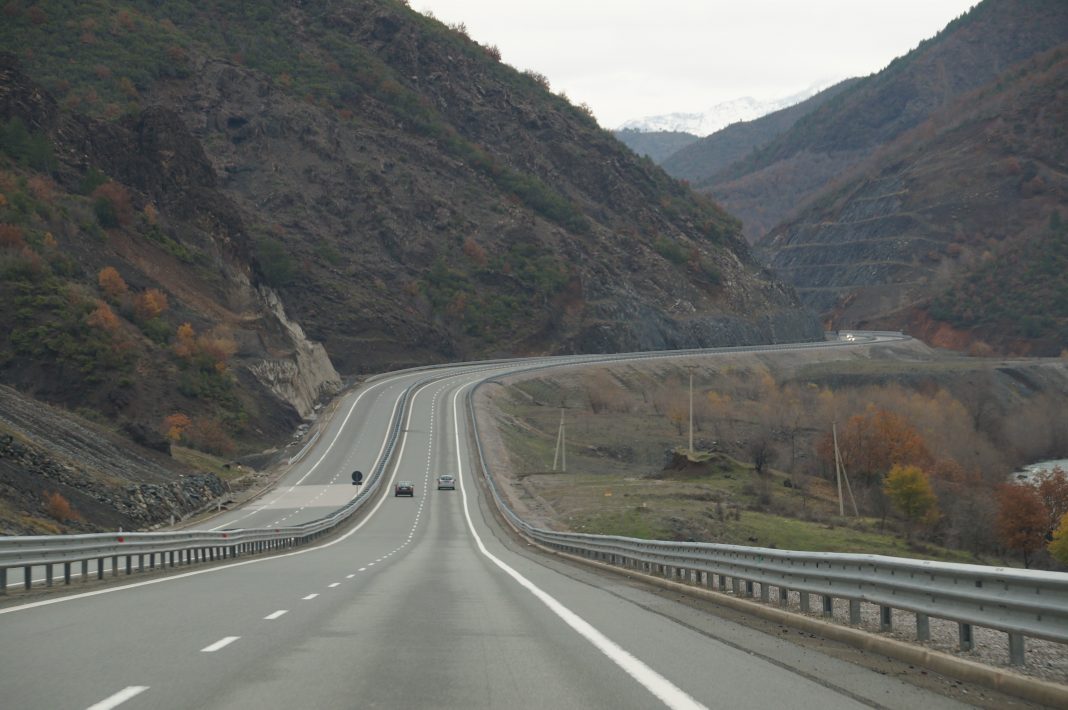
The Nation’s Route (Rruga e Kombit) is transforming into an extension of Europe’s key road network, known as TEN-T, with Serbia currently constructing the extension from Niš to Merdare, the border with Kosovo.
Recent developments have seen Serbia launch construction on the initial segment of this highway, with funding secured for the entire route, which has been designated as a priority.
Named the “Highway of Peace” due to its unifying role linking Kosovo, Serbia, and Albania through a high-standard roadway, the project has gained financial support from the European Union.
Stretching over a total of 314 kilometers, the Highway of Peace originates in Lezhë, Albania, and concludes in Merdare, bordering Bulgaria, passing through both Pristina and Niš.
The completed section spans from Lezhë to Pristina, leaving 103 kilometers yet to be constructed from Pristina to Merdare, with 76 kilometers traversing Serbia’s terrain and 27 kilometers within Kosovo’s borders. The estimated total cost for these remaining kilometers is approximately 947 million euros.
Despite encompassing numerous bridges and tunnels, the cost per kilometer is projected at 9 million euros.
This expense is notably lower than the Albanian portion of the Nation’s Route, which incurred a cost of roughly 11 million euros per kilometer. In comparison, the contemporary expense of constructing a highway within the country stands at around 15-20 million euros per kilometer.
The continuation of the Nation’s Route’s Serbian segment will comprise 88 bridges, 7 overpasses and underpasses, and 35 tunnels, all within a budget of no more than 9 million euros per kilometer.
This endeavor’s financing is a collaborative effort between the European Investment Bank (EIB) and the European Bank for Reconstruction and Development (EBRD). Additionally, the European Union is providing investment grants through the Western Balkans Investment Framework (WBIF).
In the Kosovo section, spanning from Pristina to Niš, the project is presently undergoing technical detailing in its early stages.
In its entirety, the project serves as an extension of the Trans-European Transport Network (TEN-T) and the South East Europe Transport Observatory (SEETO). This corridor, spanning over 300 kilometers, connects Lezhë in Albania to Niš in Serbia via Pristina in Kosovo. The Western Balkans Investment Framework supplies the related data.
The project constitutes part of a broader strategy to enhance the road corridor between Niš and Pristina, classified as a priority within the Connectivity Agenda of 2015.
Furthermore, the project holds a prominent position in the roster of prioritized ventures in the Multi-Annual Development Plan of the Comprehensive Network SEETO for the years 2014-2018. This priority status is also articulated within the Transport Strategy of Serbia’s Government for the period 2016-25.
Upon the completion of the Highway of Peace, Albania’s ties to the main European network will be fortified, as both highways traversing the country integrate into the central European network TEN-T, encompassing the North-South Highway and Corridor 8.





