

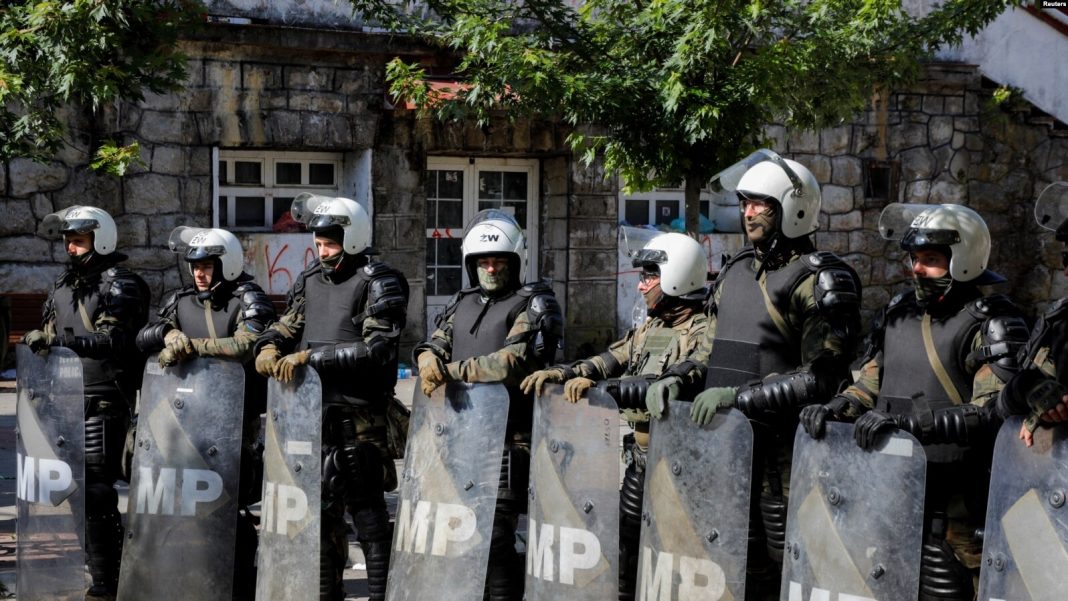
NATO-led peacekeeping forces have been deployed in front of municipal buildings in the northern municipalities in Kosovo, a day after clashes with Serbian protesters.
Groups of Serbian citizens have gathered in front of municipal buildings even this Tuesday, however, the situation so far appears to be calm.
According to a KFOR declaration, 30 soldiers have been wounded following “unprovoked violence in Zvečan”. Several soldiers of the Italian and Hungarian KFOR contingent were the subject of attacks and sustained trauma wounds with fractures and burns due to the explosion of incendiary devices.
KFOR confirmed that its added presence in the four northern municipalities of Kosovo was in order to reduce the risk of escalation. KFOR Commander Angelo Michele Ristuccia is personally following up on the situation.
“To avoid clashes between parties and to reduce the risk of escalation, KFOR peacekeepers prevented threats to the lives of Kosovo Serbs and Kosovo Albanians. Both sides must take full responsibility for what happened and prevent any further escalation instead of hiding behind false narratives,” the KFOR Commander was quoted saying.
The peacekeeping forces said they will take all necessary measures to create a safe environment and ensure freedom of movement for all communities in Kosovo.
#KFOR statement pic.twitter.com/0cnmW5PRfn
— NATO Kosovo Force – KFOR (@NATO_KFOR) May 30, 2023
On the other hand, the Kosovo Police declared it is investigating all violent acts that took place during the riots in Zvečan, Leposavić and Zubin Potok.
“Protesters, individual and criminal bands, through extreme violent acts, caused the security situation in the north of the country to escalate and degrade to the point of endangering people’s lives, including the lives of officials of institutions of security,” according to the Kosovo Police.
Monday’s clashes erupted in the municipality of Zvečan when groups of Serbs threw stones and explosive devices at NATO troops who used teargas to disperse protesters, according to witnesses.
Several Kosovo police and media cars were damaged and Serbian nationalist symbols were written on them. A television car was set on fire.
Serbian President Aleksandar Vučić said on Monday that 52 Serbs had been injured during the riots.
Meanwhile, this Tuesday Vučić received ambassadors of the QUINT countries, as well as the head of the EU delegation in Belgrade. Serbian Defense Minister Miloš Vučević was also present in the meeting. Vučić is also expected to meet with the Russian and Chinese ambassadors to Belgrade.
Monday’s violence was widely condemned by the international community.
“The violent acts committed against NATO/KFOR troops, media, civilians and police are absolutely unacceptable. The EU urges Kosovo authorities and the protesters to immediately and unconditionally deescalate the situation. We expect the Parties to act responsibly and find a political solution through the Dialogue immediately,” wrote EU High Representative for Foreign Affairs and Security Policy Josep Borrell on Twitter.
The EU condemns today’s shocking violence in #Zvecan in the strongest possible terms.
The violent acts committed against @NATO_KFOR troops, media, civilians and police are absolutely unacceptable.
1/2
— Josep Borrell Fontelles (@JosepBorrellF) May 29, 2023
Tensions in the area rose after the elected Albanian mayors took to their offices after the April 23rd elections, largely boycotted by the Serbian political parties.
Authorities in Kosovo blame Belgrade and Serbian President Aleksandar Vučić for encouraging destabilization, while the Serbian President accused Kosovo’s Prime Minister Albin Kurti for enticing violence.
Serbia opposed Kosovo’s independence, declared in 2008 with the support of the West.
The United States and the European Union have increased attempts to help resolve all disputes between parties, fearing further instability in Europe as Russia’s war in Ukraine continues.




