
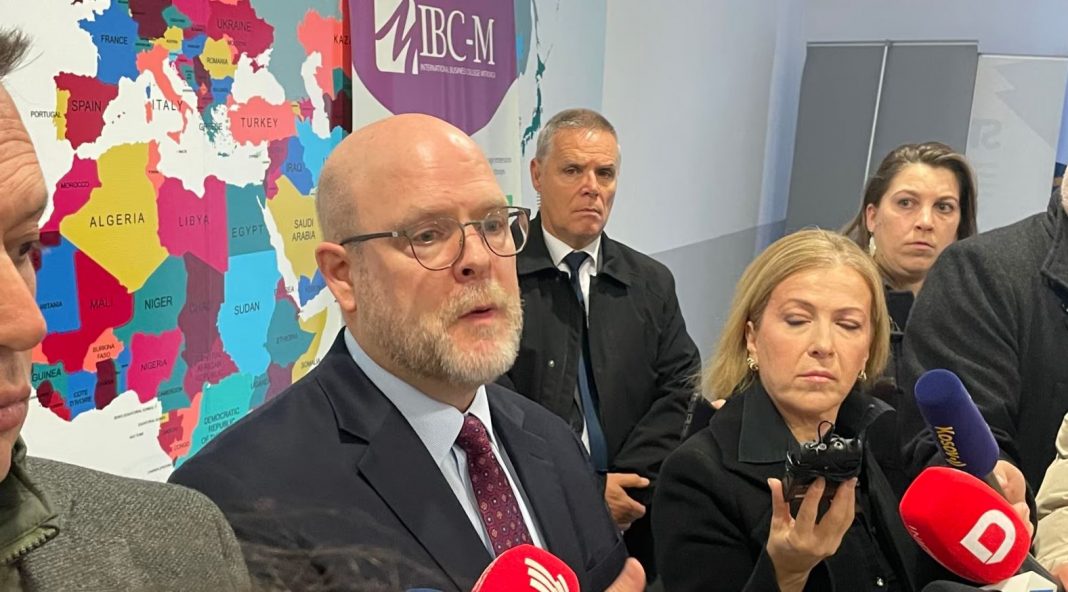
On Wednesday, the U.S. Ambassador to Kosovo, Jeffrey Hovenier, expressed surprise at the comments and criticisms being made about the draft statute for the establishment of the Association of Serb-majority Municipalities in Kosovo proposed by senior Western officials.
“I think the focus should be on how Kosovo can move forward by adopting this draft. If there are questions about constitutionality, as I have said before, and I say it again, there is only one body that can decide what is in line with the Constitution,” Hovenier said, referring to the Constitutional Court as the sole authority that can decide on the constitutionality of the proposed draft.
He made these statements following a discussion with students in Mitrovica.
Hovenier told the media that the U.S. position regarding the Association has not changed.
“The U.S. believes that it is Kosovo’s obligation to form the Association of Serb-majority Municipalities. I know that last night the EU and its Council reiterated that expectation, that the Government of Kosovo should move in that direction. The U.S. position has been clear. The Association must be in line with Kosovo’s current Constitution, in line with the decision of the Constitutional Court, it should not be a third level of government, and it should not have executive competencies. We do not want another Republika Srpska. We do not want something that has a negative impact on the functioning of the state of Kosovo,” Hovenier stated.
Concerning whether the proposed draft can be changed, despite mentioning that the document reflects the Western position, Hovenier said, “This is a question for [the EU Special Representative for the Kosovo-Serbia dialogue, Miroslav] Lajčák; I think he has told the Government of Kosovo and others that he is open to comments. However, Lajčák’s team, with the support of the U.S., has worked closely on this draft to ensure that it meets all the conditions I mentioned. Is there room for improvement? Perhaps. But we should not waste time on specifics to lose momentum, to move forward with the Association”.
The draft statute for the Association was presented to Pristina and Belgrade in October.
Prime Minister of Kosovo Albin Kurti and Serbian President Aleksandar Vučić have stated that they find it acceptable.
Things are not progressing due to the conditions set by the parties.
In several separate meetings with Western officials in October, Prime Minister of Kosovo Albin Kurti stated that the signing of agreements with the neighboring country guarantees the implementation of the agreements, while Serbian President Aleksandar Vučić insisted on implementing “what has been signed”.
Recently, the draft has also been handed over to opposition parties in Kosovo.
In several statements to Radio Free Europe, their representatives expressed concern and disagreement with it.
According to them, the draft statute, as it stands, affects the unitary character of the state and creates parallel powers.
Kosovo and Serbia reached an agreement on the Association in 2013 and then in 2015 on the principles for its establishment.
However, in 2015, the Constitutional Court of Kosovo found that the agreement was not in complete harmony with the Constitution.
Serbia insists that Kosovo implement the reached agreements, but the Government of Kosovo has declared itself against an ethnically-based association.
Regarding the administrative guidance for the removal of mayors
Ambassador Hovenier said that the U.S. expects the Government of Kosovo to be flexible and do everything possible to ensure that citizens who want to remove their municipality’s mayor can do so.
He referred to the possibility offered by an administrative guidance, drafted by the Government in September this year, which provides for taking several steps to remove the mayor.
The U.S. ambassador said that the guidance was published after a direct request from the U.S. and the EU for Kosovo to create a system for citizens to be able to remove a mayor if they wish.
Days ago, citizens of the four Serb-majority municipalities started a petition to municipal assembly presidents, as stipulated by the guidance, to remove the mayors.
The President of the Assembly of the Municipality of North Mitrovica, Nedžad Ugljanin, told local media in the Serbian language that he had rejected the citizens’ request “for formal reasons”.
In his statement, it was said that the citizens’ group did not act in accordance with the administrative guidance, and he cannot “act and consider or register the group as an authorized person”.
Regarding the arrest warrant for Radojičić
During his address to the reporters, Hovenier was also asked if there are possibilities for Serbia to arrest Milan Radojičić after the INTERPOL issued an arrest warrant for him.
Radojičić, the former deputy head of the Serb List – the largest party of Serbs in Kosovo – has taken responsibility for the attacks by an armed group against the Kosovo Police in Banjska, Zvecan, on September 24.
As a result of the attacks, a Kosovo Police officer, Afrim Bunjaku, was killed.
The arrest warrant for Radojičić was issued in December through the mediation of the UN Mission in Kosovo, UNMIK, based on the request of the Ministry of Internal Affairs of Kosovo.
Since Kosovo is not a member of INTERPOL, international arrest warrants are issued in this way.
“The arrest warrant issued by INTERPOL implies that countries potentially seek to arrest someone based on the legal process of a country. However, sometimes, governments have decided not to act based on the arrest warrant. There must be extradition agreements and other conditions,” Hovenier explained.
Radojičić was questioned by the Serbian Prosecution in October and accused of committing several offenses, including arms trafficking and causing general danger.
However, the court in Belgrade released him from custody and confiscated his documents.