

Amnesty International has voiced its concerns over the recent agreement between Italy and Albania, which allows for the transfer of rescued migrants in the Mediterranean to centers in Albania. The organization deems this agreement as both “illegal and unenforceable”.
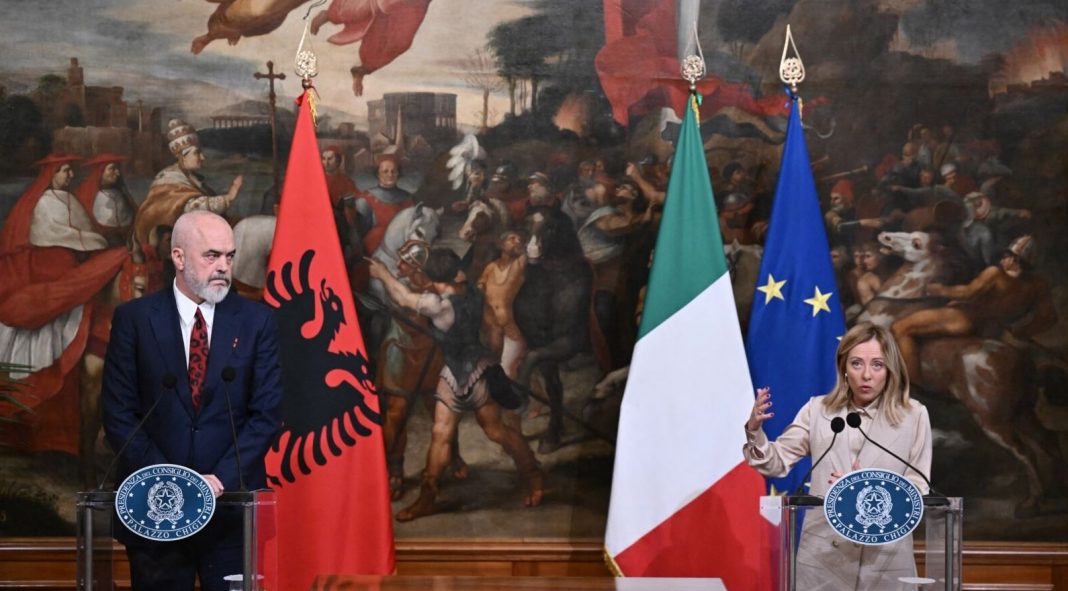
The agreement was signed on November 6 by the Prime Minister of Albania, Edi Rama, and the Italian Prime Minister, Giorgia Meloni. According to this agreement, Italy will begin sending migrants it intercepts and rescues in the Mediterranean to Albania, with the process set to commence next spring.
Elisa De Pieri, a regional researcher at Amnesty International, has raised objections, emphasizing that individuals rescued by Italian authorities, including those seeking asylum in Europe, fall under Italian jurisdiction. As a result, these individuals cannot be relocated to another country prior to a thorough assessment of their asylum claims and individual circumstances.
De Pieri labeled the agreement as “illegal, unenforceable, and in need of abolishment”. She accused Italy of attempting to bypass international and European Union laws, asserting that the detained individuals would still fall under Italian jurisdiction.
The Albanian Government revealed that Italy has already provided 16.5 million euros as an advance payment for the costs associated with hosting migrants in camps on Albanian territory, as stipulated in the agreement.
While the two prime ministers behind the agreement have cited three objectives, namely “combating illegal trafficking, preventing irregular migration flows, and providing refuge for those with legitimate claims for protection”, De Pieri contends that the agreement essentially revolves around the “return” of migrants, a practice that is prohibited by both international and European law. Italy faced condemnation by the European Court of Human Rights in 2012 for unlawfully pushing back African migrants and asylum seekers at sea.
De Pieri expressed concerns about the “serious consequences” this agreement may pose for asylum seekers, including prolonged detention and potential violations that fall outside the jurisdiction of Italian judicial authorities.
The lack of transparency surrounding this agreement has prompted reactions in both Italy and Albania.
Amnesty International has called upon the Italian Government to uphold its international legal obligations regarding non-refoulement, preventing the return of migrants to situations where they could face persecution. Additionally, the organization has urged the European Commission to ensure member states do not infringe upon the rights of asylum seekers.
Italy has already allocated 16.5 million euros into a dedicated account held by Albania’s Treasury as an upfront payment for the accommodation of up to 3,000 migrants in Albania.
This arrangement is outlined in a protocol released by the Albanian Government on November 7, just one day after both countries reached an agreement regarding the handling of migrants.
The protocol specifies that the 16.5 million euros advance payment will be executed within 90 days of the protocol coming into effect. These funds will be utilized to reimburse various service-related expenses, as detailed in the document.
Furthermore, Italy is required to open a second-tier bank account exclusively dedicated to the guarantee fund.
This protocol is slated to be in effect for five years, with the possibility of renewal for an additional five years.
The document stipulates that unless one of the parties communicates their intention not to renew the protocol at least six months before its expiration, it will be automatically renewed for another five-year term.
The protocol also designates that the entry of migrants into Albanian territorial waters and territory will be solely administered by Italian competent authorities. Albanian authorities will facilitate the entry and stay of migrants in Albanian territory for the sole purpose of conducting border procedures or repatriation, as stipulated by Italian and European legislation, and only for the time strictly necessary.
The protocol, as disclosed by the Albanian Government, outlines Italy’s responsibility for bearing any necessary expenses for the accommodation and care of migrants, including provisions for food, healthcare, and any other services deemed essential, while ensuring that the treatment aligns with the fundamental rights and freedoms of individuals, as defined by international law.
Italy, as part of the agreement, will fund all healthcare services and equipment, encompassing vehicles and fuel, as well as payments for legal representation. Meanwhile, Albania will provide facilities for Italian personnel working in Albania, exempting them from visa requirements, residence permits, and other obligations dictated by Albanian migration laws.
The agreement further establishes Italy’s obligations concerning the security of migrant reception centers, with Albania ensuring the safety of migrants during their transport outside these facilities.
It’s important to note that, initially, this agreement pertains to about 3,000 individuals, with the potential for a yearly migrant flow of up to 36,000 individuals. However, the agreement does not cover minors, pregnant women, and other vulnerable groups, as indicated by Meloni on November 6.
The implementation of this agreement is expected to commence in the upcoming spring. Notably, Prime Minister Edi Rama expressed that similar requests had been presented by other European Union member states, but these were declined. He emphasized a sense of “indebtedness” toward Italy for its actions in support of Albanian migrants.
Albania has previously offered shelter to thousands of Iranian and Afghan migrants, with some of them still residing in dedicated camps.




