

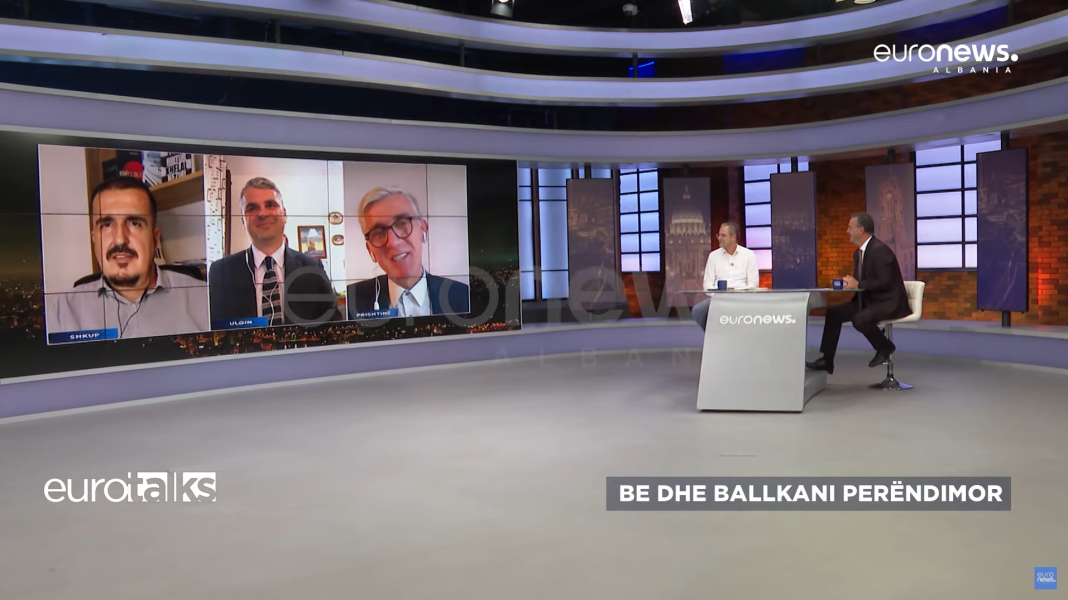
Among the topics discussed on Sunday’s ‘EuroTalks’ were the problems that Western Balkan countries encounter in order to join the European Union.
Ardian Haçkaj, the coordinator of ‘Tirana Connectivity Forum’ thinks it would be difficult to have the first Intergovernmental Conference by the end of the year, as promised by the President of the European Commission Ursula von der Leyen, at least “as long Albania is coupled with North Macedonia in the process”.
“For as long as we’re coupled, the first Intergovernmental Conference for Albania will not take place. In my judgment, negotiations should be launched not only for Albania and North Macedonia but for all countries in the Balkans. The closer to the EU we are, the more aids we get”, noted Haçkaj.
According to the former ambassador of Kosovo to Prague, Arber Vllahiu, Pristina’s growing weariness in confront to the EU is closely related to the fact that the visa regime is still in force for Kosovo.
In addition, conditioning the rule of law as an ongoing process and not a condition that can be met immediately is ‘inappropriate’, added the former ambassador.
‘The visa liberalization process seems to be interconnected to negotiations with Serbia’, said Vllahiu.
“The rule of law condition cannot be fulfilled promptly, that is why Kosovo is beginning to lose its patience with the EU, due to a lack of freedom of movement. But, we also need to see the fact that Kosovo is the last country in the region that is still at the beginning of the road for opening negotiation talks with the EU”, he said.
Ursula von der Leyen’s visit came at a “very delicate moment”, Vllahiu said, as tensions between Kosovo and Serbia were very high over, however, he added that the visit also served to ease tensions and retrieve special forces deployed at the Jarinje and Bernjak checkpoints.
North Macedonia’s negotiations are being widely seen as locked by Bulgaria’s veto, but according to Xhelal Neziri, a regional relations analyst in Skopje, the hurdle may be overcome if the technocratic government in Sofia is ousted at the elections due this November.
Naziri claims that if former prime minister Boyko Borissov returns to the executive, a political figure known for his more amicable approach with North Macedonia, then chances that Bulgaria ‘clears the way’ for Albania and North Macedonia are bigger.
Ilir Capuni, a professor at the University of Montenegro, believes that Russian and Serbian meddling has led the country to a spiraling situation.
Negotiations with the European Union have stalled since in the first year of the current pro-Serb government, as the latter needs a hard-to-reach two-third of the parliament consensus to advance any objective in the rule of law area, said Capuni.




