

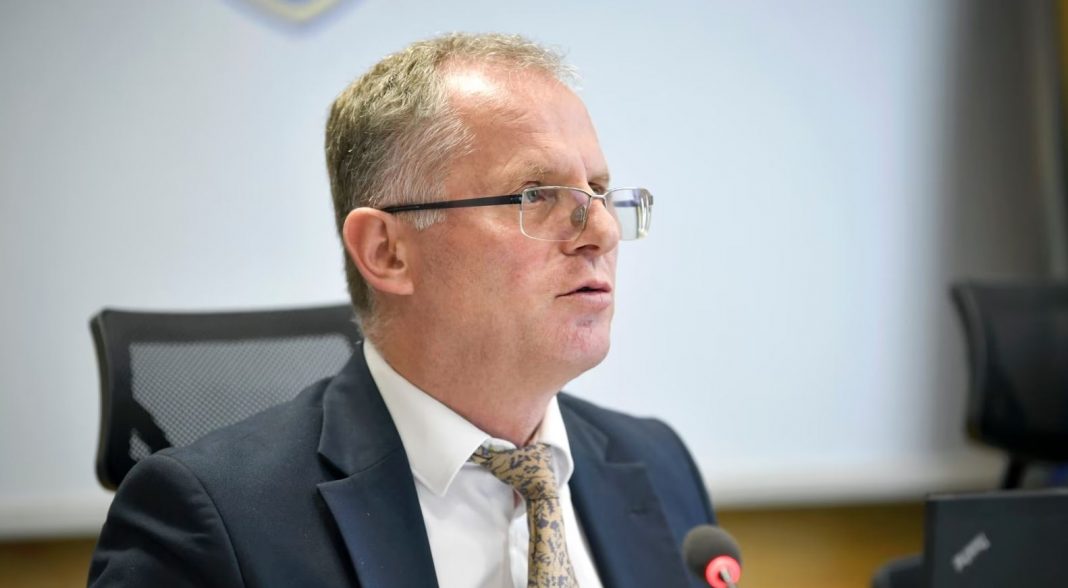
The Deputy Prime Minister of Kosovo, Besnik Bislimi, accused Serbia of unilateral actions and “flagrant violations of the functionality” of Kosovo’s institutions by attempting to send a sum of Serbian dinars to Kosovo.
Since February 1, a regulation of the Central Bank of Kosovo (CBK) has come into force in Kosovo. This regulation stipulates that the euro is the sole currency for payments in Kosovo, prohibiting the use of the Serbian dinar.
Bislimi said that Belgrade, with the action on February 7, aimed at “artificially creating tensions”, adding that it should be condemned by all those who oppose unilateral steps.
Earlier in the day, the National Bank of Serbia said that the sending of dinars to Kosovo was not allowed, but Kosovo Customs argued that they had explained to the Serbian party that the circulation of funds is not allowed without authorization from the Central Bank of Kosovo.
Bislimi said that the National Bank of Serbia sent a truck filled with Serbian dinars worth nearly 1 million euros to the Kosovo border. However, according to the Kosovar Deputy Prime Minister, the individuals accompanying this transport vehicle “presented themselves with credentials of a nonexistent company claiming that they want to send the money to an equally non-existent entity in Kosovo and for the benefit of beneficiaries, whose names they neither know nor have”.
The National Bank of Serbia stated that the funds were intended for the vault it has in Leposavic, one of the four municipalities in north Kosovo, where Serbs are the majority.
This institution argued that the transport was based on a well-known practice.
“Based on a well-known practice, the vehicle of the National Bank of Serbia with funds in dinars was sent today to the crossing point in Jarinje, where the funds for further transport would be taken from the vehicle of the ‘Henderson’ company, which has a license from the authorities of Pristina for money transport. However, it returned without any explanation,” said the National Bank of Serbia in a statement on February 7.
According to Deputy Prime Minister Bislimi, the new regulation of the Central Bank of Kosovo – which came into force on February 1 – clarifies that only licensed financial institutions, both banking and non-banking, authorized by the CBK and with special authorization from this institution, can import financial means into Kosovo.
“The Republic of Kosovo is fully committed to working and assisting in finding the mechanism to ensure that such funds are legally sent to end beneficiaries, and that as soon as possible,” wrote Bislimi on his Facebook account.
In the regulation for cash operations, approved by the CBK, it is stated that licensed institutions operating in Kosovo may carry out the import and export of currencies. Customs and the Kosovo Police are the responsible authorities to ensure that the cross-border import or export of euros or other currencies to and from Kosovo can only be allowed “through the presentation of a license and authorization issued by the CBK”.
Kosovo has said that the implementation of the CBK regulation for cash operations will be carried out through a transitional period during the month of February.
Serbia pays Serbs in Kosovo – through a parallel system – salaries, pensions, social assistance, and other benefits.
According to data presented by Serbian President Aleksandar Vučić, his state has employed 31,831 people in Kosovo, 29,115 pensioners – of which 4,700 receive pensions in hand – as well as 31,586 recipients of social assistance.
The international community has called on Kosovo to postpone the implementation of the regulation, arguing that it came into force without prior consultations. The United States and the European Union have expressed concern that the regulation may have a negative impact on the Serbian population living in Kosovo.
U.S. Ambassador to Pristina, Jeffrey Hovenier, has warned Kosovo that there may be consequences for the “quality of partnership” with the United States if it does not heed its request to postpone the implementation of the CBK regulation.
He said he is concerned about the way this decision is being implemented, which according to the American diplomat, “does not address or take into account the impact it will have on the affected community”.




