
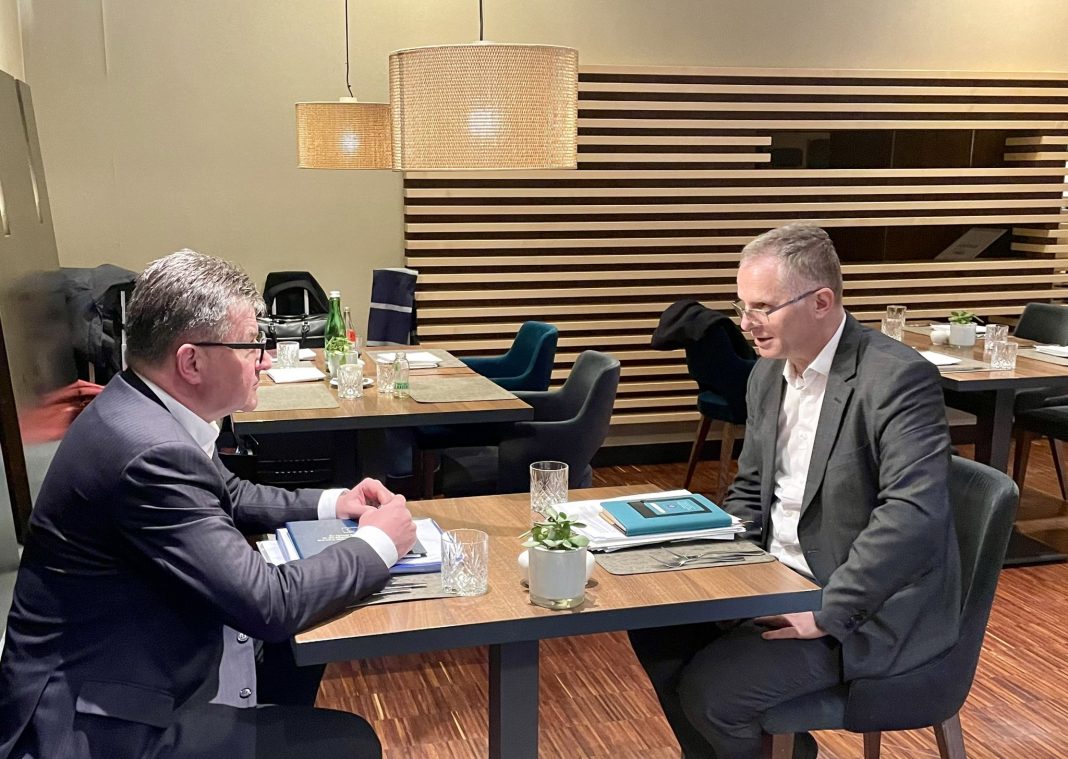
The European Union’s Special Envoy for Dialogue, Miroslav Lajčák, and Kosovo’s Deputy Prime Minister, Besnik Bislimi, met on Monday in Vienna to discuss a series of issues related to the dialogue between Kosovo and Serbia. They particularly focused on the urgent need for the immediate implementation of an agreement between the two neighboring countries to normalize relations.
Lajčák wrote on Monday afternoon on the social network X that he agreed with Bislimi that the immediate implementation of the agreement towards normalization between Kosovo and Serbia is an “emergency”.
Ahead of @Davos, I met First DPM @BislimiBesnik to discuss a wide range of Dialogue-topics and expectations on advancing the normalisation of relations with Serbia in the coming period. We agreed that swift implementation of the Agreement on the Path to Normalisation is urgent. pic.twitter.com/qwHccdOlVC
— Miroslav Lajčák (@MiroslavLajcak) January 15, 2024
He referred to the Agreement on the normalization of relations and its Implementation Annex, which Kosovo and Serbia agreed to last year during the EU-mediated dialogue.
Despite international pressure to implement it, the agreement has never been put into practice.
The normalization agreement, consisting of 11 articles, includes provisions for self-governance for the Serbian community in Kosovo and mutual recognition of state symbols. It also calls for Pristina and Belgrade to implement all previous agreements reached during the dialogue.
Bislimi stated on Monday after the meeting in Vienna that they discussed with the EU envoy the position of Serbia, which refuses to implement parts of the agreement.
“Other issues related to the urgency for full and unconditional implementation of the Basic Agreement were raised… to [discussions on] Belgrade’s letter of withdrawal from the agreement,” Bislimi wrote on X.
At the end of last year, Serbia, through a document, stated that it does not intend to implement parts of the Agreement on the path to the normalization of relations with Kosovo, causing concern for the European bloc, which stated that the Ohrid Agreement and its annex are legally binding for the parties.
Bislimi mentioned that the topics of discussion on Monday also included guidelines for the implementation of the Energy Agreement and free movement.
The Energy Agreement began to be implemented earlier this year when the Kosovo System Operator, Transmission, and Market (KOSTT) announced that as of January 1, electricity consumption in four Serbian-majority municipalities in north Kosovo started to be registered. This occurred two years after Kosovo and Serbia signed the implementation guidelines reached in 2013 within the framework of the EU-mediated dialogue.
He also reiterated Kosovo’s position to the EU envoy that recognition of passports issued by Serbia for Serbs in Kosovo would have a negative impact on their integration into the country.
“I emphasized that pushing forward the proposal for the recognition of illegal passports issued by Serbia impacts negatively on the integration process and damages severely the dialogue,” he said.
1/2 Met today in Vienna w/EUSR Lajcak to discuss dialogue related issues. Talked about the need for full & swift implementation of the energy roadmap & issues regarding freedom of movement, to Belgrade's letter of withdrawal from the agreement. pic.twitter.com/H1SlIdftSZ
— Besnik Bislimi (@BislimiBesnik) January 15, 2024
The European Commission stated last week that it expects its request for the visa liberalization to also apply to Serbian passport holders residing in Kosovo to be approved in the joint interinstitutional process within the European Union.
In April of last year, the EU emphasized that visa liberalization for Kosovo, which came into effect on January 1, applied only to holders of Kosovo passports and not to citizens with passports from the Coordinating Administration, which operates under the Ministry of Internal Affairs of Serbia. However, the commission now wishes for Serbs in Kosovo with Serbian passports to be able to travel without visas as soon as possible, as it proposed on November 16 that visa liberalization for Kosovo should also apply to them.