
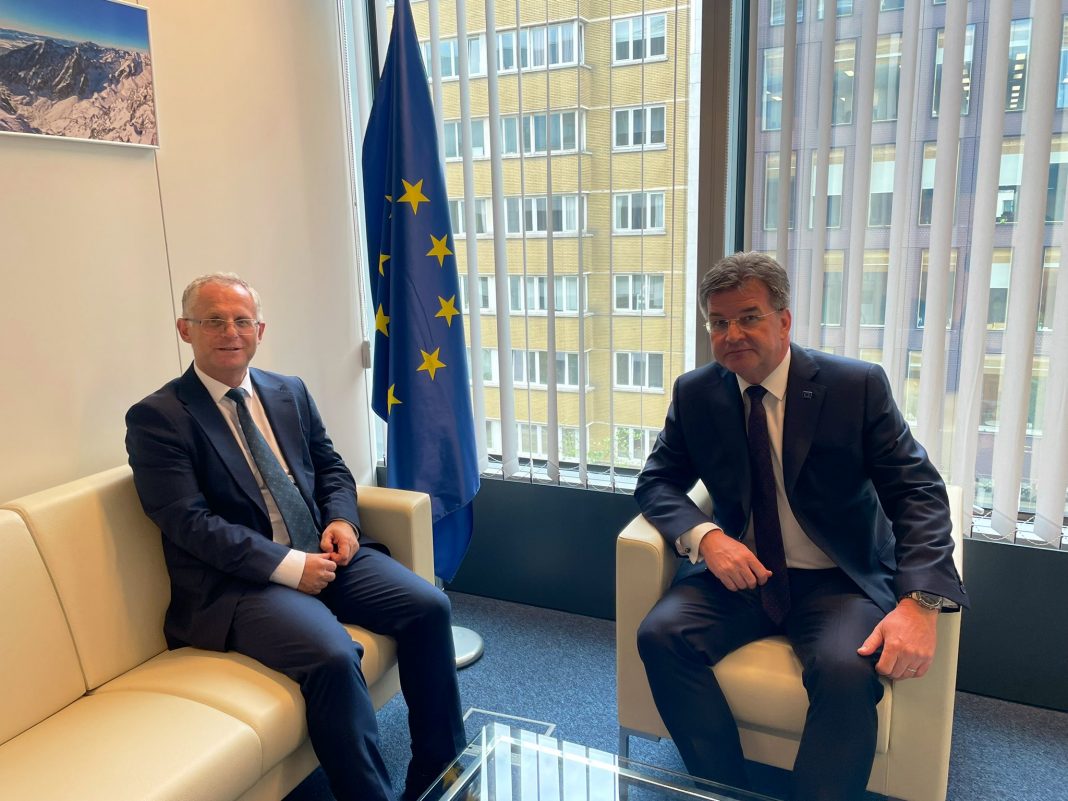
Kosovo’s Chief negotiator in the dialogue with Serbia Besnik Bislimi said on Wednesday in Brussels that the mediator of this process, Miroslav Lajčák, has decided not to hold a trilateral meeting at this moment.
He made these statements after a meeting with the EU mediator for the dialogue, stating that the Kosovo side was interested in a meeting between the three officials.
“It seems to be Lajčák’s stance that a trilateral meeting at this moment would not necessarily contribute to the finalization of the documents, as he believes that there is still a need for additional coordination before this happens. He even has the idea that the sequencing plan of the Basic Agreement requires a high-level meeting, according to him, and clearly, the chief negotiators cannot successfully conclude this process.”
Earlier in the day, Petar Petković, Serbia’s chief negotiator, also met with Lajčák.
In a late Wednesday Twitter post, Lajčák said that he discussed “a long list of Dialogue issues with Bislimi and Petković, starting with the implementation of the 27 February Agreement and de-escalation in the north”.
“Discussions will continue in the coming period.”
I hosted the Chief negotiators of Kosovo @BislimiBesnik and Serbia @PetkovicPetar in Brussels.
We discussed a long list of Dialogue issues starting with implementation of the 27 February Agreement and de-escalation in the north.
Discussions will continue in the coming period. pic.twitter.com/AqMoJiAkrP
— Miroslav Lajčák (@MiroslavLajcak) July 19, 2023
Bislimi said that he discussed four topics with Lajčák: the sequencing plan of the Basic Agreement, terms of reference for monitoring the Basic Agreement, terms of reference for the implementation of the Declaration on Missing Persons, and the Agreement on Energy.
With the Basic Agreement, Bislimi referred to the agreement reached between Kosovo and Serbia in February this year for the normalization of relations.
The two countries then also agreed on the implementation annex, in Ohrid, North Macedonia.
U.S. Special Envoy for the Western Balkans Gabriel Escobar said on Tuesday that he does not see readiness from Kosovo and Serbia to implement the Ohrid Agreement, although, according to him, it offers extraordinary opportunities for both countries.
Recent tensions in northern Kosovo have turned the dialogue process into a crisis management phase and shifted the focus away from the implementation of the Ohrid Agreement.
The situation in northern Kosovo – an area predominantly inhabited by Serbs – has been tense since the end of May when the Kosovo Police assisted newly elected Albanian mayors in Zubin Potok, Zvecan, and Leposavic to enter municipal buildings, despite the resistance of local Serbian residents.
Tensions escalated into violence on May 29 when Serbian protesters in Zvecan clashed with NATO KFOR troops.
Dozens of injuries were reported on both sides.
The international community has held Kosovo responsible for the tensions created, while Kosovo and Serbia have blamed each other.
The European Union has even imposed punitive measures against Kosovo.
Asked whether reaching an agreement on July 10 in Bratislava between Kosovo and the EU on tension reduction will result in the lifting of the EU’s punitive measures against Pristina, Bislimi said he is surprised by the inaction of EU’s High Representative Josep Borrell.
“In Bratislava, we agreed on a deal called the Arrangements between Kosovo and the EU for the implementation of the stance of the 27 EU member states, dated June 3. The title shows that the agreement is about implementing EU’s demands, and consequently, it complies with EU’s requirements. For us, it was clear that this is the path to lift the punitive measures against Kosovo, and we are surprised that eight days after the deblocking, we still don’t have an explanatory letter from Mr. Borrell seeking the lifting of the measures”.
Kosovo and Serbia are part of the dialogue mediated by the EU for the normalization of relations since 2011.
The parties have signed a series of agreements, but not all have been implemented.