

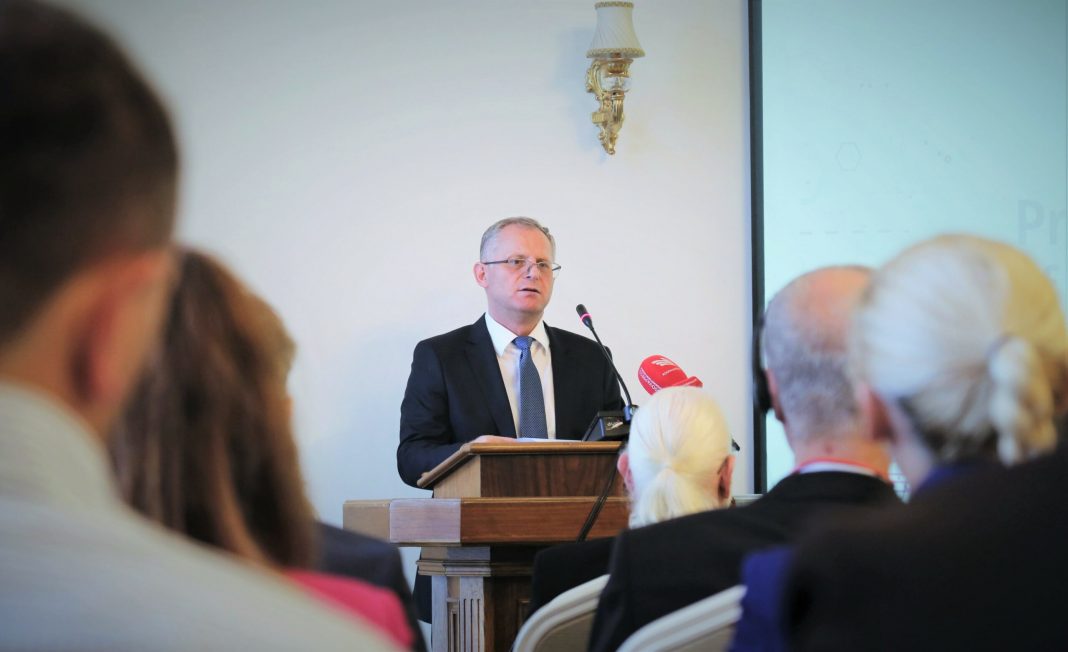
Kosovo’s Deputy Prime Minister Besnik Bislimi addressed media in Pristina, emphasizing that holding elections in the northern region of the country should not proceed until the punitive measures imposed by the European Union are lifted.
Bislimi highlighted the significance of receiving confirmation from the EU regarding the removal of sanctions after an agreement was reached between Kosovo and the EU in Bratislava. This agreement also involved the withdrawal of 25% of police forces from municipal buildings in four northern municipalities.
Although Kosovo’s President Vjosa Osmani previously asserted that organizing elections could be legally accomplished through a petition signed by 20% of registered voters, Bislimi expressed reservations about the existence of an appropriate legal framework for such declarations.
“It is an internal dilemma for Kosovo, whether administrative instructions alone suffice or if new legislation is required,” said Bislimi, who is also Kosovo’s chief negotiator in the dialogue with Serbia.
Should the mayors in the region resign, it would prompt snap elections in these municipalities. Nonetheless, Bislimi confirmed that the government, led by the Self-Determination Movement, would not request this of the mayors in North Mitrovica and Leposavic, both belonging to the party.
The mayors of the other two municipalities, Zvecan and Zubin Potok, come from the Democratic Party of Kosovo.
On July 10, the Kosovo Government agreed to publicly support the notion of holding snap elections in the four northern municipalities following the summer season. A critical condition of this agreement is Kosovo’s commitment to establish the necessary legal basis to facilitate these elections.
However, Kosovo’s inability to meet the demands of the European bloc resulted in the implementation of punitive measures by Brussels at the end of June.
EU diplomats revealed to Radio Free Europe that the eventual lifting of sanctions will be contingent on Kosovo fulfilling its obligations and undertaking further actions to deescalate tensions in the north.
Although the EU views Kosovo’s recent steps as progress, they expect to witness more concrete actions before fully rescinding the measures.
One diplomatic source stated that these measures were not imposed lightly and are reversible, but their removal necessitates proof that Kosovo is diligently undertaking the steps required of them – the very reason these sanctions were introduced.
The punitive measures implemented by the EU include a temporary suspension of units established under the Stabilization and Association Agreement, a non-engagement policy in high-level meetings, and a suspension of two-way visits, with the exception of those addressing the crisis in northern Kosovo as part of the EU-facilitated dialogue.
Additionally, programming funds for Kosovo from IPA 2024 (Instrument for Pre-Accession Assistance) were halted, and proposals from Kosovo within the framework of the Investment Framework for the Western Balkans were not submitted for review on June 29 and 30.
The situation in northern Kosovo has been further complicated by local Serbs opposing the installation of new Albanian mayors in municipal buildings with the support of the Kosovo Police.
These mayors had secured their mandates in elections held in April, which were boycotted by the Serb community.




