

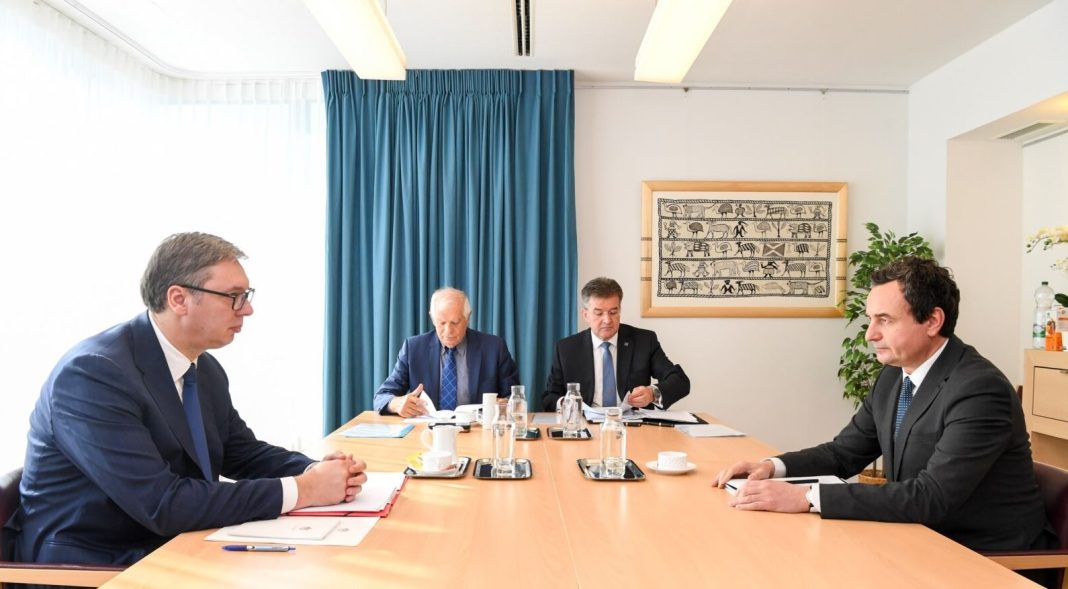
The chief of European Union Diplomacy, Josep Borrell, said there have been “unsuccessful” meetings with the leaders of Kosovo and Serbia regarding the de-escalation of the situation between the two states.
In an article published after the Security Conference in Munich concerning the EU’s geopolitical agenda, Borrell also mentioned separate meetings with the Prime Minister of Kosovo, Albin Kurti, on February 16, and with the President of Serbia, Aleksandar Vučić.
“With President Vučić of Serbia, and Prime Minister Kurti of Kosovo, I discussed, in separate meetings, how to de-escalate the situation between the two states, but unfortunately without success,” said Borrell.
Tensions between Kosovo and Serbia have increased since February 1 when a regulation of the Central Bank of Kosovo (CBK) started to be implemented, which designates the euro as the sole currency for cash transactions, prohibiting the Serbian dinar.
The European Union is seeking for this issue to be resolved through dialogue, but Kosovo has stated that the regulation of the CBK is not up for discussion.
Meanwhile, the United States is urging Kosovo to postpone the implementation of this decision, arguing that it was made without prior consultations and without taking into account the negative impacts on the Serbian population in Kosovo.
The Serbian state allocates millions of euros for Serbs in Kosovo after paying them in dinars – through a parallel system – salaries, pensions, and additional assistance.
After the meeting in Munich, Kurti’s Office stated that discussions with Borrell and the EU envoy, Miroslav Lajčák, revolved around the statements of Serbian officials regarding the Agreement on the road to normalizing relations.
“In light of Serbia’s continued violations, terrorist and paramilitary attacks in Banjska against the territorial integrity and national security of Kosovo, and continuous public letters and statements of non-legal obligation of the agreement for Serbia and incomplete implementation of the Basic Agreement reached in Brussels and its Annex in Ohrid, the signing of agreements has become necessary as a guarantee of respect and full implementation of them, towards the full normalization of relations between the two countries,” Kurti said, according to the statement.
The European Union has stated that the Agreement on the road to normalizing relations, reached last year, has not started to be implemented.
The 11-point agreement, among other things, also provides for a level of self-governance for the Serbian community in Kosovo and mutual recognition of state symbols, while also requiring Pristina and Belgrade to implement all previous agreements reached during the dialogue.




