

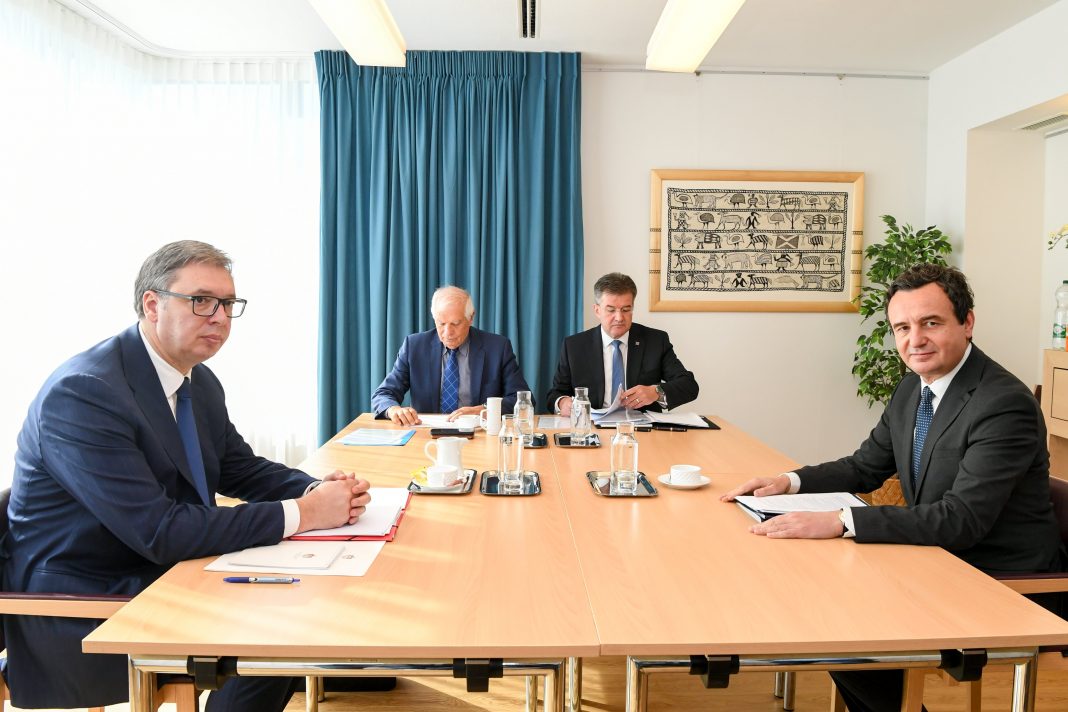
The European Union’s High Representative, Josep Borrell, stated on Sunday that the time has come for Kosovo and Serbia to resolve the crisis and tensions, and move forward into a “new European era” by implementing the agreement for the normalization of neighbourly relations.
Borrell remarked on March 17, a day before the anniversary of the Ohrid Agreement between Kosovo and Serbia, that “it is regrettable that, despite comprehensive efforts by the EU and the international community, Kosovo and Serbia have made very limited progress thus far in implementing the obligations they agreed to under this agreement.”
On February 27, 2023, Kosovo and Serbia reached the Basic Agreement in Brussels, while on March 18 an agreement on the Implementation Annex was reached in Ohrid.
The 11-point agreement, among other provisions, entails a level of self-governance for the Serbian community in Kosovo and mutual recognition of state symbols, while requiring Pristina and Belgrade to implement all previous agreements reached during the dialogue.
Brussels has accused both parties of failing to implement the agreement.
The EU’s chief diplomat expressed his expectation that Kosovo and Serbia’s leaders will demonstrate “responsibility, vision, and leadership by making progress in implementing the agreement without delay”.
High-ranking officials from Kosovo and Serbia have consistently expressed positions indicating they are not willing to adhere to the agreement.
Kosovo’s Prime Minister Albin Kurti insists on signing the agreement, as he considers it a guarantee that Serbia will also fulfil its obligations.
In the middle of January this year, he also stated that the Association of Serb-majority municipalities “is not a priority” for normalising relations with Serbia and should not be singled out.
Top of Form
Previously, Serbia’s President Aleksandar Vučić stated he would not sign any agreement implying recognition of Kosovo or its membership in the United Nations.
On December 14, Serbia’s Prime Minister Ana Brnabić submitted an official letter to the European Union headquarters expressing reservations about the obligations arising from the agreement and its implementation annex.
Borrell stated that in a time of “unprecedented wars in our continent”, achieving an agreement that promises peace, stability, and good neighbourly relations “was a historic achievement”.
He warned both Kosovo and Serbia that their European future depends on the implementation of this agreement and that it is their obligation under international law.
“The lack of implementation not only jeopardises the European integration of the parties but also damages their reputation as reliable partners,” he said.
Tensions between Kosovo and Serbia have escalated since February 1 when a regulation of the Central Bank of Kosovo (CBK) began to be enforced, stipulating the euro as the sole currency for cash transactions, prohibiting the Serbian dinar.
The Serbian state allocates millions of euros for Serbs in Kosovo as it pays them salaries, pensions, and additional assistance in dinars – through a parallel system.
The EU announced that on March 19, Kosovo and Serbia will discuss the issue of the dinar in Brussels, at the level of chief negotiators.
The European bloc, as well as the United States, have criticised the decision regarding the dinar, stating that it was made without prior consultations and without taking into account the negative impact it has on the Serbian community.
Washington has asked Kosovo to suspend the decision, but so far, the Kosovo government has shown no signs of withdrawing from this regulation.




