

With five European Union member states currently not recognizing Kosovo and with leading figures of the Kosovo-Serbia dialogue coming from non-recognizing countries, questions arise if the European Union can seriously lead this process.
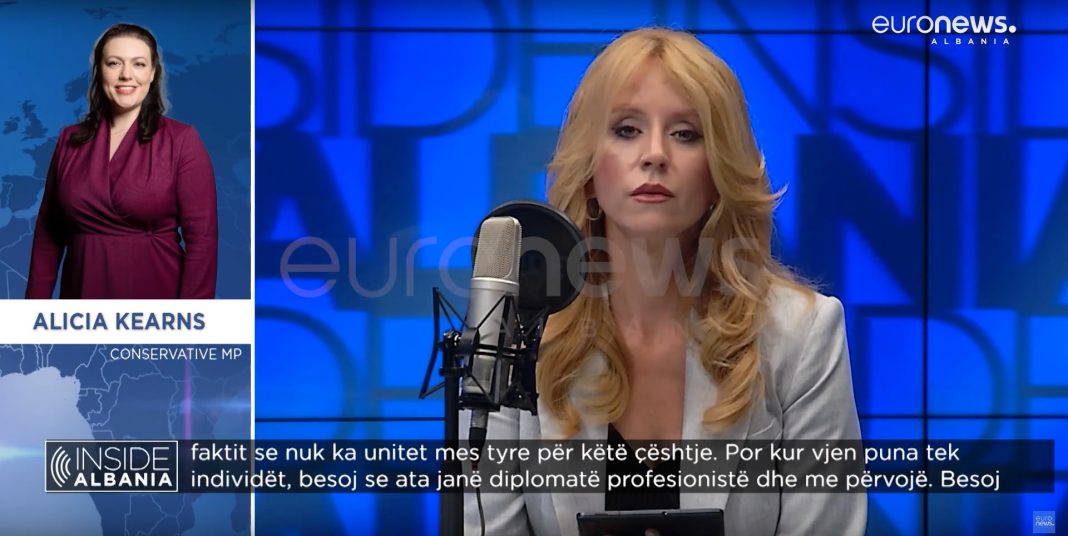
Speaking to Alice Taylor for “Inside Albania”, British Conservative Party politician and Chair of the Foreign Affairs Select Committee in the British House of Commons, Alicia Kearns said so:
“I think there is a fundamental challenge around the fact that the EU does not have unity on this issue [recognition of Kosovo]. I think EU member states would appreciate and recognize the fact that there is no unity amongst the EU around this.”
Considering the fact that Josep Borrell (High Representative of the European Union for Foreign Affairs and Security Policy) comes from Spain, a non-recognizer; Miroslav Lajčák (EU Special Representative for the Belgrade-Pristina Dialogue and other Western Balkan regional issues) comes from Slovakia, another non-recognizer; Olivér Várhelyi (European Commissioner for Neighborhood and Enlargement) comes from Hungary, a recognizer country of Kosovo but with close ties to Serbia and Russia, MP Kearns is of the opinion that these are professionals who can draw the line between their countries’ foreign policies and the EU stance on Kosovo’s independence.
“When it comes to individuals, I do believe that these are professional and highly experienced diplomats. So, I genuinely believe and I have to believe that they would act in the best interest of stability in Europe, and not in line with those local policies of their own countries. But of course, I’m disappointed that when they were leading figures within their own systems, they chose not to help ensure that Kosovo was recognized. This is about the EU being divided as an institution is not about the individuals themselves.”
Kosovo and Serbia are part of the dialogue mediated by the European Union which aims towards the normalization of relations, since March 2011.
These are the first negotiations between the two entities since Kosovo declared independence in February 2008, as Serbia claims Kosovo as its southern province under United Nations administration, rejecting its independence.
Talks between parties halted from 2018 until 2020, following the assassination of Kosovo Serb politician Oliver Ivanović in North Mitrovica, and the arrest and deportation of former Director of Serbia’s Kosovo office Marko Đurić after illegally entering Kosovo and attending a meeting in North Mitrovica.
Parties returned to the EU-backed dialogue in September 2020 and progressed since then.
A raft of agreements have been signed but very few of the provisions have ever actually been implemented.
One of the most prominent issues in the dialogue has been the Association of Serb-majority municipalities in Kosovo.
The agreement to its establishment was reached in 2013 and then in 2015 there was an agreement on the principles.
However, in that same year the principles were agreed upon, the Constitutional Court of Kosovo found that the agreement was not in full harmony with the Constitution of Kosovo.
Serbia demands that Kosovo implement the agreements reached, but the Government of Kosovo has declared against a mono-ethnic association.
In February 2023, Kosovo Prime Minister Albin Kurti and Serbian President Aleksandar Vučić agreed on the final text known as “Agreement on the path to normalization between Kosovo and Serbia” at a meeting in Brussel with EU High Representative for Foreign Affairs and Security Policy Josep Borrell and EU Special Representative for the Belgrade-Pristina Dialogue Miroslav Lajčák.
Kurti and Vučić met again in March in Ohrid, North Macedonia and verbally accepted a roadmap for the implementation of the agreement.




