

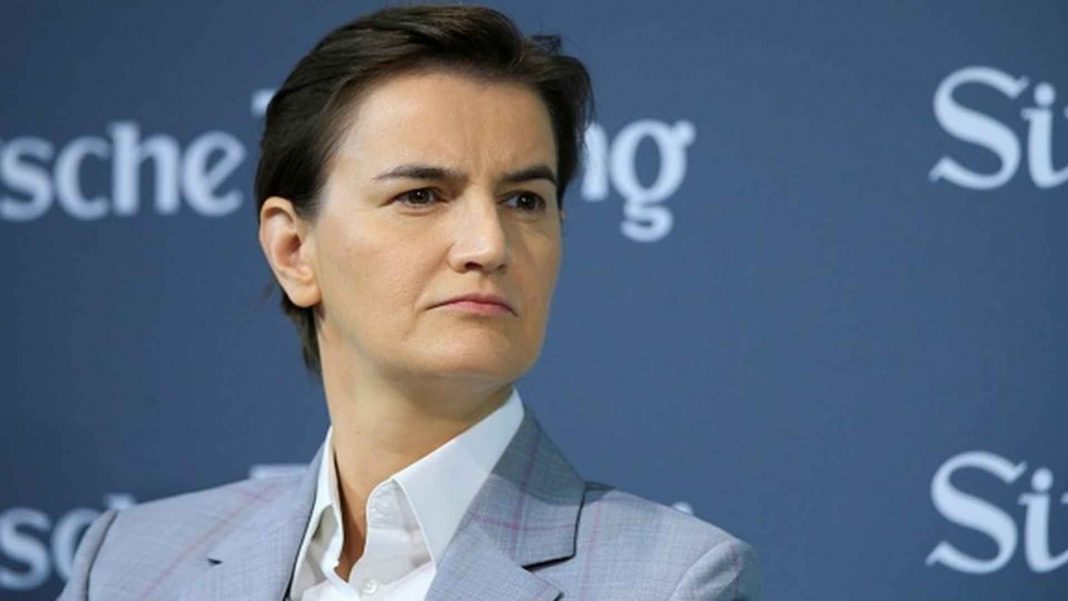
Serbia’s Prime Minister Ana Brnabić has expressed approval of the letter sent on August 8 to European and American lawmakers, which called for a more assertive stance towards Serbia; however, she called it a “positive signal” that serves as “living proof” that her Kosovar counterpart, Albin Kurti, is actually receiving “full support and encouragement” for destabilizing peace and stability in the Balkans.
This letter and the tweets by @aliciakearns, @MiRo_SPD and @SFRCdems are more than welcome, as they provide living proof that Kurti does indeed enjoy full support and encouragement for undermining peace and stability in the Balkans,⬇️ https://t.co/5bG4TxJl13
— Ana Brnabic (@anabrnabic) August 8, 2023
On August 7, a multitude of European and American politicians addressed a letter to the chief diplomat of the European bloc, Josep Borrell, the U.S. Secretary of State Antony Blinken, and the UK’s James Cleverly. This letter called for a revision of the approach towards both Kosovo and Serbia.
British MP Alicia Kearns, the letter’s publisher, indicated that it bore the signatures of ten foreign affairs committee chairs and 56 MPs.
Among the co-signers of the letter were also U.S. Senator Bob Menendez and Congressman Ritchie Torres.
10 Chairs of Foreign Affairs Committees and 56 Parliamentarians have called on the US, EU & UK to change our approach to #Kosovo and #Serbia.
We need deterrence diplomacy, where we ensure there is balance in our dealings, and we do not repeat the mistakes of the past. 1/ pic.twitter.com/zEYsvTNFP3
— Alicia Kearns MP (@aliciakearns) August 6, 2023
Kosovo’s President Vjosa Osmani warmly received this letter, describing it as exposing Serbia’s “destructive and destabilizing agenda”.
The letter underscored that “Kosovo has endured significant repercussions following leaders’ attempts to enter their offices in northern Kosovo”.
“While Kosovo must collaborate with KFOR in the future to avert escalations, the absence of pressure on Serbia following the arbitrary detention of three Kosovo police officers and the failure to hold accountable those who attacked KFOR underscores the inequality in addressing tensions,” the letter highlighted.
During a period of heightened tensions, three Kosovo police officers were apprehended by Serbian forces on June 14. While Kosovo contended that they were “abducted” within its borders, Serbia argued that their arrest took place “deep within” Serbian territory. The officers were subsequently released on June 26.
Brnabić took to social media to point out that the striking example of the lack of credibility and objectivity among the initiators of the letter is Alicia Kearns, who “became one of the rare individuals whose public statements had to be refuted by KFOR”.
Brnabić referred to Kearns’ statement made on July 4, where she claimed that guns from Serbia were being illicitly transported into Kosovo using ambulances and were being stored in Serbian Orthodox Church buildings.
On July 5, NATO’s peacekeeping mission in Kosovo, KFOR, clarified that the case to which the British MP referred dated back to 2022 when a British infantry battalion was stationed in northern Kosovo to support KFOR.
“Though reports of alleged illegal weapons were made to KFOR Headquarters, further investigations yielded no evidence” of smuggling, KFOR’s statement concluded.
Concurrently, Kosovo’s Prime Minister Albin Kurti informed that efforts were underway to verify the information presented by the British MP.