

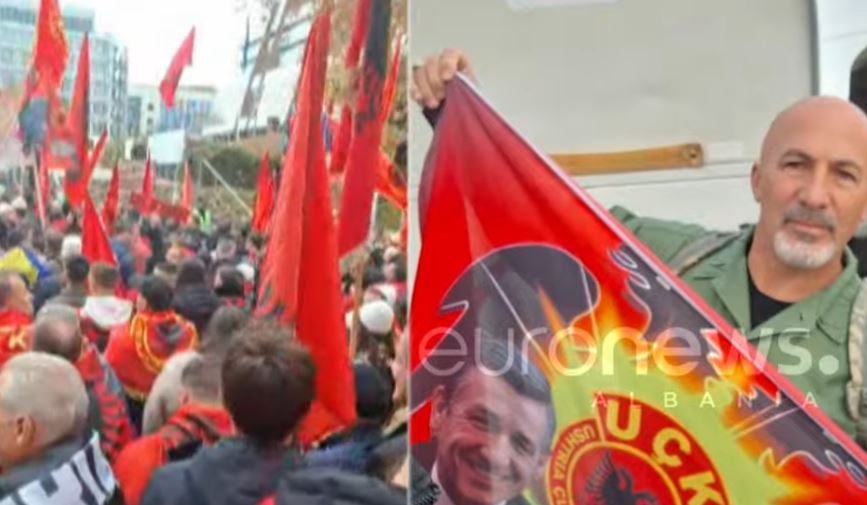
After protests held in several European cities, the objections to the trial of the former leaders of the Kosovo Liberation Army (KLA) have now reached Strasbourg, France, in front of the Parliamentary Assembly of the Council of Europe.
According to local media, around six thousand people are expected to participate in this protest.
The purpose of the protest, organized by associations formed after the KLA war, is to express dissatisfaction with the trial of its former senior leaders — Hashim Thaçi, Kadri Veseli, Jakup Krasniqi, and Rexhep Selimi — at the Kosovo Specialist Chambers in The Hague.
The trial against Thaçi, Veseli, Krasniqi, and Selimi began in 2023 and is moving toward its conclusion. All of them deny the charges of war crimes and crimes against humanity.
Before Strasbourg, similar protests were held in Tirana, The Hague, and Pristina.
Organizers said the protest in Strasbourg brings Albanians together “at the place where the unjust saga against our history began.”
A 2010 report, drafted by former Swiss senator Dick Marty and adopted by the Parliamentary Assembly of the Council of Europe, claimed that KLA leaders were involved in organ trafficking during the 1998–99 war.
This report led, in 2015, to the establishment of the Kosovo Specialist Chambers to investigate alleged crimes committed by KLA members against ethnic minorities and political rivals.
The Trial in The Hague
The trial of the four former KLA commanders began in 2023, three years after they were arrested and transferred to detention at the Kosovo court in The Hague.
Now, more than two years later, the trial is approaching its end, as the defense team of former Kosovo president Hashim Thaçi has begun presenting its witnesses.
In September, testimonies were given by the former U.S. Assistant Secretary of State, James Rubin; Paul Williams, the legal advisor of the Kosovo delegation during the 1999 Rambouillet negotiations; the former U.S. special envoy during the Kosovo war, Chris Hill; and former British diplomat John Stewart Duncan.
All of them said in their testimonies that Thaçi did not have authority over the KLA.
The Special Court expects the trial against the former KLA leaders to conclude by the end of December.
Thaçi was the political leader of the KLA before and during the 1998–1999 war; Veseli led the intelligence service; Krasniqi served as spokesperson; and Selimi was a member of the general staff.
The indictment against them includes charges of unlawful detention, torture, murder, crimes against humanity, enforced disappearance, and persecution of hundreds of civilians and non-combatants.
These crimes are alleged to have occurred between March 1998 and September 1999 in various locations in Kosovo and also in northern Albania.
According to the Specialist Chambers, Thaçi, Veseli, Krasniqi, and Selimi bear individual criminal responsibility for these crimes, but all of them plead not guilty.
Defense lawyers have stated that the KLA would not have received international support if a criminal plan — as claimed by the prosecution — had existed.
According to them, the indictment is based on a selective misinterpretation of events.




