

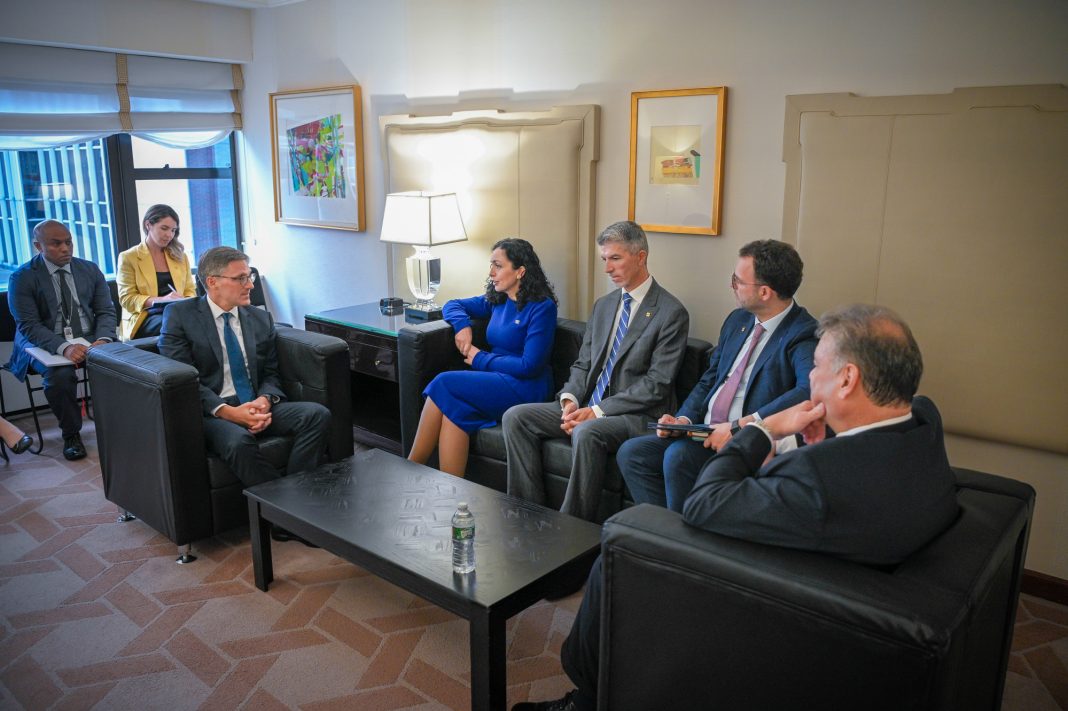
Derek Chollet, senior advisor at the United States Department of State, engaged in discussions with Kosovo’s President Vjosa Osmani, regarding Kosovo’s involvement in the dialogue for normalizing relations between Pristina and Belgrade, as well as the pressing need to de-escalate tensions in northern Kosovo.
In New York, Chollet and the U.S. Special Envoy for the Western Balkans, Gabriel Escobar, held talks with President Osmani.
“Good discussion with President Vjosa Osmani on our shared commitment to Kosovo’s Euro-Atlantic future, the need to de-escalate tensions, and engage urgently in the EU-Facilitated Dialogue to normalize relations with Serbia – the key to regional stability and EU integration,” Chollet shared on X (formerly known as Twitter).
Good discussion with President @VjosaOsmaniPRKS on our shared commitment to Kosovo’s Euro-Atlantic future, the need to de-escalate tensions, and engage urgently in the EU-Facilitated Dialogue to normalize relations with Serbia – the key to regional stability and EU integration. pic.twitter.com/vMHxk2mcsT
— Derek Chollet (@CounselorDOS) September 19, 2023
Meanwhile, President Osmani underscored the importance of adhering to “a principled approach for the full and equitable implementation of agreements” achieved within the dialogue process during her meeting in the United States.
“The role of the U.S. is key to successfully conclude the process, paving the way for mutual recognition,” Osmani wrote on X.
With @CounselorDOS Chollet & DAS Escobar we discussed developments in the dialogue.
Stressed the importance of a principled approach to full & balanced implementation of agreements & that 🇺🇸 role is key to successfully conclude the process, paving the way for mutual recognition. pic.twitter.com/jYHPF9Y1y5
— Vjosa Osmani (@VjosaOsmaniPRKS) September 18, 2023
This meeting between President Osmani and high-ranking U.S. officials comes one week after the last round of Kosovo-Serbia dialogue in Brussels concluded without any tangible results.
Following the meeting on September 14, the EU stated that Kosovo’s Prime Minister Albin Kurti displayed reluctance to move forward, in contrast to Serbia’s President Aleksandar Vučić, who “accepted their proposal” for implementing the Basic Agreement on normalizing Kosovo-Serbia relations.
The EU’s High Representative for Foreign Affairs, Josep Borrell, and the EU’s Special Envoy for the dialogue, Miroslav Lajčák, facilitated the meeting and indicated that Kurti had insisted on Serbia first formally acknowledging Kosovo’s de facto status.
On September 18, Prime Minister Kurti accused Lajčák of showing “partiality”, asserting that he had “taken sides” against Kosovo.
Kurti revealed that during the Brussels meeting, he had presented his plan for the sequential implementation of the Basic Agreement and its Annex, to which Kosovo and Serbia had previously agreed earlier this year. However, he contended that Serbia and the EU had rejected his plan.
This agreement does not encompass mutual recognition, which Kosovo insists upon, but rather it necessitates Kosovo and Serbia acknowledging each other’s documents and symbols, encompassing passports, diplomats, and license plates. Furthermore, the parties commit to enacting the agreements reached earlier in the dialogue process.
Kurti elucidated that his proposed plan for the Basic Agreement’s implementation was a “specific, highly constructive proposal founded on the principle of comprehensiveness”. He emphasized that comprehensiveness is also embedded in this agreement and its annex, which stipulates that “every article of the Basic Agreement must be executed, and the parties must not raise objections to any article”.
When asked if he would seek U.S. intervention in the dialogue, Kurti stated that both Washington and Brussels are united in this process.
“Our intention is not to replace one superpower with another. We need both the EU and the U.S. However, we do not require such a one-sided, entirely impartial and correct mediation, which contradicts the Basic Agreement, as has occurred with [the mediation of] envoy Lajčák,” Kurti remarked.
Lajčák met with Chollet and Escobar in the U.S., and they all shared the same “assessment of the situation in the Western Balkans”.
“It is always useful to reconfirm that we share the same reading of the situation in the Western Balkans and are on the same line regarding the way forward,” he wrote on X.
Had dinner among good friends in New York with @CounselorDOS Derek Chollet and DAS Escobar. Always useful to reconfirm that we share the same reading of the situation in the Western Balkans and are on the same line regarding the way forward. pic.twitter.com/6xmlc6ACG0
— Miroslav Lajčák (@MiroslavLajcak) September 19, 2023
Kosovo and Serbia have been engaged in dialogue under EU mediation since 2011, a process that the U.S. supports.
The most recent dialogue round marked the first meeting between Kurti and Vučić since tensions escalated in northern Kosovo in late May.
Local Serbs have been opposing the newly elected Albanian mayors who emerged from the April elections, a vote that Serbian parties and the Serb population boycotted.
The U.S. and the EU have called for reduced tensions and new elections in Kosovo. They have also commended Kosovo’s efforts to decrease police presence and enable the removal of mayors through petitions. Nevertheless, the EU has urged both parties to take further action to de-escalate the situation.