

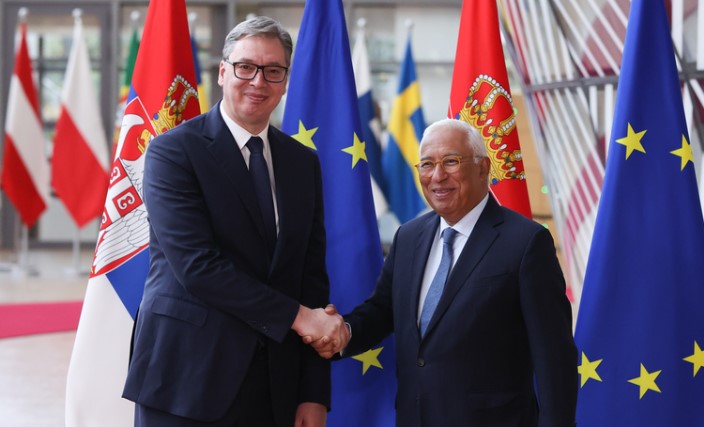
The President of the European Council, António Costa, called on Serbia to accelerate its reform agenda and advance dialogue with Kosovo, stressing that European Union enlargement is a strategic necessity.
Speaking at a joint press conference with Serbian President Aleksandar Vučić, Costa stated that the path toward EU membership is based on trust and tangible progress in three key areas:
- Good-neighborly relations and regional cooperation.
- Alignment with EU policies and values.
- Implementation of internal reforms.
Costa emphasized that the Belgrade–Pristina dialogue and the full implementation of the Ohrid Agreement remain essential for regional stability and security.
He also called for further progress in:
- The rule of law.
- Media freedom.
- Electoral reform in line with international recommendations.
While welcoming the adoption of four electoral laws last week, Costa noted that Serbia must still address concerns regarding the misuse of state resources and pressure on voters.
According to Costa, the door to the European Union remains open for Serbia, but the time for concrete decisions and actions is now. He stressed that the pace of European integration ultimately depends on Serbia’s own commitment and determination to carry out the required reforms.
In his remarks, Costa described EU enlargement as more than just an opportunity:
“In these times of global geopolitical uncertainty and economic instability, enlargement is not merely an option. It is a geostrategic necessity for Europe. It is an investment in peace, stability, security, and prosperity for our continent.”
He further underlined that Serbia’s accession process should involve all sectors of society, including the opposition and civil society, arguing that EU membership is not solely the responsibility of the government but a national project requiring broad societal engagement.
Costa concluded by reaffirming the EU’s support for Serbia’s European path:
“The European Union remains Serbia’s most important partner in trade, investment, and the strengthening of democratic institutions. We want to do more and are ready to do more. But the pace of progress depends on Serbia itself. The EU’s door remains open, but the moment for decisive action is now.”
He expressed confidence that, through cooperation and commitment, Serbia could achieve the shared goal of becoming a full member of the European Union.




