

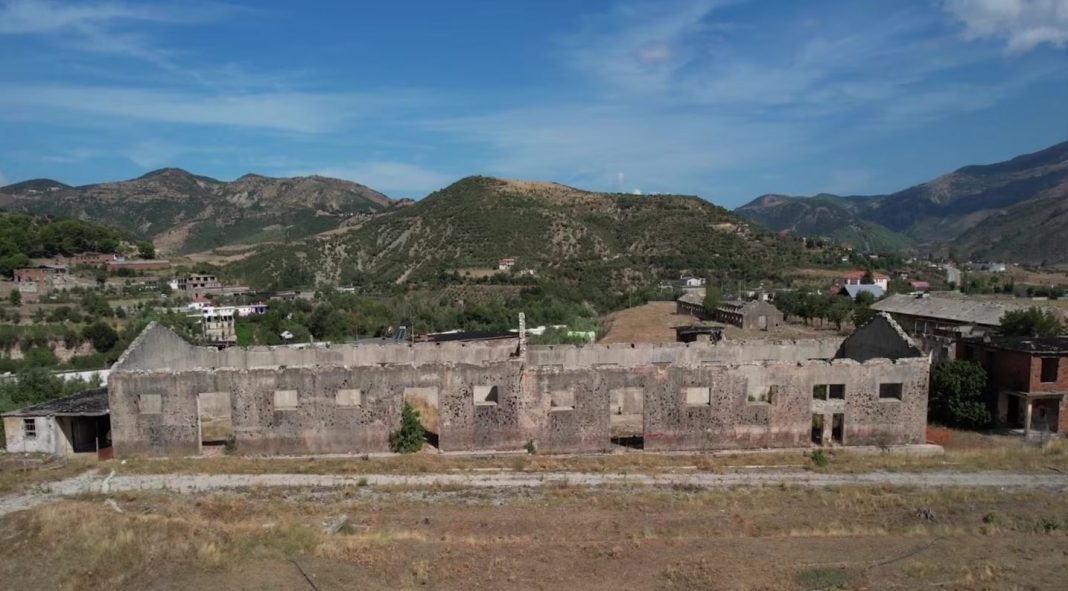
Five years ago, the Ministry of Culture in Albania announced its plans to protect and preserve the former internment camp in Tepelena, with the goal of transforming it into a national museum.
Despite some limited efforts over the years to convert the former military barracks into a memorial, the crumbling ruins continue to attract the attention of both local and foreign visitors.
Scholars argue that Albania still lacks a comprehensive reflection on its communist past. Despite various legal initiatives, the country is yet to establish a museum dedicated to the victims of communism and those who endured the hardships of internment and forced labor.
Witnesses who once walked the grounds of the Tepelena internment camp, enduring their captivity from 1949 to 1954, are becoming increasingly rare.
Many of their contemporaries have either passed away or are no longer able to revisit the place where they suffered.
Approximately 3,000 individuals experienced internment at this camp, and tragically, around 500 of them lost their lives, including roughly 300 children.
Even though nearly three decades have passed since the fall of communism in Albania, the nation has yet to comprehensively address its communist history. Enriketa Pandalejmoni, a history professor at the University of Tirana, highlights the lack of proper education on the topic, especially in school textbooks with limited hours dedicated to the subject.
Despite some legislative initiatives, tangible progress remains elusive, particularly concerning the establishment of a memorial or museum dedicated to the victims of communism.
One of the ongoing projects involves the transformation of the former internment camp in Tepelena into a museum symbolizing the suffering endured by those who were imprisoned, deported, and subjected to forced labor. However, progress on this front has been slow.
Tepelena’s local authorities have incorporated the former camp into virtual tours and tourist itineraries, making it a popular destination for both Eastern and Western European tourists.
This five-year journey began when the history of the Tepelena internment camp and the events that transpired between 1949 and 1954 began to gain recognition. However, it has not been an easy process due to public opinion and the lingering impact of historical narratives. While the area has become a “modest” tourist destination, it is still too early to consider it a fully sustainable one.
In the current year, opposition lawmakers have proposed the transformation of the Spaç prison and the former Tepelena internment camp into museums, a matter that is currently under consideration by the Albanian Parliament.
The former internment camp in Tepelena, a place that bears witness to the immense suffering during a dark period in Albania’s history, continues to illuminate the understanding of human resilience to this day.




