

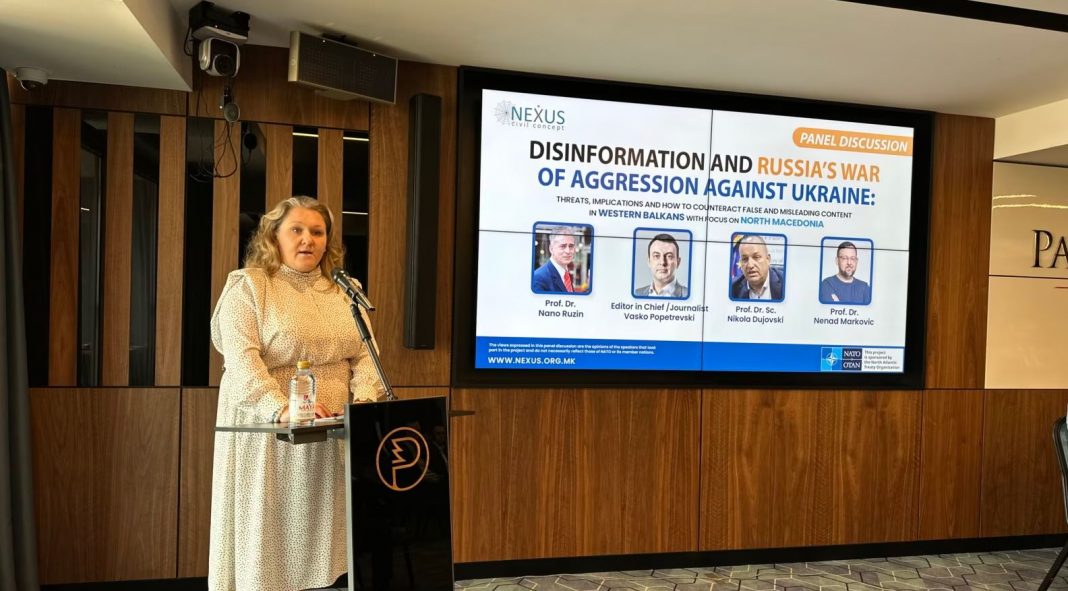
North Macedonia’s Defense Minister Slavjanka Petrovska voiced concerns on Wednesday regarding Russia’s dissemination of false information within North Macedonia, suggesting that it is sowing division “among citizens along national lines” and has the underlying goal of eroding confidence in local institutions.
Petrovska made these remarks during a panel discussion titled “Disinformation and Russia’s Aggressive War against Ukraine”, hosted by the non-governmental organization NEXUS in Skopje.
“In this conflict, Russia exploits historical ties to Slavic identity among certain populations in these regions, leverages economic relationships, and simultaneously utilizes specific political entities as conduits for disseminating disinformation and diverting public opinion,” Minister Petrovska remarked.
She underscored that Russian disinformation poses a security challenge, “not only for countries in the Western Balkans but also for a broader audience”.
Petrovska called for increased cooperation among regional nations to counteract Russian disinformation.
Afrodita Musliu from NEXUS pointed out that North Macedonia’s institutions lack effective mechanisms to defend against false information.
“There is a prevailing impression that our weak defenses against the influx of disinformation and false news leave us vulnerable and susceptible to external influences,” Musliu noted.
Nikolla Dujovski, a lecturer at the Faculty of Security in Skopje, highlighted the diversity of opinions among young people in North Macedonia regarding Russia’s conflict in Ukraine. He stated that roughly half of them support Russia.
“Several studies conducted in North Macedonia indicate a roughly even divide among young people here – half supporting Russia in the Ukraine conflict and the other half supporting North Macedonia’s path toward European integration, with a positive view of NATO and the EU’s policies toward Ukraine. Regrettably, this is the reality we must acknowledge,” Dujovski explained.
Nenad Markovic, a university professor specializing in International Relations, argued that the stagnation of the integration process enables pro-Russian sentiments to gain traction in North Macedonia.
“Deep-seated frustration with the Western orientation fuels pro-Russian sentiments in North Macedonia,” Markovic emphasized.
Furthermore, journalist Vasko Pop Petreski highlighted how Russia has expanded its influence in North Macedonia through frequent posts from its embassy in Skopje. He cited data from a study conducted by the Center for Democracy in Sofia, revealing that the Russian embassy outpaced other embassies, including those of the United States, the United Kingdom, France, Germany, and EU member states, in terms of publication frequency in 2021 and 2022.