

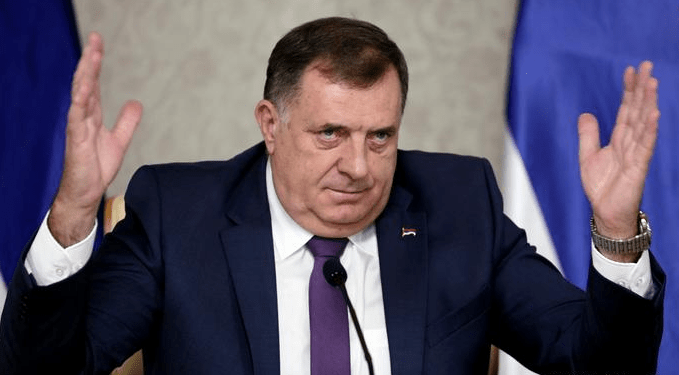
The US Embassy in Sarajevo accused the President of the Republika Srpska, Milorad Dodik, on Friday of a “direct attack on the state structure of Bosnia and Herzegovina and the Dayton Peace Agreement”, which ended the war in 1995.
During the night between Thursday and Friday, the Assembly of the Republika Srpska approved the electoral bill of this entity, the text of which envisages usurping the competencies of Bosnia and Herzegovina for the conduct of elections in the country.
This stance of the Serb entity followed the announcement of the High Representative for Bosnia, Christian Schmidt, about changes in the electoral process in Bosnia and Herzegovina. The announcement, supported by the United States, was opposed by Milorad Dodik, who demanded on Thursday that within seven days the decisions of Schmidt be revoked, “otherwise the representatives of Republika Srpska will abandon the decision-making institutions of Bosnia and Herzegovina” and will not return.
In a statement by the US Embassy in Sarajevo, it is said that the conclusions and legislation that Milorad Dodik and his coalition partners in the government of the Republika Srpska issued, “represent a direct attack on the state structure of Bosnia and Herzegovina and the Dayton Peace Agreement. As Mr. Dodik and his cronies often do, they demonstrated their contempt for democracy and political pluralism with the despicable language they directed at assembly members who opposed these measures.”
The Embassy emphasizes that it is not surprising that Dodik and his sycophants attacked the recent action of the High Representative to strengthen the integrity of the electoral process, “given that free and fair elections present an existential threat to parties that rely on fraud to maintain their hold on power.”
The US Embassy warns that the Republika Srpska electoral bill “would usurp state-level competencies and create a parallel electoral system”. This, the statement says, is yet another example of Dodik’s destructive, anti-Dayton policies, which have hindered Bosnia’s path toward Euro-Atlantic integration.
Milorad Dodik said on Thursday that the ambassadors of the United States, Britain, and Germany, as well as Representative Schmidt, should be declared enemies of Bosnia and expelled from the country.
The US Embassy did not comment on these demands, but said that if Dodik wanted to facilitate the closure of the Office of the High Representative and rapidly advance Bosnia’s integration into European institutions, he could do so by engaging in good faith negotiations aimed at forging consensus and compromise as well as by embracing reforms consistent with European standards rather than resisting them through a policy of blockades, blackmailing and bullying.
The session of the Republika Srpska Assembly, the statement says, is yet more evidence that Dodik does not care about the people of this country, including the residents of the Republika Srpska, and is prepared to sacrifice his constituents’ prosperity to his own narrow political and financial interests.
“The United States strongly supports Bosnia and Herzegovina’s territorial integrity, sovereignty, and multiethnic character, and we will continue to use the tools at our disposal to address anti-Dayton actions,” stated the US Embassy in Sarajevo.
A pro-Russian politician, Milorad Dodik, who has previously called for the secession of his entity and unification with Serbia, is under sanctions from the United States and the United Kingdom.
After the war of the 1990s, which left over 100,000 dead, Bosnia was divided into two autonomous entities, the Republika Srpska and the Federation dominated by Bosniaks and Croats, linked by a weak central government in Sarajevo.




