

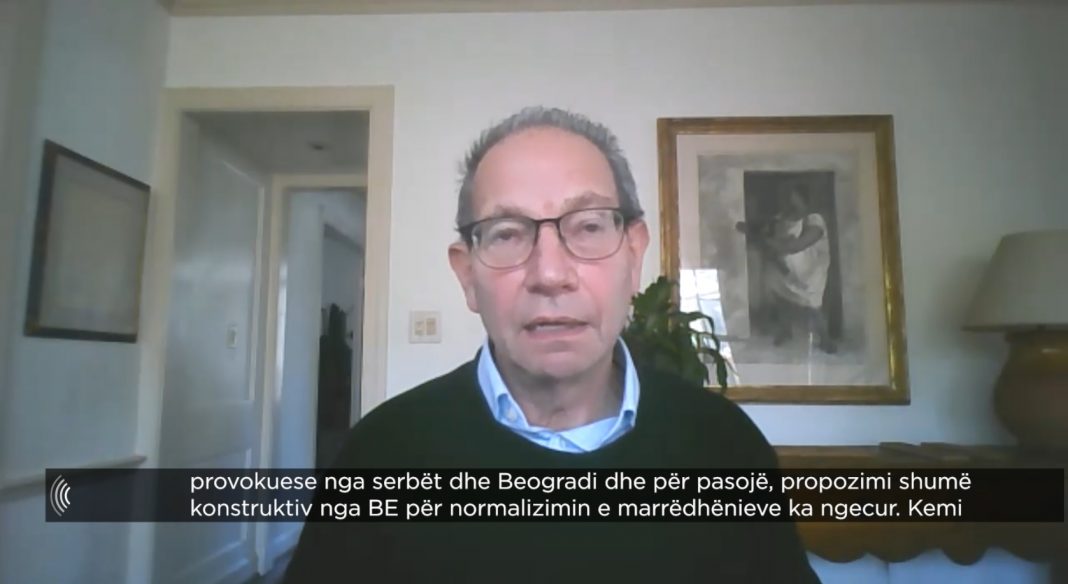
Charles Kupchan, an academic at the Council on Foreign Relations, was the guest this Saturday on the “Inside Albania” podcast hosted by journalist Alice Taylor.
Kupchan conducted a detailed analysis of the security situation in the Western Balkans, warning that there is a risk of escalating violence with ethnic motives in the region.
“There is clearly a risk of violence, and it is evident from the fact that we have seen recent outbreaks of violence in north Kosovo and Banjska. The situation in Kosovo has not improved since the country declared independence, and in fact, we have seen recent regressions due to some actions by the Government in Pristina, such as changing license plates, identity cards, appointing mayors in northern municipalities, even though they were elected by a very low percentage of the population. These are considered provocative actions by the Serbs and Belgrade, and as a result, the very constructive proposal by the EU for normalizing relations has stalled. We have heard reports of Serbian army mobilization on the border with Kosovo; NATO talks about a permanent increase in KFOR. We can conclude that isolated cases of violence may escalate,” explained Kupchan.
Asked whether the actions of the Kosovo Government are justified, Kupchan explains that beyond legal and moral justification, Prime Minister Albin Kurti is not acting wisely in the political aspect.
“There is no doubt that Pristina has the legal and moral right to want the territory that is part of sovereign and independent Kosovo and to join it with the central government, to integrate them into a broader multi-ethnic society. Whether the steps taken by Kurti are productive or not, that’s another debate. I think the current government has taken some steps that have damaged Kosovo’s position in the court of public opinion. At the time of NATO intervention that led to the separation of Kosovo from Serbia, the court of public opinion was on Kosovo’s side, and Serbia, Vučić, and those before him were seen as the problem. Now we have a situation where the U.S. and the EU see Pristina as the problem. They are taking actions that do not help the country progress toward the agreement that the EU has put on the table. Even if what Kurti is doing is legally and morally justified, it is not politically wise”.
Kupchan also analyzed the major problem of arms trafficking in the Western Balkans and the risks arising from weak states that cannot control societies.
“I think the situation in the Western Balkans, broadly speaking, is very problematic. There is widespread arms trafficking, smuggling, and human trafficking. In many respects, I think this problem arises because of weak states. It comes from governments that do not have the capacities we associate a modern state with. So, they do not have full control over society, are unable to use police forces, bureaucracies, ministries to establish control over the illicit flow of arms and people. In a way, we need to go to the root of the problem, in order to build state capacities. This, over time, requires the Western Balkans to integrate into Europe. Therefore, when it comes to Kosovo and Serbia, Republika Srpska and Bosnia and Herzegovina, these problems cannot be allowed to fester. This is because they not only pose a risk of ethnic violence but also hinder the governments’ building of state capacities and the creation of functional institutions needed to control the illicit flow of arms and people”.
However, for the American expert, there is no doubt that the future of the Western Balkans lies in Euro-Atlantic institutions as the natural orientation of the region.
“In the Biden administration, there are many individuals with an Atlanticist nature, including President Biden, who has been engaged in the Balkans for a long time. I think there is also a renewed commitment in Europe. The region has suffered from neglect from Washington and the EU, but now I see them trying to redress this situation. I am optimistic, I believe the region will be fully integrated into Euro-Atlantic institutions. It’s a matter of time, not if it will happen”.
Whether Russia has influence in the region through Serbia as its satellite, expert Kupchan believes that the Kremlin is losing ground in the Western Balkans despite interventions.
“Russians have long tried to prevent the integration of the Western Balkans into Europe and Atlantic institutions. Whether it’s the issue of the name between North Macedonia and Greece, Montenegro’s NATO membership, the stability of Bosnia and Herzegovina, intelligence operations in Serbia, Serbia’s relations with Kosovo, wherever you look, you can find traces of Russia’s involvement. I think on this trajectory, Russia is losing ground. This is partly because some of the divides that Russia sought to exploit have been overcome. The Russians failed to block Montenegro’s NATO membership. They failed to prevent Greece and North Macedonia from reaching a solution to the name issue. Gradually, Russian influence is waning, and I believe that the Russian invasion of Ukraine is accelerating this. Even a country like Serbia, which does not support Ukraine or align itself with the West on imposing sanctions, can see the same picture, that Russia has taken a bold aggression against its neighbors. From many perspectives, I believe we are witnessing Russia’s last gas to prevent the integration of the Western Balkans”.
For journalist Alice Taylor, Kupchan indicated in which areas Russia might try to extend influence after the Western Balkans.
“I think the answer is in the Caucasus and Central Asia. They will try to have an impact in Syria and Africa through the Wagner Group. But because of the distance, because of the position of the Western Balkans, I don’t think they will have much energy and attention left for this part of Europe, as much as the Russians continue to play the role of spoiler. It will end up dealing with countries closer to it, especially in the Caucasus and Central Asia because it is easier to intervene there than in the Western Balkans,” concluded Kupchan.




