

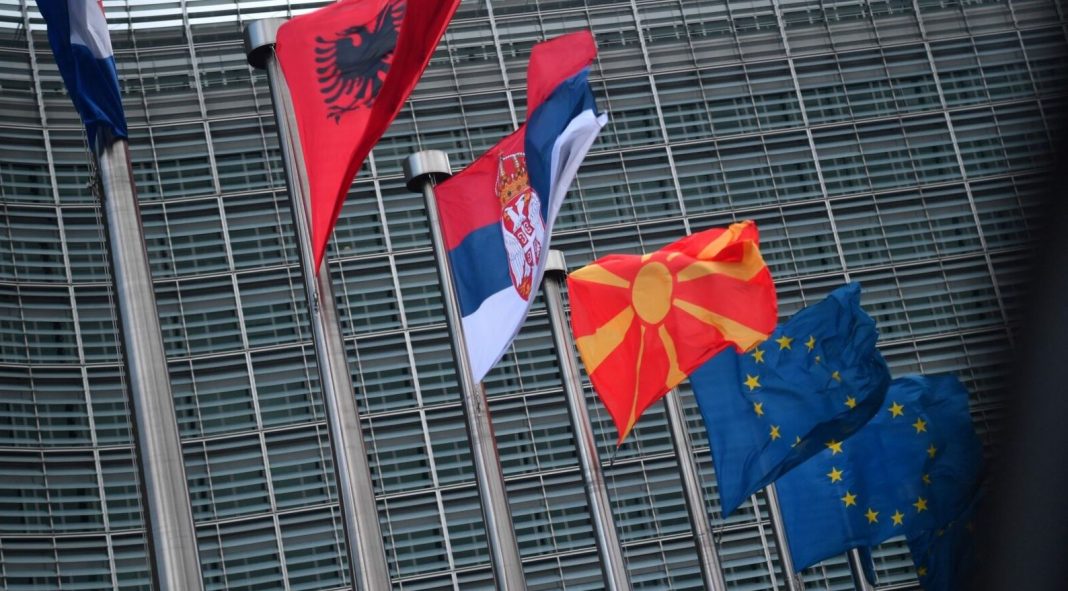
Under the shadow of the enlargement package, approved by the European Commission in Brussels this Wednesday, an ambitious plan for economic growth in the Western Balkans was also approved. Prior to its formal approval, European Commission President Ursula von der Leyen had already traveled to the region to promote this plan.
Radio Free Europe has gained access to a document outlining strategies for aiding Western Balkan countries in achieving economic convergence with the European Union and preparing for EU membership even before formal accession. The plan consists of various proposals for integrating Western Balkan nations into multiple EU policies and programs before becoming full-fledged members.
To realize the objectives of this growth plan, the European Commission has put forth a substantial financial assistance package of 6 billion euros for the period spanning from 2024 to 2027. According to the plan, up to 2 billion euros of this sum will be provided as non-repayable assistance, while the remaining 4 billion euros will be available in the form of favorable loans or capital investments. A portion of these financial resources can be allocated directly to the budgets of the region’s countries to be used for these purposes.
The report states, “Economic convergence is a critical factor in bringing Western Balkan countries closer to the European Union. Currently, the pace and level of convergence between the region’s countries and the EU are unsatisfactory, both economically and in terms of reform. This is impeding their progress towards EU membership”.
This document also presents data on Gross Domestic Product per capita, based on purchasing power, in comparison to the EU average. For instance, Kosovo’s indicator stands at only 27 percent in contrast to the EU average.
The European Commission has formulated a new growth plan for the Western Balkans structured around four pillars.
The first pillar emphasizes “strengthening economic integration into the EU single market”. This will be contingent on the region’s countries adapting to the rules of the single market and concurrently opening their markets in relevant sectors to neighboring countries.
The second pillar of this plan underscores “strengthening economic integration within the Western Balkans through a common regional market”. As per the EU’s experience, this could potentially lead to a 10 percent increase in economic growth.
The third pillar of the plan focuses on “accelerating fundamental reforms”. This includes implementing rule of law reforms that attract foreign direct investments and bolster regional stability.
The fourth pillar of the European Commission’s new plan for economic growth in the Western Balkans centers on “increasing financial assistance to support reforms”. This encompasses the proposal for 6 billion euros in aid.
Following the region’s countries’ benefit from trade relations with the European Union, including the Stabilization and Association Agreements, the European Commission proposes moving beyond these agreements to establish equitable conditions in trade between the expansion process and EU member states.
All these goals align with initiatives being executed through the Berlin Process and the creation of a “common regional market”.
Implementing these proposals will enhance the freedom of movement for goods, labor, and services among the countries in the region and between them and the European Union. Examples include establishing “green lanes” at border crossings to expedite the movement of goods with faster customs procedures.
The Commission also mentions eliminating roaming charges for mobile phones and the internet. While this is already in place in the EU and is progressing in the region, the Commission suggests removing roaming charges between Western Balkan countries and the EU.
There will also be accommodations for young people, who will find it easier to pursue studies in EU countries if this plan comes to fruition.
Even before joining the EU, Western Balkan countries will participate in various working groups of the European Union.
“At a minimum, Western Balkan countries should fully participate in relevant EU programs, including, in particular, the single market program, fiscal and customs program, European digital program, and Horizon Europe program,” the document specifies.
The Commission’s proposal underscores that the region’s countries must simultaneously intensify cooperation among themselves and achieve the objectives of the common regional market, in addition to accelerating the reform process, especially in terms of rule of law and governance.
The European Commission is confident that by seizing the opportunities presented by the growth plan, the Western Balkans will expedite their journey toward integration into the European Union.