

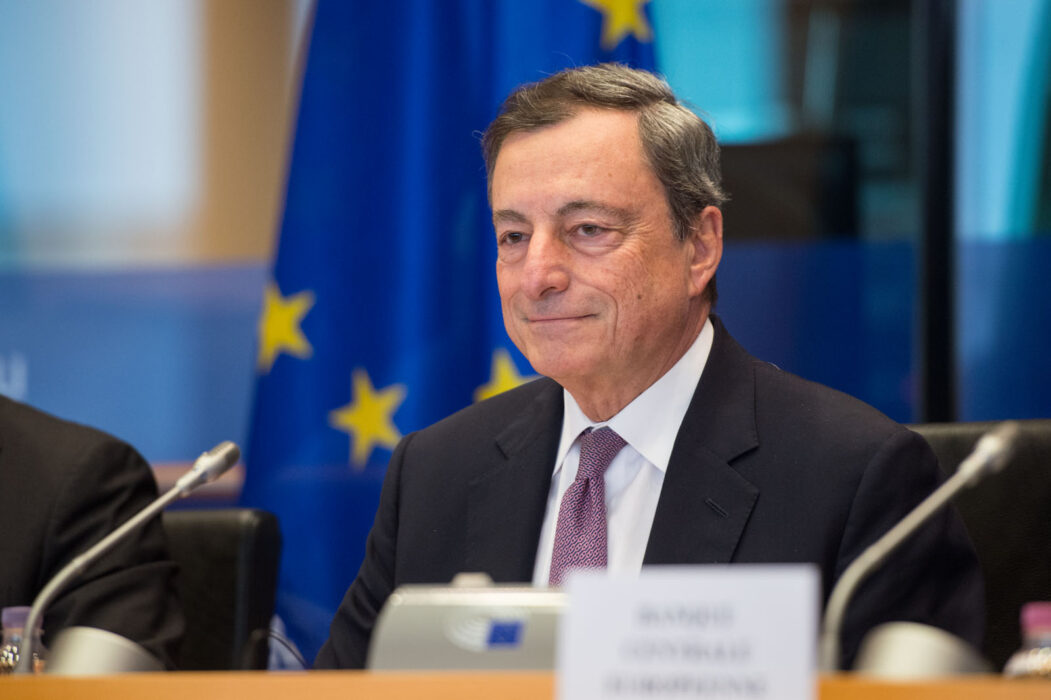
Mario Draghi: The bloc lags behind global peers
Former President of the European Central Bank Mario Draghi has expressed a pessimistic outlook on the economic growth of the European Union, foreseeing a recession by the year’s end. He also cautioned that the enduring success of the European project hinges on urgent political integration.
“It is almost certain that we will experience a recession by the end of the year,” he remarked during the Financial Times Global Board conference.
“It is abundantly clear that the first two quarters of the coming year will reflect this”.
While Draghi indicated that the recession is unlikely to be “deep” or “destabilizing”, his evaluation contrasts with recent forecasts from both the ECB and the IMF, which anticipate a resurgence in European growth in the latter part of this year.
Draghi’s warning comes at a time when the EU is grappling with consecutive crises stemming from the coronavirus pandemic and the ongoing conflict between Russia and Ukraine. These challenges have laid bare vulnerabilities in the bloc’s supply chains, energy markets, and global interdependencies.
“Either Europe acts cohesively and forges a stronger union capable of expressing foreign and defensive policies, in addition to economic policies… or I fear the European Union will persist solely as a single market,” Draghi added.
Tasked by the European Commission to prepare a report on how the EU can navigate global competition, especially in comparison to the U.S. and China, both heavily invested in supporting their economies’ green transition, Draghi emphasized the need for concern.
“We must be greatly concerned about this. The European economy has lost competitiveness over the last 20 years, not only to the United States but also to Japan, South Korea, and, of course, China,” Draghi stated.
This shift, he noted, occurred as the bloc’s previous model, relying extensively on the United States for defense, China for trade, and Russia for energy, has come to an end.
“The geopolitical and economic model on which Europe has relied since the end of World War II has disappeared”.
Draghi highlighted Europe’s challenges, including low productivity, high energy costs, and a shortage of skilled labor.
“To have an economy capable of supporting an aging society at the pace we have in Europe, we need much higher productivity. Our area of focus should be energy. We are not progressing while paying for energy two or three times more than it costs in the rest of the world”.
While the eurozone economy contracted by 0.1 percent in the third quarter compared to the previous quarter, according to preliminary estimates from Eurostat, many economists anticipate further contraction in the fourth quarter.
Nevertheless, the latest ECB forecast for the eurozone suggests a return to economic growth by 0.1 percent in the final quarter of this year, 0.3 percent in the first quarter of 2024, followed by a period of average growth at 0.4 percent.
Draghi expressed optimism that the impact of the anticipated recession on the European economy would be tempered by the relatively low level of unemployment, which increased slightly in September after reaching a record low of 6.4 percent earlier this year.