

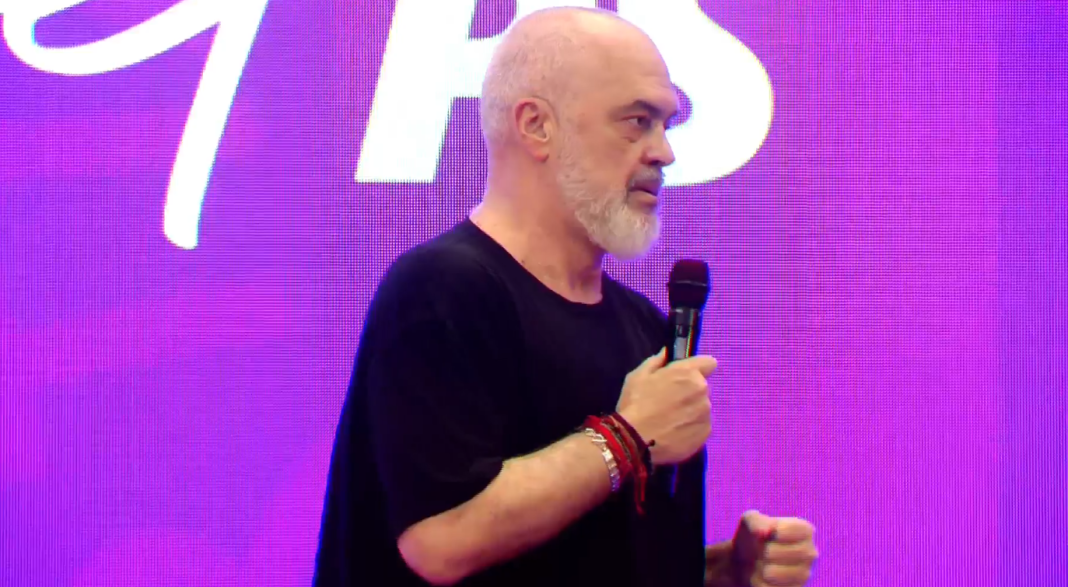
Prime Minister Edi Rama, speaking at an event in Elbasan marking the 35th anniversary of the Socialist Party, also addressed the protests that have taken place in recent days across the country.
Referring to foreign investments in Montenegro, Rama argued that such projects have played a key role in that country’s development, while in Albania, according to him, protesters are resisting development initiatives.
He stated that the project at the center of the debate is worth €4 billion, describing it as the largest tourism investment in Europe. Rama added that, in his view, a distorted image of Albania is being created through social media and public reactions.
“And should we act like the cow, as the saying goes, that fills the bucket and then kicks it over at the end, showing the world a completely different image from who we really are? Should we act like the cow by spreading all kinds of messages through the mud-filled channels of social media, where Albanians say things they have never said before?
The Albanian’s home belongs to God and to the guest; even the Kanun says so. Albanians are masters of their own homes, but Albania is open to everyone,” Rama said.
Continuing his argument, Rama stressed that Albania should follow development models similar to those adopted by neighboring countries that have benefited from tourism and large-scale investments. He once again emphasized the importance of the tourism sector as a driver of economic growth.
He cited both Greece and Montenegro as examples of countries that have significantly benefited from tourism development and foreign investment.
“Look at Greece to the south and what it has achieved through tourism, and look at Montenegro to the north—a country smaller than Albania, with only 500,000 to 600,000 inhabitants, a much smaller territory, and fewer natural resources.
For years, Montenegro has led the Western Balkans in wages, pensions, and financial support for those in need. It has no major factories, produces neither cars nor tractors nor ships, and does not have a developed industrial sector. Agriculture is limited, and a significant share of agricultural products comes from Albania.
So how does it manage to have higher incomes even than Serbia, the region’s largest country? There is one reason: Montenegro did what it is now our turn to do.
The very projects that opened the path to Montenegro’s transformation are the ones some people are protesting against here today, creating confusion and mixing environmental passion, love for nature, and the desire to protect it with other agendas and objectives.
Montenegro would not be what it is today if the project that transformed it had been implemented in Albania. The Canadian investor first knocked on our door, but here the doors were closed to him—or, more precisely, he was asked for a share.
If that had not happened, Montenegro would not have advanced so quickly, and we would not be where we are today. Instead, Albania could have been leading the region in wages, pensions, and other forms of income, thanks to the tourism industry and properly managed capital.
Those who say, ‘We do not need luxury tourism because we cannot afford to stay in those hotels,’ do not understand that those resorts and hotels are actually engines of the economy,” Rama said.
During the event, Rama also paid tribute to Qazim Sejdini for his contribution to the Socialist Party in Elbasan. Participants rose to their feet and applauded, while the Prime Minister remarked that he believes Sejdini is “watching from above.”