

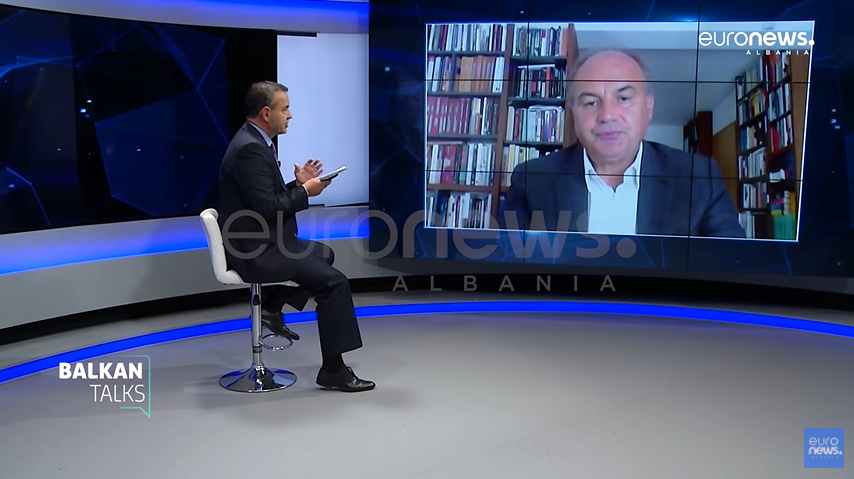
Enver Hoxhaj, Kosovo’s former foreign affairs minister, said that PM Albin Kurti’s decision to impose reciprocity for license plates was ‘the right choice’. He said that the fact that it wasn’t implemented since the 2011 agreement, indicates how unstable is the status quo in Kosovo.
According to Hoxhaj, it is time to resolve the disputes between Prishtina and Belgrade and suggests that it can be achieved if the dialogue goes through a restructuring.
“I think it is time to rethink on reformatting the dialogue and speak solely about mutual recognition and discuss technical issues”, said Hoxhaj.
Kosovo’s ex-diplomacy chief stressed that the current situation is not a test for Kosovo and Serbia, but for the West and Russia.
“Undoubtedly, the recent developments have also a geopolitical dimension. Serbia’s out in the public military threats, the mobilization of the army and their placement near the border with Kosovo, as well as Vucic’s minacious language and the presence of the Russian ambassador in a military barrack in southern Serbia, point out that this whole thing is also a test for the relations between the West and Russia, therefore the EU and the US must be more determined”, declared Hoxhaj.
The former minister believes there is a connection between the recent developments and an incident that took place in Montenegro a few days ago, where Serbs sparked a civil conflict, adding that both Russia and Serbia are trying to restore their influence in the Western Balkans.
“I don’t think that Vucic is reacting only on behalf of Serbia. Definitely, there is some coordination with Russia and this means that Kosovo’s integrity and sovereignty are under a direct threat from Belgrade, but above all, it is an attempt to threaten the entire region. An effort to produce insecurity in the Balkans in order to block the integration process”, he said.
For Hoxhaj, the government of Kosovo must maintain a clear stance on the agreements reached, but also needs to think about the next steps for the dialogue process, as the reciprocity on vehicles is only a technical move, while more importance must be attributed to the political and diplomatic plan.




