

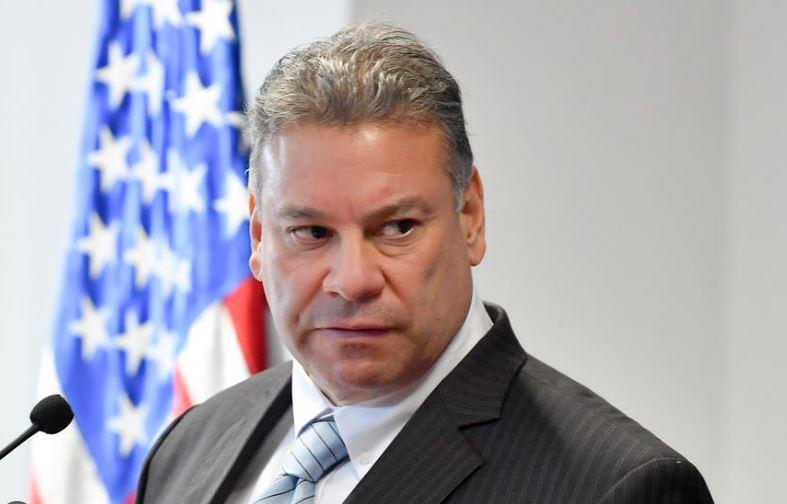
Special Envoy of the United States for Western Balkans Gabriel Escobar said that the situation in northern Kosovo needs to be immediately deescalated, and he does not want to wait until July for new elections.
“The mayors should not exploit the [municipal] buildings, the Kosovo Police should withdraw from the areas surrounding [these] buildings, and the protesters should leave. We hope there will be new elections, and we want Serbs to participate in them without preconditions,” he said.
Escobar made the comments to journalists in Belgrade, where he traveled together with the European Union Special Representative for the Kosovo-Serbia dialogue Miroslav Lajčák.
Escobar, who harshly criticized Kurti a day earlier for “lack of cooperation” in de-escalating the situation, said that Serbian President Aleksandar Vučić assured him that he would use his influence to persuade the Serb community in northern Kosovo to participate in the potential elections.
Following Belgrade’s calls, Serbs boycotted the elections held on April 23rd, which resulted in the election of Albanian mayors in the northern municipalities of North Mitrovica, Zvečan, Zubin Potok, and Leposavić.
“The biggest challenge for Serbia now is to convince Serbs to return to the institutions [of Kosovo],” Escobar said.
“That is where I think we are in line with Serbia. We must ensure that those who participate in the elections and the Serbs who return to the institutions are welcome,” the senior U.S. official said.
When asked by journalists if there has been any response from Kosovo Prime Minister Albin Kurti regarding the international community’s proposal to deescalate the situation in the north, Escobar said that discussions between the Government of Kosovo and Lajčák will continue even after the latter’s departure from Belgrade today.
“I don’t know if there has been a specific response from the Government of Kosovo. I hope the Government of Kosovo understands that what we are trying to achieve is a sustainable and mutually beneficial outcome for both countries,” Escobar said, adding that he has not given Kurti any deadline.
He emphasized that the partnership between the United States, the European Union, and the United Kingdom with Kosovo is “open”. However, if the Government of Kosovo, he added, takes unilateral steps and deviates from the partnership with the transatlantic community, “that is a consequence in itself.”
Escobar said that Kosovo and Serbia should return to the dialogue on the normalization of relations because “if they turn their backs on it, they are turning their backs on Europe.”
He stressed that the United States is committed to helping both Kosovo and Serbia resolve this crisis in a way that benefits both parties.
He reiterated that the formation of the Association of Serb-majority Municipalities is a “legal requirement” for the Government of Kosovo.
“At some point, if Kosovo wants to move forward with its integration, it must form the Association. The question is whether this will happen with this government or with the future government,” Escobar said.
Kosovo and Serbia reached an agreement on this association back in 2013 within the framework of the dialogue on the normalization of relations mediated by the EU.
However, despite continuous calls from the international community to implement it, Kosovo has consistently refused, arguing that the broad competencies of the Association would threaten the internal functioning of the state.
Escobar said that both parties – Kosovo and Serbia – should focus on implementing the Ohrid Agreement for the normalization of relations. This agreement, among other things, envisages the implementation of all agreements reached within the dialogue, including the one on the Association.
“I still think we can have all the elements, the majority of the elements, implemented this calendar year,” Escobar said.
When asked if he sees any influence from Russia in this situation, he said that Russia benefits from divisions within Europe and is not interested in seeing the expansion of the European Union.
“What is happening now in Kosovo is an unresolved problem between different groups that has existed before the current crisis in Ukraine, but the crisis in Ukraine makes it more important to be resolved. However, [the problem] does not solely originate from Russia,” Escobar said.
In a reaction last week, the Kremlin expressed support for Serbs in Kosovo, while Russian Foreign Minister Sergei Lavrov said that the situation in Kosovo “could produce a new conflict in Europe”.




