

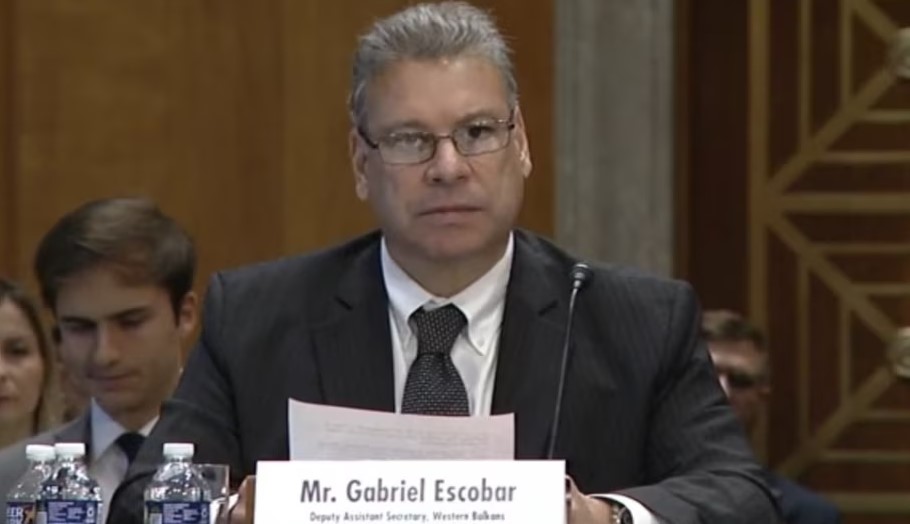
The American envoy for the Western Balkans, Gabriel Escobar, has said that he has received commitments that Serbia will not oppose the upcoming elections in the north of Kosovo and that Serbia will face consequences if it acts otherwise.
He made these statements before the Committee on Foreign Affairs of the House of Representatives in the United States, as he discussed the security and stability of the Western Balkans and the approach of the United States to this region.
He said that among the key problems facing the Western Balkans are: slow progress in democratization, corruption, dependence on Russian energy sources, ethno-nationalist policies, misinformation and harmful influence from abroad.
Speaking about the recent tensions in the north of Kosovo, he said that the United States is committed to expansion and that they are working to advance the states of the Western Balkans towards European and transatlantic integration.
Escobar has said that he hopes for significant progress this year between Kosovo and Serbia.
He focused especially on the Ohrid Agreement – reached between Kosovo and Serbia in March of this year – saying that it offers extraordinary opportunities for the two countries to establish peaceful relations with each other.
“The agreement requires Serbia to recognize the sovereignty of Kosovo and its territorial integrity. To recognize national symbols, the flag, government documents, diplomas, car license plates and forbids Serbia to block Kosovo’s membership in international organizations. Kosovo is asked to implement the obligation it has for the formation of the Association of municipalities with a Serbian majority. We believe that both countries should immediately engage in these aspects, without preconditions. They must start doing their part”, said Escobar.
Tensions in the north of Kosovo have been high for several weeks, especially in June.
The situation has worsened since the local Serbs in the municipalities in the north of Kosovo – Zveçan, Leposaviq and Zubin Potok – have opposed the entry of the new Albanian mayors, with the assistance of the Kosovo Police, into the municipal buildings.
The leaders won the mandates in the elections held in April this year, which were boycotted by the Serbs.
However, on July 11, the European Union has confirmed that Kosovo has agreed to reduce the police presence in and around municipal buildings in Zveçan, Leposaviq and Zubin Potok, and that Kosovo will support the holding of new elections in the four northern municipalities, as part of actions to escalate the situation.
The Government of Kosovo has said that all steps will be “finalized within a two-week period”.
For Albania and North Macedonia
Escobar has said that both Albania and North Macedonia have opened negotiations for membership in the European Union, and that both are solid partners in encouraging the normalization of relations between Kosovo and Serbia.
“To advance the aspirations for membership in the EU, the Government of North Macedonia is committed to constitutional changes to recognize the Bulgarian minority. We strongly support this difficult but necessary step, and we are engaged with the new Government of Bulgaria to ensure that it will not have new demands once North Macedonia meets the requirements of the agreement existing”.
He said that European and transatlantic integrations are essential to reduce the influence of harmful actors in this region, such as Russia and China, but also of corrupt local actors, who aim to destabilize the region and hinder integrations, by expand their influence.
Escobar said during his testimony that Russia extends its influence in the region through two channels: disinformation and energy.
“Nothing more. Russia offers no bilateral trade, no aid, no construction capacity, no support for democratic reforms. Simply put, it traps the region through energy dependence. Therefore, the sooner we can help the region reduce dependence, whether through liquefied natural gas or renewable energy, the sooner we can combat Russian influence in the region.
He has also mentioned the influence that China intends to extend through investments.
“We offer alternatives to build resilience against these impacts”, said Escobar, among other things.
“Citizens of the Western Balkans want a better future for their children – a future in which governments are held accountable, support for human rights is strong, and where everyone benefits from economic security.
For Bosnia-Herzegovina
Escobar has said that the president of the Republika Srpska entity in Bosnia-Herzegovina, Milorad Dodik, continues to be focused on dismantling the Dayton Agreement and the state constitution.
“Dodik’s continuous anti-democratic actions threaten the stability, security and prosperity of the state and the entire region,” he said.
Escobar has said that the US will continue to monitor these actions and demand accountability from all those who harm the Dayton Agreement or who threaten the sovereignty and territorial integrity of Bosnia and Herzegovina.
Dodik is sanctioned by the United States and the United Kingdom.
Escobar made these statements at a time when Bosnia is facing a series of political crises.
Finally, the Government of Republika Srpska has adopted laws for non-implementation of the decisions of the Constitutional Court of Bosnia and not to publish the decisions of the High Representative of the international community.