

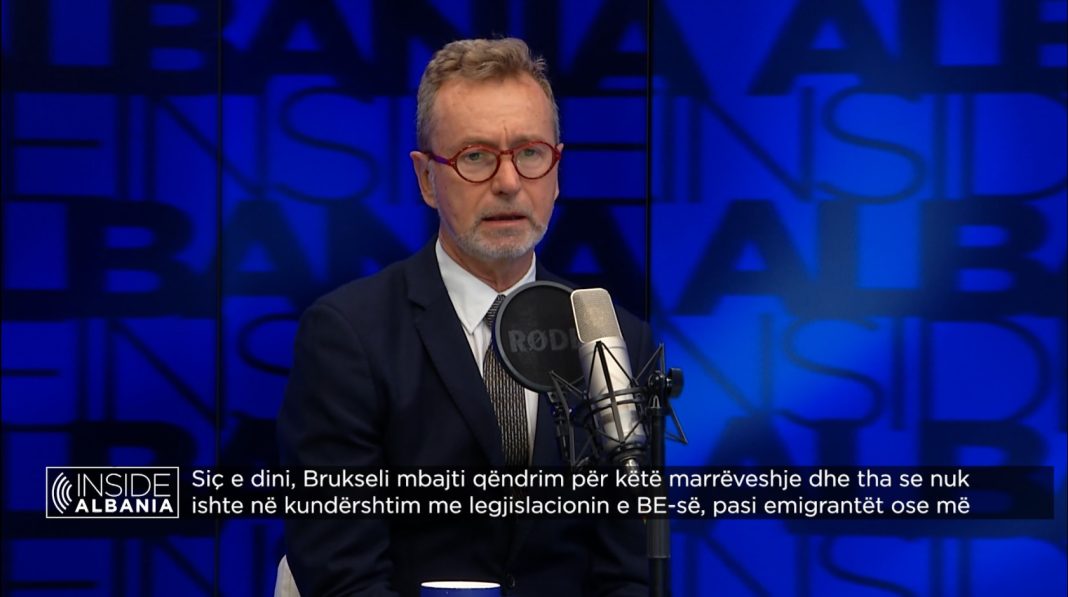
Silvio Gonzato, the European Union ambassador to Albania, said that deals such as the one signed in November last year between Italy and Albania on externalizing migration, is not opposed to any EU laws.
Speaking on “Inside Albania” podcast with Alice Taylor, the diplomat stated that, “Brussels did take a stance on this agreement and it said that it is not in contravention of EU law because the asylum applicants that will be taken to Albania in order to process their applications, will be those who are rescued in international waters by Italian vessels and therefore EU law does not apply to these individuals.”
Under the five-year deal, Albania would shelter up to 36,000 migrants for a year, or about 3,000 a month, who try to reach Italy without proper documentation, mostly in perilous sea voyages.
The agreement envisions the establishment of two centres, the first in Shëngjin where verification procedures for migrants will be carried out, and the second in Gjadër, where they will be held in isolation until the completion of asylum acceptance or rejection procedures. The deal was endorsed by European Commission President Ursula von der Leyen.
“President von der Leyen also expressed the opinion that this was a way of thinking out of the box and finding solutions to the migratory pressure that some countries like Italy, because of its geographic situation, feel very heavily. Whether this is the most effective solution to the issue, I don’t know,” the ambassador added.
Human rights groups have continuously denounced the agreement, describing it as “dehumanising”, while Amnesty International condemned it as “illegal and unworkable”. Despite criticism, the agreement was ratified by parliaments of both countries.
However, the EU diplomat to Albania said such agreements should serve to invoke more solidarity with migrants who jump on dangerous voyages to reach Europe.
“The EU has adopted a pact for migration which tries to ensure that there is greater solidarity between Member States in this critical area. I think also in the political discourse is also important not to demonise the migrants. Often, they are the victims of extremely harrowing situations and we should be there to help those who deserve international protection and that should be our main preoccupation,” Gonzato concluded.